
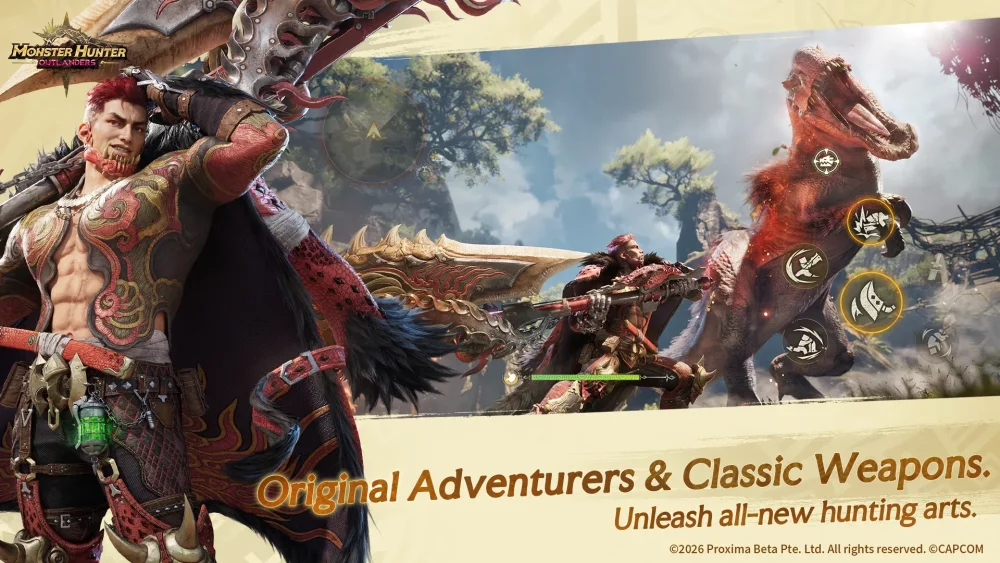
Selecting the right weapon class at the start of your journey in Monster Hunter Outlanders is the most critical decision you will make. Unlike many action RPGs where weapons are simple stat sticks, every weapon class in Monster Hunter Outlanders fundamentally alters how you interact with the monster, how you manage your stamina, and how you survive lethal encounters.
Choosing correctly depends on your comfort with two specific skill sets: your ability to predict monster attack patterns (timing) and your ability to maintain uptime on weak points (positioning). Whether you prefer the slow, calculated strikes of a heavy hitter or the constant, frantic rhythm of a dual-wielder, understanding the mechanical identity of your chosen gear is the first step toward becoming a master hunter.
Mastering the Great Sword for Heavy Impact
The Great Sword is the quintessential "hit-and-run" weapon in Monster Hunter Outlanders. It is designed for players who prioritize massive, singular damage numbers over sustained DPS. When you wield the Great Sword, you are not engaging in a brawl; you are engaging in a calculated game of chess.
- Mechanical Focus: The weapon’s strength lies in its "Charged Attack" mechanics. You must hold down the attack button to wind up a strike, increasing its damage potency.
- The Mobility Trade-off: Because you move very slowly with your weapon drawn, you must master the art of "sheathing." The most effective Great Sword players spend the majority of the fight running, sheathing, and unsheathing to reposition.
- Expert Insight: Do not get greedy. The Great Sword’s recovery animations are long. If you miss your target, you are highly vulnerable to a counterattack. Aim to strike only when the monster is locked in an animation or recovering from a major move.
Sword and Shield: The Versatile All-Rounder
If you are new to the Monster Hunter franchise or want a weapon that can handle any situation without forcing you into a niche, the Sword and Shield is your best choice. It is the only class in this starting lineup that allows you to use items (like potions) without sheathing, making it the most "proactive" defensive tool in the game.
- Defensive Utility: The shield allows you to block incoming damage that would otherwise cart (faint) other players. While it doesn't block everything, it is a vital safety net for learning monster behaviors.
- Constant Pressure: Because you can attack quickly and move while doing so, you can stay glued to a monster’s leg or tail for the duration of the hunt.
- Why It Works: It is the best "teaching" weapon. It gives you the mobility to dodge, the shield to block, and the speed to escape, ensuring you stay in the fight long enough to observe monster patterns.
Light Bowgun for Ranged Precision
The Light Bowgun shifts the Monster Hunter Outlanders experience into a third-person shooter. This is the premier choice for players who struggle with melee positioning and prefer to manage the hunt from a distance.
- Resource Management: Your performance is tied directly to your ammunition. You must familiarize yourself with different ammo types (e.g., Pierce, Spread, Normal) because the effectiveness of your weapon depends on using the right shot for the right monster part.
- Distance Control: You are extremely squishy. If a monster closes the gap, you must rely on your evasion skills to reposition. You do not have the block capability of the Sword and Shield or the heavy armor of a melee set.
- Strategy: Treat the Light Bowgun as a tactical role. Focus on hitting the monster’s specific weak points (usually the head or tail) to trigger flinches, which keeps the monster at bay.
Dual Blades for Agility and Pressure
Dual Blades are the high-octane, high-risk option. This class is defined by one core mechanic: Demon Mode. When activated, you gain increased movement speed and unique attack patterns, but your stamina drains continuously.
- Stamina Management: The greatest mistake new Dual Blade users make is depleting their stamina entirely. If you run out, you cannot dodge. You must learn to toggle Demon Mode on and off to maintain a healthy stamina buffer.
- Aggressive Positioning: You are effectively a "blender." Your goal is to stay under or to the side of the monster, dealing thousands of small hits that add up to massive total damage.
- Expert Insight: Focus on elemental damage. Dual Blades hit so frequently that they are the most effective class for applying status effects or elemental weaknesses, making them a top-tier choice for specialized hunts.
Strategic Comparison: Which Class Fits You?
| Weapon Class | Mobility | Defensive Capability | Skill Floor | Damage Output |
|---|---|---|---|---|
| Great Sword | Low | Low (Sheath-reliant) | High | Burst (Very High) |
| Sword & Shield | High | High (Shield block) | Low | Balanced |
| Light Bowgun | Moderate | Low (Evasion-reliant) | Moderate | Precision/Variable |
| Dual Blades | Very High | Low (Stamina-reliant) | Moderate | Sustained (High) |
Making Your Decision
- Choose the Great Sword if you enjoy "souls-like" combat where timing and prediction are everything.
- Choose the Sword and Shield if you value survivability and want to learn the game without being punished for every mistake.
- Choose the Light Bowgun if you have strong aim and prefer to manage the hunt from a safe, tactical distance.
- Choose the Dual Blades if you want to play aggressively and enjoy managing high-speed resource bars.
Common Mistakes to Avoid
- Over-committing: Regardless of your weapon, don’t try to finish a combo if the monster is already turning to look at you.
- Ignoring the Training Room: Monster Hunter Outlanders provides a space to test your weapon’s move set. Spend 15 minutes in the training area before heading into your first real hunt.
- Neglecting Upgrades: Your weapon choice matters, but your gear level matters more. Early on, focus on upgrading your weapon as soon as the materials become available to keep your damage output consistent with the rising HP pools of larger monsters.
Ultimately, there is no "best" weapon in Monster Hunter Outlanders. The weapon that allows you to maintain the highest uptime on a monster's weak point is the one that will carry you to the endgame. Start with the class that feels most natural to your instincts, and don't be afraid to branch out once you have mastered the fundamental movement mechanics of the game.

Free Monster Hunter Outlanders Codes
Current active codes and how to redeem them.

Emily Johnson
Emily writes practical mobile strategy guides with a focus on resource planning, base progression, and the early decisions that shape a long-term account.
COMMUNITY
Player Comments
40 players commented on this guide.
I wish I had read this before upgrading the wrong thing.
This helped me understand strategy much better.
Can you add more details about strategy in a future update?
This guide answered the exact question I had.