
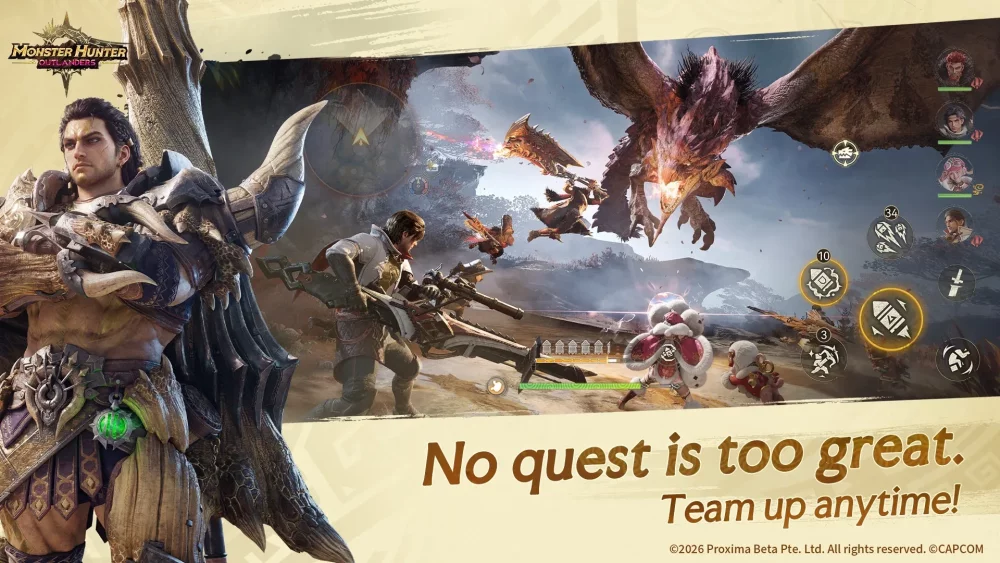
To avoid early progression bottlenecks in Monster Hunter Outlanders, do not spend premium currency pulling duplicate characters or advance your Adventure Rank capstone before your equipment is ready. You can reach maximum awakening on core roster units through open-world systems, while uncontrolled world-level scaling can trap you against monsters your weapons cannot reliably defeat.
How to Maximize Free Character Awakenings
Core adventurers do not require gacha summons to reach full awakening. Monster Hunter Outlanders provides steady character fragments and awakening tokens through standard gameplay systems. Spending premium currency on standard banner duplicates wastes valuable pulls that are better saved for exclusive banners.
To max out your units organically, progress through these in-game sources in order of priority:
| Method | Resource Needed | Upgrade Priority |
|---|---|---|
| Regional Shop Exchanges | Exploration Badges and Hunt Medals | Buy all character-specific tokens before spending any premium currency. |
| Character Bond Quests | Affinity EXP and Field Dialogue | Finish individual storylines as soon as rank requirements are met. |
| Map Exploration Milestones | Zone Clearance and Totem Syncs | Complete regional exploration goals to collect milestone fragment bundles. |
| Universal Shards | High-Tier Event Rewards | Save exclusively for limited-banner units that lack open-world vendors. |
Always clear merchant shops of regional character materials first. Using universal awakening tokens on standard units slows your ability to develop limited event units later.
Pacing Adventure Rank and World Level Scaling
Your Adventure Rank governs your World Level. When your Adventure Rank crosses designated thresholds, field monsters and large hunt targets gain higher health pools and deal increased damage. If your gear lags behind, basic hunting tasks become long battles of attrition that consume excessive healing supplies.
Before you undertake the capstone rank-up trial for any Adventure Rank bracket, pause story turn-ins and confirm your combat readiness:
- Maximize the enhancement level on your primary damage weapon for the current rank tier.
- Upgrade defensive armor pieces to survive direct hits from local elemental threats.
- Level essential combat talents for your primary hunter.
- Test your damage output on roaming mid-tier monsters to ensure you can stagger and defeat them within normal hunt times.
If hunts feel slow or consume excessive recovery items, stay at your current Adventure Rank until your gear is reinforced. Capstone trials do not expire, so taking time to farm crafting nodes at a manageable difficulty level prevents severe scaling traps.
Equipment and Resource Management
Spreading rare monster components across multiple weapon classes early on creates severe material shortages. Enhancing weapons to higher tiers requires scarce monster drops, such as horns, tails, and elemental plates.
- Specialize your loadout: Commit your rarest monster drops and highest-grade upgrade stones to one primary weapon class, maintaining at most one secondary elemental counter.
- Limit low-tier investments: Upgrade early blue and green gear only to the minimum threshold needed to clear current content, as low-tier components cannot be easily recovered.
- Sync forward camps and totems: Unlock every hunting totem and campsite upon entering a new biome. Elevated totems serve as glider launch points to cut traversal time, while forward camps let you restock consumables and adjust loadouts without traveling back to the main hub.
- Maintain passive dispatch boards: Assign idle companions to camp dispatch nodes before and after each hunt. Matching companion attributes to regional node requirements yields a steady flow of crafting herbs, ores, and potion ingredients without requiring manual field gathering.

Free Monster Hunter Outlanders Codes
Current active codes and how to redeem them.

Emily Johnson
Emily writes practical mobile strategy guides with a focus on resource planning, base progression, and the early decisions that shape a long-term account.
COMMUNITY
Player Comments
28 players commented on this guide.
This guide answered the exact question I had.
This saved me time in the early game.
I wish I had read this before upgrading the wrong thing.
Can you add more details about early game in a future update?