
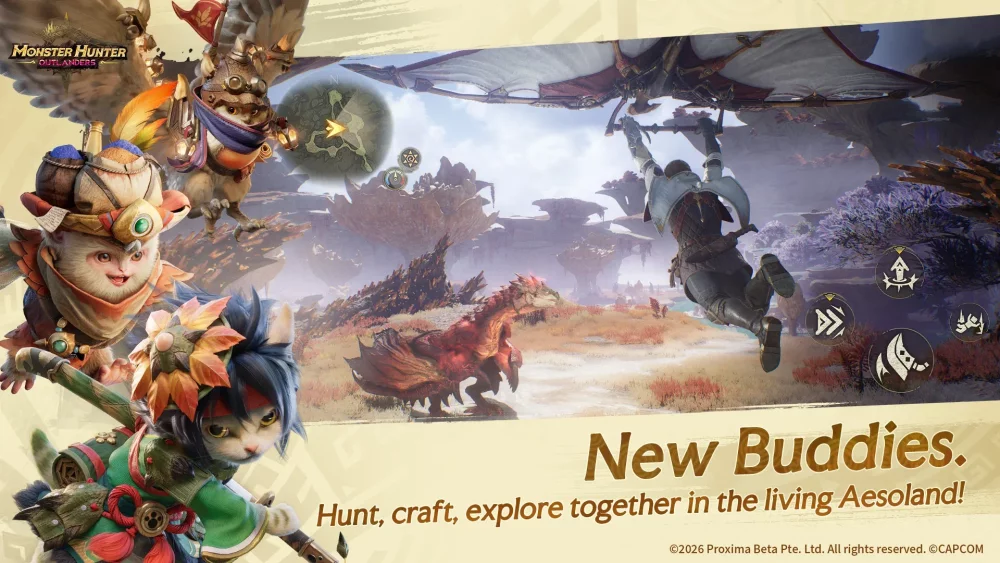
Participating in the testing phases of Monster Hunter Outlanders requires a fundamental shift in how you approach the classic Monster Hunter loop. While the core DNA of the franchise—tracking, hunting, and crafting—remains intact, Monster Hunter Outlanders introduces an expansive open-world structure and a gacha-based adventurer system that drastically alters your progression path. To succeed, you must move beyond the traditional "hunt and craft" mindset and embrace a more strategic approach to exploration, team management, and resource allocation.
Mastering Open-World Traversal and Stamina Management
In previous Monster Hunter titles, map movement was largely functional, serving only to connect you to the monster’s current zone. Monster Hunter Outlanders demands much more. The map is designed with significant verticality, requiring you to climb, glide, and sprint across diverse biomes to reach objective markers and hidden resource nodes.
Stamina Management Tips:
- Prioritize Stamina Nodes: Whenever the game offers upgrades for your stamina capacity, treat these as a top priority. Climbing higher cliffs or gliding across deep ravines requires a larger pool than default settings provide.
- Route Planning: Do not attempt to sprint-climb every obstacle. Look for ledges, flat surfaces, or natural resting spots where your stamina can regenerate.
- Fall Awareness: Falling from great heights not only wastes time but can also trigger a stamina penalty or force you to navigate a long, winding path back to your intended location. Always check your stamina bar before committing to a vertical ascent.
Navigating the Gacha-Driven Adventurer System
One of the most significant departures from series tradition is the move away from a single, customizable hunter. Monster Hunter Outlanders utilizes a gacha-driven character acquisition system. You are no longer just crafting armor to get skills; you are building a roster of adventurers, each with unique elemental affinities, signature roles, and passive abilities.
Strategic Squad Building:
- Specialize, Don't Dilute: Early in the test, materials for character progression will be scarce. It is far more efficient to max out a single "main" adventurer who excels in damage output than to spread your resources across a wide, low-level roster.
- Synergy Over Raw Power: Read the passive skill descriptions for your adventurers. Some characters are designed to provide buffs, while others focus on crowd control or debuffs. A balanced squad that can trigger elemental reactions or provide utility (like healing or defense boosts) will consistently outperform a team of high-damage dealers that lack cohesion.
- Elemental Advantage: Always check the weaknesses of the monster you are about to hunt. Having a dedicated adventurer for each element will make mid-to-late-game hunts significantly easier.
Leveraging Interactive Environmental Elements
The world of Monster Hunter Outlanders is reactive. You are not fighting in a vacuum; the environment contains numerous hazards and tools that can be used to shift the momentum of a battle.
Combat Tactics:
- Baiting and Positioning: If you find a monster near explosive barrels, environmental traps, or ledge-drops, prioritize your positioning. Luring a monster into a hazard is often more effective than attempting a direct, high-risk trade of hits.
- Environmental Hazards: Learn to identify hazards like falling rocks or flammable pools. If you are struggling with a specific monster's attack pattern, use these environmental tools to create "breathing room" to sharpen your weapon or consume items.
- Resource Conservation: By using the environment to deal damage, you save your weapon’s durability and reduce your reliance on consumables, allowing you to sustain your hunt for longer periods.
Mastering Weapon Specialization and Skill Execution
Combat in Monster Hunter Outlanders is skill-based and tied to the adventurer’s kit. You cannot rely on basic attacks alone if you intend to tackle high-rank monsters.
Combat Efficiency Steps:
- Practice Rotations: Every adventurer comes with a unique set of skills. Spend time in the early game practicing these on smaller, docile monsters to understand the cooldowns and animation commitment.
- Interrupt Windows: Many monster attacks have "tells" or wind-up phases. Use your character’s signature moves to interrupt these attacks or trigger a stagger, creating a window for massive damage.
- Weapon Familiarity: Since your weapon is often tied to your character, be prepared to adapt your playstyle. A heavy, slow-attacking character requires different positioning than a fast-paced dual-wielder. Test out different adventurers to find the weapon class that matches your personal reaction speed.
Efficient Resource Gathering and Material Loops
In Monster Hunter Outlanders, gathering is an integrated part of the exploration loop rather than a secondary activity. You need a constant stream of materials to upgrade both your gear and your adventurers.
Optimizing Your Grind:
- Map Your Routes: When you enter a new region, take note of high-density resource areas. Efficiently looping through these areas while heading toward an objective ensures you never have to "stop to grind" later.
- Prioritize Upgrades: Always focus on gathering materials for your current weapon tier first. Bottlenecks occur when you have the monster parts for an upgrade but lack the common flora or ore materials gathered from the map.
- Inventory Management: Your bag space is a limited resource. Learn which materials are "essential" (used for frequent upgrades) and which are "secondary." Keep your inventory purged of junk to ensure you always have room for rare monster drops.
Final Decision-Making: The "Outlanders" Mentality
To succeed in Monster Hunter Outlanders, you must be agile in your decision-making. If you find yourself consistently failing a hunt, stop and evaluate: Is your team composition correct for the elemental weakness of the monster? Are you using your stamina efficiently during the approach? Have you ignored the environmental hazards that could turn the tide?
This game rewards the prepared. By treating the open world as a tool, the adventurer system as a strategic puzzle, and gathering as a fundamental part of your movement, you will find yourself mastering the hunt far more effectively than those who try to force traditional Monster Hunter gameplay into this new, expansive framework. Keep your roster focused, your routes planned, and your environmental awareness sharp.

Free Monster Hunter Outlanders Codes
Current active codes and how to redeem them.

Emily Johnson
Emily writes practical mobile strategy guides with a focus on resource planning, base progression, and the early decisions that shape a long-term account.
COMMUNITY
Player Comments
69 players commented on this guide.
I tried this today and it worked better than my old setup.
This guide answered the exact question I had.
Good guide for Monster Hunter Outlanders players. The heroes part was useful.
This helped me understand heroes much better.