
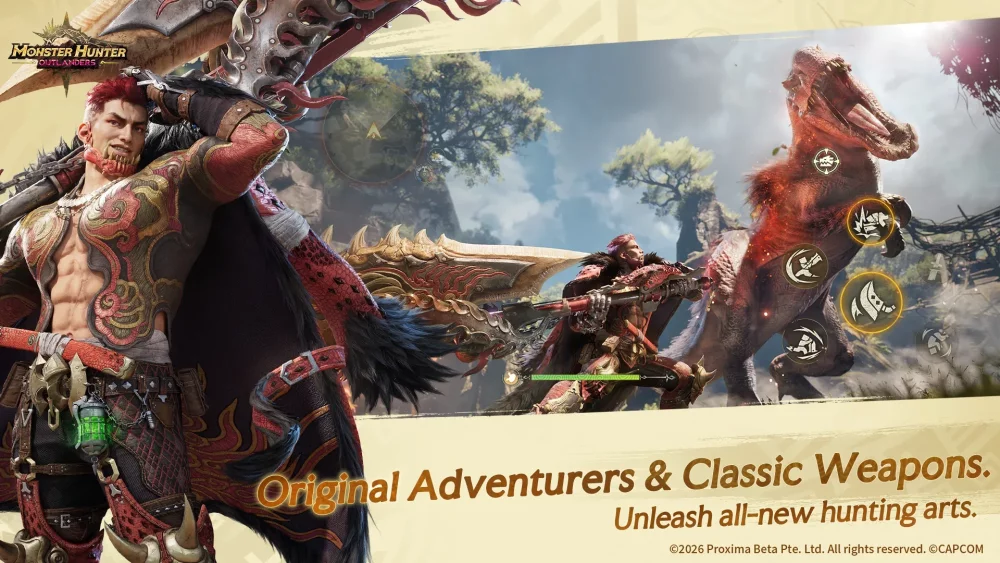
In Monster Hunter Outlanders, build your squad by assigning one high-mobility damage dealer as your active main hunter and two passive buff providers as your sub supports. You will control the main character for most of the hunt, while your sub characters boost offensive stats, apply status build-up, and provide burst tag-in attacks from off-field.
Main Character Selection Criteria
Your active main character handles monster positioning, dodges incoming attacks, and capitalizes on damage windows. Because this unit spends the most time on the field, pick a weapon kit focused on offensive scaling and rapid recovery.
- Responsive counter options: Weapons such as the Long Sword and Dual Blades allow you to react quickly to monster attacks and immediately resume dealing damage.
- Offensive multipliers: Prioritize characters with innate talents that boost raw attack power, critical strike rate, or weak-point damage against staggered targets.
- Low animation lock: Choose kits with quick recovery out of dodges so you can punish openings like breath attacks and tail swipes without delay.
Avoid setting defensive or utility-heavy characters as your primary fighter unless an encounter requires continuous shielding or status cleansing. Maining a low-damage character stretches hunt times, depletes consumable items, and risks quest timeouts.
Sub Character Evaluation
Sub characters act as stat amplifiers. Their primary value comes from background abilities that remain active while they are benched.
Evaluate sub candidates using these priorities:
- Universal stat increases: Passives that grant unconditional percentage boosts to attack or critical damage rank highest because they benefit every weapon type across all monster encounters.
- Status and element application: Passives that speed up paralysis, sleep, or elemental build-up create opportunities to incapacitate targets and generate free damage phases.
- High-impact swap skills: Units that trigger quick stuns, heavy knockback, or rapid multi-hit arts when tagged in deliver immediate value during transitions.
Deprioritize sub characters whose passive buffs require prolonged on-field combo chains to activate. Spending active combat time building stacks on a secondary character lowers total team damage.
Core Party Templates
Choose a team structure based on whether you need raw speed or encounter control.
| Team Archetype | Main Role | Sub Role 1 | Sub Role 2 | Combat Focus |
|---|---|---|---|---|
| Hyper-Offense | High-mobility DPS (Dual Blades / Long Sword) | Universal attack buffer | Critical damage / Affinity booster | Fast clear times through constant damage scaling |
| Balanced Control | Elemental burst attacker | Status / Paralysis specialist | Blunt weapon / Stagger support | Frequent monster knockdowns and fatigue interrupts |
In the Hyper-Offense template, keep your main fighter on the field roughly 90% of the hunt. In the Balanced Control setup, use blunt weapon assists and status procs to interrupt hyper-mobile wyverns and create reliable attack openings.
Combat Swapping Rules
Treat keeping your main character on the field as your default baseline. Tagging in a sub unit triggers an immediate swap action with brief invulnerability frames, which you can use to avoid wide-area monster attacks without spending stamina. However, switching initiates a short cooldown before that character can be swapped out again.
Limit your character swaps to three specific situations:
- Defensive repositioning: Tag in a sub unit to use invulnerability frames to avoid a hit when stamina is depleted.
- Monster down phases: Swap in sub units to discharge ready burst skills or ultimate gauges while the monster is incapacitated.
- Interruption windows: Switch during monster roars or transition animations only if the incoming sub skill hits quickly enough to avoid punishment.
Progression and Resource Allocation
Do not split upgrade materials evenly across your entire squad early in the game. Concentrating resources on your primary attacker ensures your damage keeps pace with scaling monster health pools.
- Upgrade your main first: Maximize your primary character’s weapon tier, armor reinforcement, and active combat talents before spending materials on other units.
- Target sub passives: For your two sub party members, spend resources exclusively on their shared passive talents and switch skills. Leave their armor and secondary weapon levels at baseline until your main reaches the current tier cap.
- Redeem promotional supplies: Enter the serial code
mhogohuntin the in-game redemption menu to claim early upgrade materials and currency. Hold high-rarity skill materials until your core three-character squad is established.

Free Monster Hunter Outlanders Codes
Current active codes and how to redeem them.

Michael Smith
Michael covers live-service games, events, reward systems, and efficient daily routines, turning frequent updates into clear actions for players.
COMMUNITY
Player Comments
95 players commented on this guide.
This guide answered the exact question I had.
Good guide for Monster Hunter Outlanders players. The base building part was useful.
Nice guide. I am checking the other Monster Hunter Outlanders articles next.
Can you add more details about base building in a future update?