
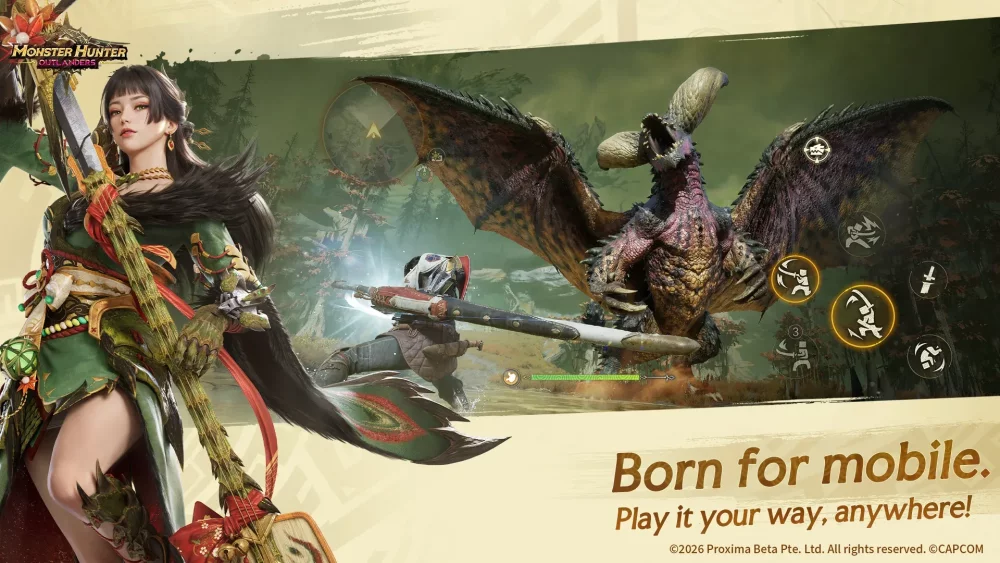
Monster Hunter Outlanders represents a massive leap for the franchise on mobile devices, blending the series' signature deep combat and crafting systems with a vast, seamless open world. To succeed in this environment, players must move beyond traditional "arena-style" thinking. Instead, you must balance intensive exploration with efficient resource management and mobile-optimized combat tactics. Whether you are a series veteran or a newcomer, the key to progression lies in how effectively you utilize the game’s unique open-world traversal mechanics and how you prioritize your growth loop before every high-stakes hunt.
Leveraging Open-World Traversal for Efficient Hunting
In Monster Hunter Outlanders, the environment is not merely a backdrop; it is your primary tool for success. Unlike previous titles that relied on zone-based maps, this game features a massive, interconnected ecosystem. Efficient traversal is your greatest advantage.
To master this, you must treat the landscape as a resource. Use your traversal tools—such as grappling hooks or specialized movement mechanics—to reach high-ground vantage points. From these summits, you can survey the terrain for monster tracks, gathering nodes, or environmental hazards.
- The "Survey" Strategy: Before engaging a target, spend a minute observing its movement patterns from a distance. Identifying the monster's pathing allows you to ambush it near environmental traps, such as unstable rocks or natural hazards, which can deal massive damage or stagger the beast, providing you with a critical damage window.
- Node Prioritization: While exploring, do not treat gathering as an afterthought. Develop a mental map of high-frequency nodes. If you see a cluster of rare ores or plants, mark them. Efficient hunters gather materials while tracking their target, ensuring that by the time you reach the combat zone, your pockets are full of potential healing items and crafting reagents.
Strategic Weapon Selection for Mobile Combat
Mobile gaming requires a different approach to combat rhythm. Because Monster Hunter Outlanders utilizes a touchscreen interface, you must select weapons that align with your ability to navigate the screen while executing complex combos.
- Agile Weapons (e.g., Dual Blades, Sword and Shield): These are essential for players who prefer a "hit-and-run" style. On mobile, quick evasion is often more reliable than complex manual camera control. Agile weapons allow you to remain mobile, darting in for quick strikes before moving out of the monster's attack radius.
- Heavy Weapons (e.g., Great Sword, Hammer): These weapons reward deep knowledge of monster attack patterns. If you choose a heavy weapon, your focus should be on "positional anticipation"—placing yourself where the monster’s head or tail will be after it completes its current animation.
- Ranged Options (e.g., Light Bowgun, Bow): Ranged combat is highly effective for observing behavior. It provides a safer distance to learn the "tells" of new monsters. Use ranged play when you are farming a new monster for the first time; it allows you to analyze its moveset without the immediate pressure of melee-range combat.
Resource Management and Equipment Crafting
Progression in Monster Hunter Outlanders is gated by your gear level, which relies on a constant loop of gathering and crafting. The mistake most players make is ignoring "common" materials.
In the early stages, you will be tempted to farm only the rarest monster drops. However, base-level equipment upgrades require vast quantities of common ores, bones, and herbs.
- The 80/20 Rule: Spend 80% of your time focused on the quest, but always reserve 20% of your travel time to clear every gathering node in your path.
- Elemental Preparation: Once you unlock the ability to craft gear sets, prioritize elemental resistance over raw defense. Fighting a fire-breathing monster with armor that has negative fire resistance is a recipe for failure, regardless of your skill level.
- Crafting Efficiency: Always check the "Wishlist" function in the crafting menu. By pinning the gear you want to build, the game will highlight the necessary materials during your exploration, making your gathering runs far more productive.
Adapting to Dynamic Environmental Challenges
Monster Hunter Outlanders features a dynamic climate system. Environmental shifts—such as extreme heat, freezing cold, or torrential rain—are not just visual flair; they directly affect your stamina and item efficacy.
- Stamina Management: In extreme weather, your stamina may deplete faster. If you are mid-hunt and notice your stamina bar draining, prioritize "hit-and-retreat" tactics to let your stamina recover.
- Environmental Synergies: Use the weather to your advantage. Some monsters are naturally weaker when they are wet or cold. Look for environmental triggers, such as luring a monster into a swampy area during rain to slow its movement speed. Mastering these environmental interactions is often the difference between a clean kill and an exhausting 20-minute slog.
Maximizing Group Coordination and Hunt Preparation
While the open world is vast, the most dangerous hunts in Monster Hunter Outlanders demand group coordination. Before entering a high-level hunt, your party must establish clear roles.
- Role Clarity: Ensure your team has a mix of damage dealers (DPS) and utility. A player using a Hunting Horn or a weapon with status-effect coatings can provide the necessary breathing room for heavy hitters to unleash their strongest attacks.
- The "Item Pouch" Check: Before departing, always verify your pouch configuration. Because inventory space is limited on mobile, you cannot bring everything. If you are facing a monster that inflicts Poison or Paralysis, prioritize Antidotes and Cleansers over extra traps.
- Communication: Even without voice chat, use the game’s ping system to mark resources and alert teammates to monster locations. A well-organized team that shares gathering nodes and traps will progress through the endgame significantly faster than a group of solo players working in the same instance.
By integrating these strategies into your daily play, you transform from a scavenger into a master hunter. Remember: in Monster Hunter Outlanders, preparation is as important as the hunt itself. Keep your gear updated, keep your eyes on the environment, and never underestimate the value of a well-timed gathering run.

Free Monster Hunter Outlanders Codes
Current active codes and how to redeem them.

Sarah Williams
Sarah specializes in RPG and collection games, explaining team building, character growth, and beginner-friendly ways to avoid expensive early mistakes.
COMMUNITY
Player Comments
116 players commented on this guide.
I tried this today and it worked better than my old setup.
This saved me time in the early game.
Can you add more details about resources in a future update?
Good guide for Monster Hunter Outlanders players. The resources part was useful.