
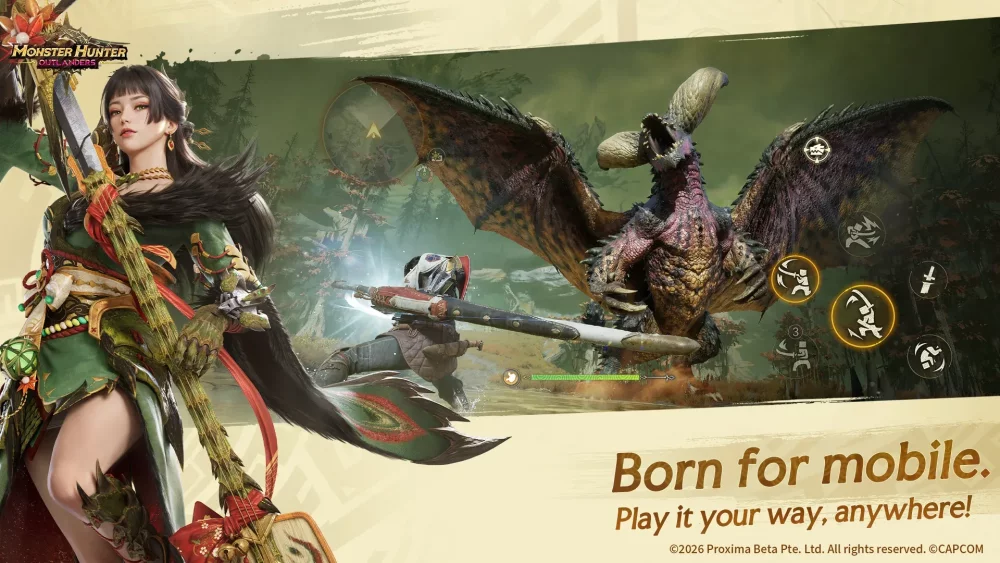
In Monster Hunter Outlanders, your choice of weapon is the single most important decision you make. It determines not just your damage output, but your entire movement rhythm, defensive options, and tactical role during a hunt. Because every weapon class functions as a unique mechanical system, choosing the right one requires aligning your personal playstyle with the specific strengths and limitations of each armament.
To succeed, you must move beyond simple damage numbers and consider how a weapon’s reach, attack commitment, and skill synergies dictate your survival. This guide breaks down the essential factors for selecting and mastering your weapon in Monster Hunter Outlanders.
Understanding Weapon Archetypes: Speed vs. Power
The foundation of Monster Hunter Outlanders combat is the relationship between animation commitment and mobility. Every weapon falls along a spectrum of "heavy" or "light" playstyles, and understanding where your weapon sits on this spectrum is critical for avoiding monster telegraphs.
- Heavy Weapons (e.g., Greatsword): These weapons favor high-damage, burst-window strikes. You are effectively "locked" into animations for several seconds. Success with these requires deep knowledge of monster AI, as you must predict where the monster will be before the attack connects. Your defensive strategy relies on timing strikes during downtime or utilizing dedicated blocking mechanics.
- Light/Fast Weapons (e.g., Sword & Shield, Dual Blades): These weapons prioritize mobility and rapid repositioning. They allow for a "hit-and-run" style, where you can capitalize on micro-openings. These are generally more forgiving for beginners because they allow you to dodge-cancel out of combos more easily.
- Ranged Weapons (e.g., Bowguns): These options change the fundamental geometry of the fight. You are no longer in the monster's "safe zone" (usually the area near the legs or under the belly). Instead, you must manage critical distance and ammunition. While you avoid many melee-specific attacks, you become a priority target for long-range monster projectiles.
Mastering Weapon-Specific Skill Synergies
In Monster Hunter Outlanders, weapons are not just "stat sticks"; they are mechanical engines. Every weapon class features a unique gauge, stance, or "counter" mechanic that defines its peak performance.
The Gauge Economy
Many weapons feature a secondary resource system. For example, some weapons require you to land a specific combo sequence to charge a "Spirit" or "Energy" gauge. Once this gauge is filled, you unlock a state of enhanced damage or speed. If you fail to maintain this gauge through consistent aggression, your effective damage drops significantly.
Counter and Guard Mechanics
Advanced players prioritize weapons with "active" defensive skills. Weapons like the Lance or Greatsword allow you to guard through incoming damage, while others, like the Longsword, feature counter-attacks that reward perfect timing. A well-timed counter doesn't just negate damage; it often provides a massive window for a follow-up combo. Identify whether your weapon rewards blocking (mitigating damage) or countering (punishing the monster) to dictate your flow.
Managing Attack Commitment and Recovery
The most common mistake for new players in Monster Hunter Outlanders is over-committing to an attack string. Every move has a "recovery frame"—a period where your character is stuck in an animation and unable to dodge or block.
- The Rule of Three: As a general rule, never commit to a full combo string unless the monster is downed or trapped. When a monster is active, stick to shorter pokes or hits.
- Dodge-Canceling: Some weapons allow you to cancel the end of an animation with a dodge. If you are struggling with "getting hit during combos," test your weapon’s recovery time. If your current weapon feels too "clunky," switching to a weapon with faster animation recovery can drastically improve your survivability.
- Stamina Management: If you are using a weapon that relies on constant movement or blocking, stamina is your most precious resource. Always ensure your gear loadout includes stamina-boosting skills, as running out of energy while trying to dodge a tail swipe is a common cause of defeat.
Strategic Resource Allocation and Progression
Monster Hunter Outlanders requires a significant time investment to upgrade gear. To avoid "progression walls," you must be disciplined with your crafting resources.
Focus on One Path Initially
Early in the game, do not try to build every weapon type. Crafting materials are finite and often require specific monster parts. By focusing on one weapon class, you can maximize its upgrade level, which is necessary to overcome the health pools of mid-game and endgame monsters.
Elemental Strengths
Once you have established your main weapon, start diversifying your arsenal based on elemental weaknesses. Most monsters have a specific weakness (Fire, Water, Thunder, Ice, or Dragon). Keeping a collection of weapons that cover different elements is the most efficient way to lower hunt times. Before crafting a new weapon, check the "Monster Field Guide" in-game to see which elements are effective against your next major target.
Checklist for Choosing Your Main
When you are testing a weapon for the first time, run through this checklist to see if it fits your playstyle:
- Can I sheath this weapon quickly? If you need to use items often, a slow sheathing speed might get you killed.
- Does it have a defensive tool? If you are not comfortable with dodge-timing, look for a weapon with a shield or a parry.
- Is the mobility adequate? Can you close the gap on a mobile monster, or are you constantly chasing it?
- Is the "special" mechanic fun? If a weapon requires a complex mini-game (like managing a heat gauge or complex combo inputs) that you don't enjoy, you will eventually burn out. Play what feels intuitive to your fingers.
By focusing on these mechanical interactions rather than just the raw stats, you will be able to navigate the complex combat ecosystem of Monster Hunter Outlanders with confidence. Remember, the best weapon is the one that allows you to remain aggressive while staying safe, and that balance is unique to every player.
Free Monster Hunter Outlanders Codes
Current active codes and how to redeem them.

Sarah Williams
Sarah specializes in RPG and collection games, explaining team building, character growth, and beginner-friendly ways to avoid expensive early mistakes.
COMMUNITY
Player Comments
74 players commented on this guide.
I tried this today and it worked better than my old setup.
I wish I had read this before upgrading the wrong thing.
This helped me understand strategy much better.
Can you add more details about strategy in a future update?