
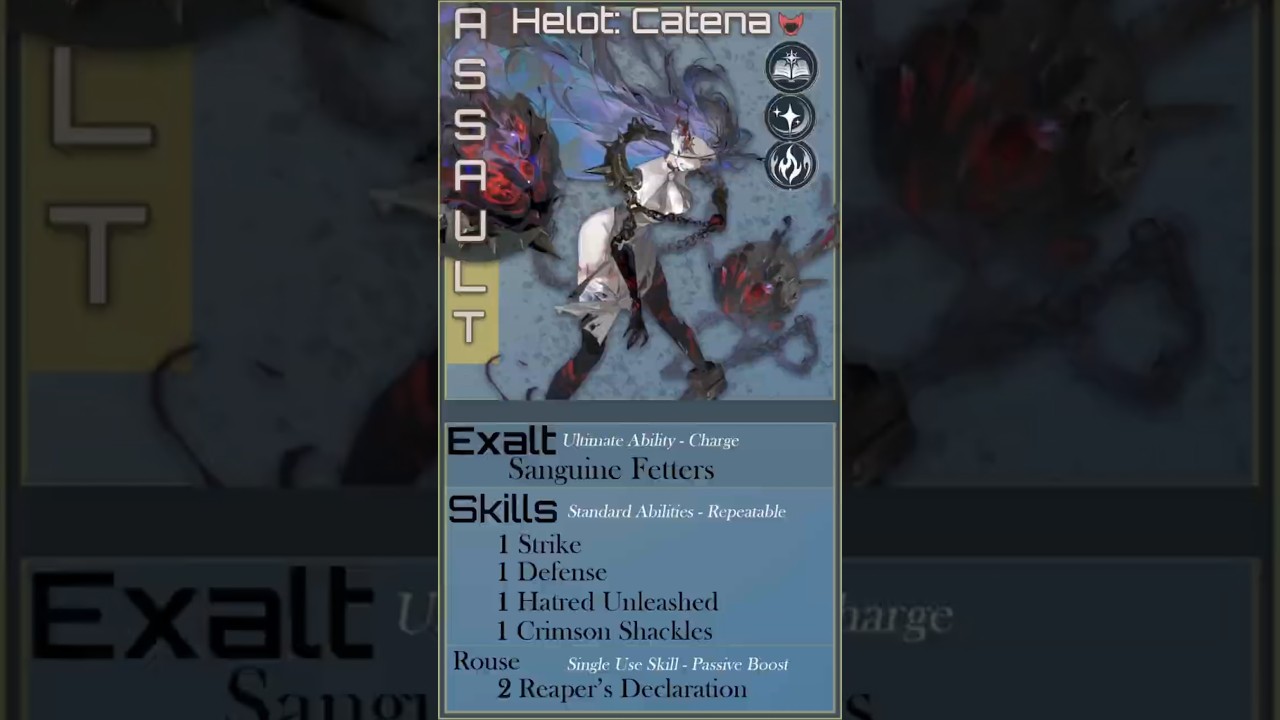
To play Helot: Catena effectively in Morimens, prioritize opening turns with low-cost chain enablers to apply Bleed and build Rouse energy before committing Action Points (AP) to heavy strike finishers. Because her kit lacks innate shields or self-defense, pair her with dedicated frontline protection and align her burst state with enemy vulnerability windows.
Card Priorities and Turn Sequencing
Helot: Catena's damage scales from active debuffs and turn momentum. Playing high-cost strikes as opening actions wastes Action Points because heavy finishers require existing marks to reach full output. Structure card plays in three stages: apply status effects, generate combat buffs, and finish with burst attacks.
| Card Archetype | AP Cost | Tactical Function | Play Priority |
|---|---|---|---|
| Chain Lash | 1 AP | Inflicts Bleed and applies chain marks | High (Turn opener) |
| Hatred Surge | 1 AP | Builds Rouse meter and increases attack power | Medium (Setup bridge) |
| Binding Strike | 2 AP | Deals multi-hit damage and extends active debuffs | High (Mid-sequence chain) |
| Execution Cleave | 2–3 AP | Consumes target marks for heavy burst damage | Critical (Turn finisher) |
Sequence cards according to your turn AP:
- 3-AP Turns: Open with Chain Lash (1 AP) to establish Bleed and chain synergy, then follow immediately with Binding Strike (2 AP) to build Rouse meter and extend debuffs.
- 4-AP Turns: Play Chain Lash (1 AP), weave in Hatred Surge (1 AP) to boost attack and generate Rouse energy, then spend the remaining 2 AP on Execution Cleave to strike a fully marked target.
Avoid playing Execution Cleave without prior marks, as unbuffed heavy strikes deplete your hand without bypassing high-armor thresholds.
Rouse State and Theophany Timing
Helot: Catena reaches peak damage during her Rouse state. Playing cards across turns fills her Rouse meter, empowering her abilities with enhanced critical strikes, lower AP costs, and extra Bleed ticks.
To avoid wasting this burst window:
- Track enemy states: Delay Rouse activation if a boss prepares an immune phase, evasion posture, or damage-reflecting counter stance.
- Target stagger windows: Trigger Rouse when boss stagger gauges break in high-difficulty D-Tide stages to maximize incoming damage multipliers.
- Execute Theophany: If her Theophany ability is charged, activate it while Rouse is active and after refreshing Bleed stacks on the primary target to maximize multi-hit physical output.
Team Setup and Synergy
Helot requires offensive enablers and survivability buffers to offset her high AP consumption and lack of defensive skills.
- Main DPS (Helot: Catena): Spends AP on chain sequences and detonations.
- Bleed Sub-DPS (Flesh Realm): Applies initial Bleed stacks and strips armor so Helot can reserve AP strictly for burst cards.
- Defensive Anchor (Guardian): Generates persistent shields and redirects single-target boss attacks away from Helot.
- Rouse and AP Battery (Support): Supplies bonus AP and deck manipulation, ensuring you draw core setup cards and finishers together.
Encounter Tactics and Deck Management
Helot relies on multi-hit physical sequences rather than single strikes. In advanced D-Tide stages, bosses often deploy counter-stance mechanics that reflect damage per incoming hit. Attacking directly into a counter posture can wipe her out in a single turn.
When an enemy signals a counter stance, redirect low-AP actions toward secondary targets or conserve AP to let your defensive anchor deploy barriers. During roguelite runs, visit shop nodes to trim extraneous basic strikes from your deck, ensuring Chain Lash, Binding Strike, and Execution Cleave cycle back into your hand every two turns.

Free Morimens Codes
Current active codes and how to redeem them.

Sarah Williams
Sarah specializes in RPG and collection games, explaining team building, character growth, and beginner-friendly ways to avoid expensive early mistakes.
COMMUNITY
Player Comments
85 players commented on this guide.
I wish I had read this before upgrading the wrong thing.
The explanation is clear, especially for beginners.
Good guide for Morimens players. The strategy part was useful.
This guide answered the exact question I had.