
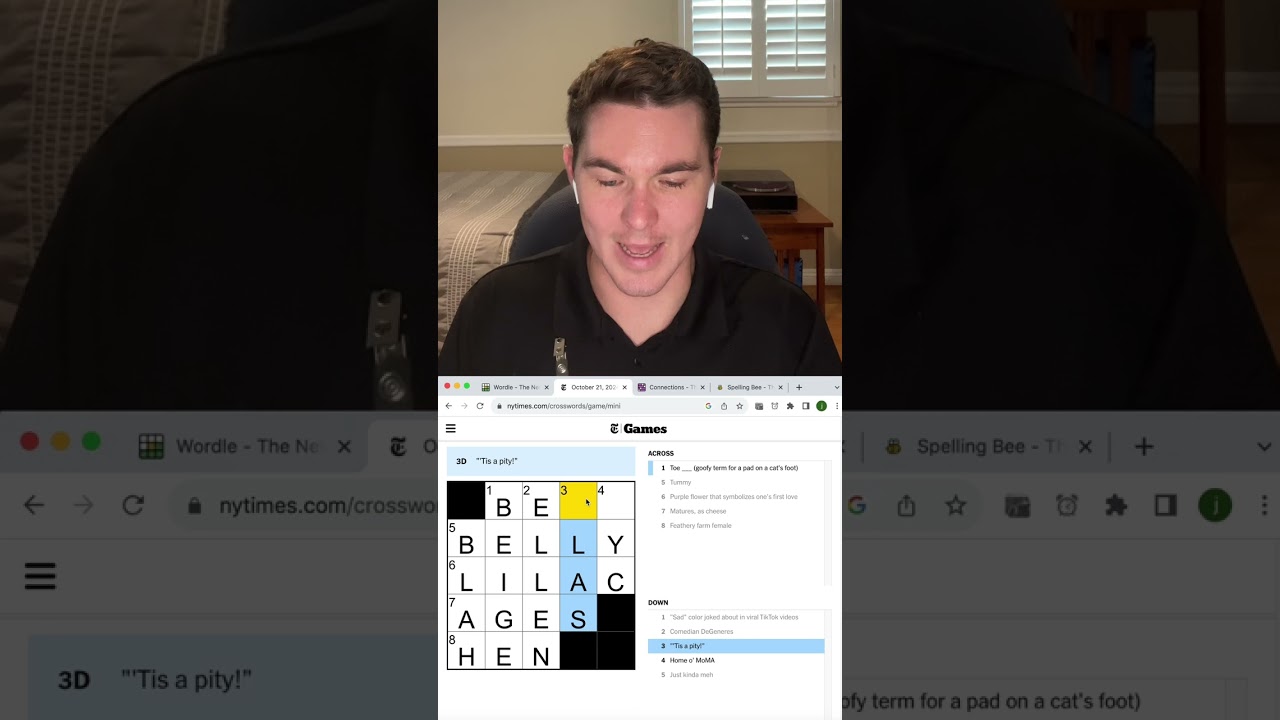
Solving the daily suite of NYT Games: Wordle & Crossword requires a combination of linguistic precision, lateral thinking, and vocabulary depth. Whether you are aiming to maintain a long Wordle streak or pushing for the "Genius" rank in Spelling Bee, success relies on systematic approaches rather than random guessing. This guide provides an authoritative breakdown of how to navigate the October 21st puzzles, offering repeatable strategies you can apply to any daily challenge.
Strategic Wordle Openers and Pattern Recognition
Wordle is a game of information management. Your goal is not just to guess the word, but to maximize the data you gain from every attempt.
- The Vowel-Heavy Start: Begin with words like "ADIEU," "AUDIO," or "ROATE." These words help you immediately identify or rule out the most common vowels. If your first guess turns up zero greens or yellows, do not panic—you have just successfully eliminated five common characters, which is a massive advantage for your second row.
- Consonant Clustering: Once you have a vowel baseline, target high-frequency consonants like 'R', 'S', 'T', 'L', and 'N'. If you have a 'T' and an 'R', test common letter combinations like "TR-" at the start or "-ER" at the end.
- Avoid the "Hard Mode" Trap: If you find yourself with only one or two letters confirmed, do not try to force a word that fits those letters if it requires using obscure consonants. Use your second or third turn to "burn" a word that tests three or four new, common consonants. This approach is statistically superior to guessing a specific word that only tests one new letter.
Mastering Connections Through Lateral Thinking
Connections is designed to trick your brain. The game creators intentionally include "red herrings"—words that could fit into multiple categories to throw you off the scent.
- Spotting the False Leads: When you see four words that seem to clearly belong together, pause. If they are too obvious, they are likely a trap. A category that looks like "types of fruit" might actually be part of a larger, more complex category like "words that follow the word 'star'."
- The "One Away" Strategy: If the game tells you that you are "one away," do not start swapping words randomly. Instead, look at the group you submitted and identify the word that feels the least connected. Is there another word on the board that fits that specific category better?
- Thematic Clustering: Categorize by parts of speech (all verbs, all nouns) or linguistic patterns (words that start with the same sound, synonyms, or compound word components). If you hit a wall, step away from the screen for five minutes. Lateral thinking is often inhibited by "tunnel vision," and a fresh set of eyes often reveals the connection instantly.
Efficiency in the Mini Crossword
The Mini Crossword is a sprint. The key to finishing in record time is understanding that the grid is interconnected.
- Cross-Pollination: Never solve in isolation. If you are stuck on an "Across" clue, check the "Down" clues that intersect with the empty squares. Often, filling in just one or two letters in a "Down" clue will provide the necessary anchor to solve the "Across" clue.
- Look for Wordplay: The Mini Crossword frequently uses puns or shorthand. If a clue feels literal but makes no sense, consider if it is a play on words, an abbreviation, or a pop-culture reference.
- Start with the Shortest: If you are feeling overwhelmed, identify the three-letter words first. They are the easiest to solve and provide structural support for the longer answers that intersect them.
Vocabulary Expansion in Spelling Bee
Spelling Bee rewards players for persistence and systematic exploration of suffixes and prefixes.
- The Central Letter Rule: Remember that the central letter must be included in every word. Once you have that, scan the remaining letters for common prefixes like "UN-," "RE-," "IN-," or "DIS-."
- Suffixes are Gold: Once you have a base word, immediately test it against "-ING," "-ED," "-ER," and "-LY." Players often miss the simplest points by forgetting these common modifications.
- Don't Ignore the Plurals: If you find a word, check if it can be pluralized with an 'S'. While not every word in the game is pluralizable, it is a low-effort way to check for additional points.
- The "Genius" Mindset: To reach the "Genius" rank, you need to think beyond simple three-letter words. Focus on finding at least one seven-letter word or a pangram (a word that uses all seven letters). These are the keys to jumping up the leaderboard quickly.
Common Mistakes to Avoid
Even experienced players fall into the same traps. Here is how to stay sharp:
- The Over-Commitment Fallacy: In Wordle, players often stick to a word that looks right even when it contradicts the logic of the letters they’ve uncovered. Trust the grid, not your intuition.
- Neglecting the "Red Herrings": In Connections, if you fail a guess, stop and re-examine all sixteen words. The game often presents a category that is 75% complete but requires one word from a completely different set to finish.
- Rushing the Crossword: Trying to fill the grid in one go often leads to errors in the long answers. If you are stuck, move to a different corner of the puzzle. The grid is a puzzle of dependencies; solving one segment usually opens up the rest.
- Forgetting Spelling Bee Rules: If you find a word that isn't accepted, check if you accidentally used a letter that wasn't provided, or if you failed to include the mandatory center letter.
Final Advice for Consistent Success
The NYT Games: Wordle & Crossword suite is designed to be a daily ritual, not a test of raw intelligence. The best strategy is consistency. By applying these logical frameworks—prioritizing high-frequency letters in Wordle, checking for traps in Connections, using intersections in the Mini Crossword, and systematically testing prefixes in Spelling Bee—you will find that your solve times drop and your accuracy increases. Treat each game as a logical exercise, and you will find the answers come much more naturally.

Free NYT Games: Wordle & Crossword Codes
Current active codes and how to redeem them.

Sarah Williams
Sarah specializes in RPG and collection games, explaining team building, character growth, and beginner-friendly ways to avoid expensive early mistakes.
COMMUNITY
Player Comments
32 players commented on this guide.
Can you add more details about strategy in a future update?
Nice guide. I am checking the other NYT Games: Wordle & Crossword articles next.
The explanation is clear, especially for beginners.
I wish I had read this before upgrading the wrong thing.