
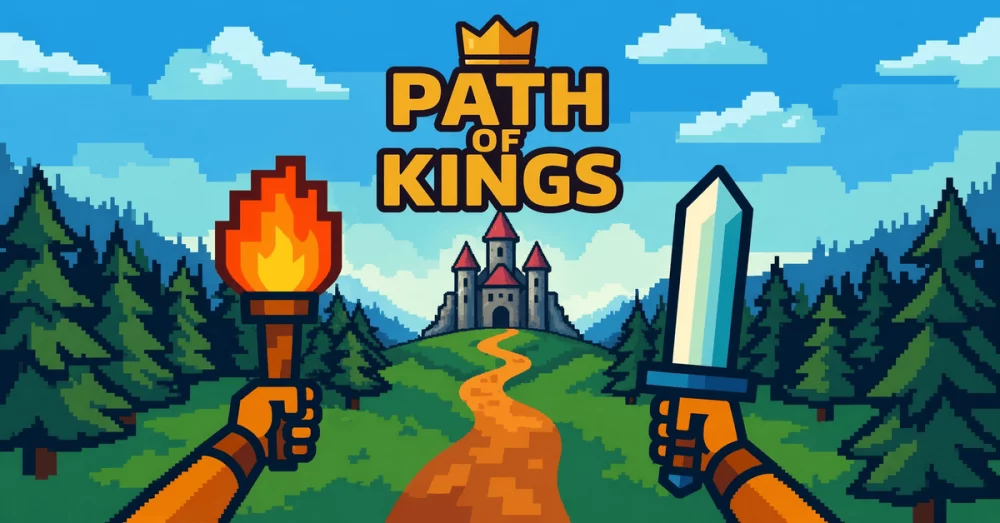
Path of Kings functions primarily as a decision-heavy RPG where your survival hinges on a "Tinder-style" swipe mechanic. By choosing left or right on various prompts, you dictate the path of your kingdom and hero. While the game presents itself as a deep strategy title, its core appeal lies in the immediate, high-stakes consequences of these binary choices. This guide evaluates whether the game’s mechanics offer enough depth to warrant long-term commitment for new players.
Mastering the Swipe-Based Choice System
The fundamental gameplay loop in Path of Kings revolves around evaluating incoming narrative prompts and swiping to resolve them. Each swipe triggers a shift in your character’s status, resources, or the stability of your realm. You must treat every prompt as a mini-crisis, as there is no "neutral" option; every decision influences the trajectory of your current run.
When you encounter a prompt, you are not just making a story choice; you are managing a balance of variables. The game requires you to constantly monitor how your decisions impact your standing with different factions or your supply levels. If you ignore the underlying balance, you will quickly find your kingdom collapsing, regardless of how well you managed earlier stages.
Analyzing Narrative Consequences and Progression
The weight of your decisions in Path of Kings is immediate and often unforgiving. Unlike traditional RPGs that offer expansive dialogue trees, the swipe mechanic forces you to react to scenarios in real-time. This design choice prioritizes pacing over complex branching paths, meaning your progress is defined by how well you adapt to the specific "theme" of the current event or quest line you are navigating.
Because the game relies on these rapid-fire decisions, your success is tethered to pattern recognition. You will eventually learn which archetypes of choices lead to positive outcomes versus those that drain your resources. This makes the game highly accessible for short sessions, but it also means that your long-term success is largely a result of learning the game's specific "logic" rather than pure tactical depth in combat encounters.
Limitations of the Core Loop
While the swipe mechanic is intuitive, it can lead to a sense of stagnation if you are looking for deep, tactical combat. The game does not emphasize manual battlefield control or intricate skill rotations. Instead, it focuses on the "what if" scenarios of your choices. If you prefer games with heavy mechanical skill requirements, you may find the reliance on binary swipes to be a limitation rather than an innovation.
Additionally, the procedural nature of these choices means that some runs can feel repetitive. Once you understand the optimal way to handle recurring scenarios, the tension of the decision-making process diminishes. To keep the experience fresh, you should focus on exploring different narrative paths rather than trying to perfect a single strategy, as the game rewards curiosity about the "bad" outcomes as much as the "good" ones.
Evaluating Replayability and Long-Term Value
Path of Kings is best suited for players who enjoy "pick-up-and-play" experiences where the narrative is the primary driver. The replayability comes from the sheer volume of unique scenarios you might encounter. If you are looking for a game to sink hundreds of hours into for competitive leaderboard climbing, the current structure may feel thin. However, for those who enjoy uncovering secret endings or seeing how different leadership styles affect their kingdom, it offers significant value.
Key Factors for Long-Term Engagement
- Prompt Variety: The game frequently introduces new scenarios, which helps mitigate the feeling of repetition in the early stages.
- Resource Sensitivity: Tracking how a single swipe affects your resources creates a satisfying, albeit simple, layer of management.
- Narrative Variety: The game’s strength lies in the creative consequences of the choices, encouraging multiple playthroughs to witness different fates for your kingdom.
Is the Experience Worth Your Time?
Ultimately, Path of Kings is a specialized experience that leans heavily into its swipe-based identity. It is not an action-heavy RPG, but rather a narrative simulator with strategic consequences. If you value quick, punchy decision-making and are interested in seeing how your choices ripple through a kingdom, it is a rewarding title. If you prioritize complex combat mechanics or deep character building, you may find the gameplay loop eventually reaches a plateau.
The game’s true value is found in the "what happens next" factor. By treating every swipe as a learning opportunity, you can extract the most enjoyment from the title. Approach it as a series of evolving puzzles where your primary tool is your ability to interpret and anticipate the consequences of your actions.

Free Path of Kings Codes
Current active codes and how to redeem them.

James Brown
James focuses on Android gaming on PC, emulator setup, controls, performance tuning, and practical troubleshooting for longer play sessions.
COMMUNITY
Player Comments
98 players commented on this guide.
The explanation is clear, especially for beginners.
The tips are practical and easy to follow.
This saved me time in the early game.
This helped me understand base building much better.