
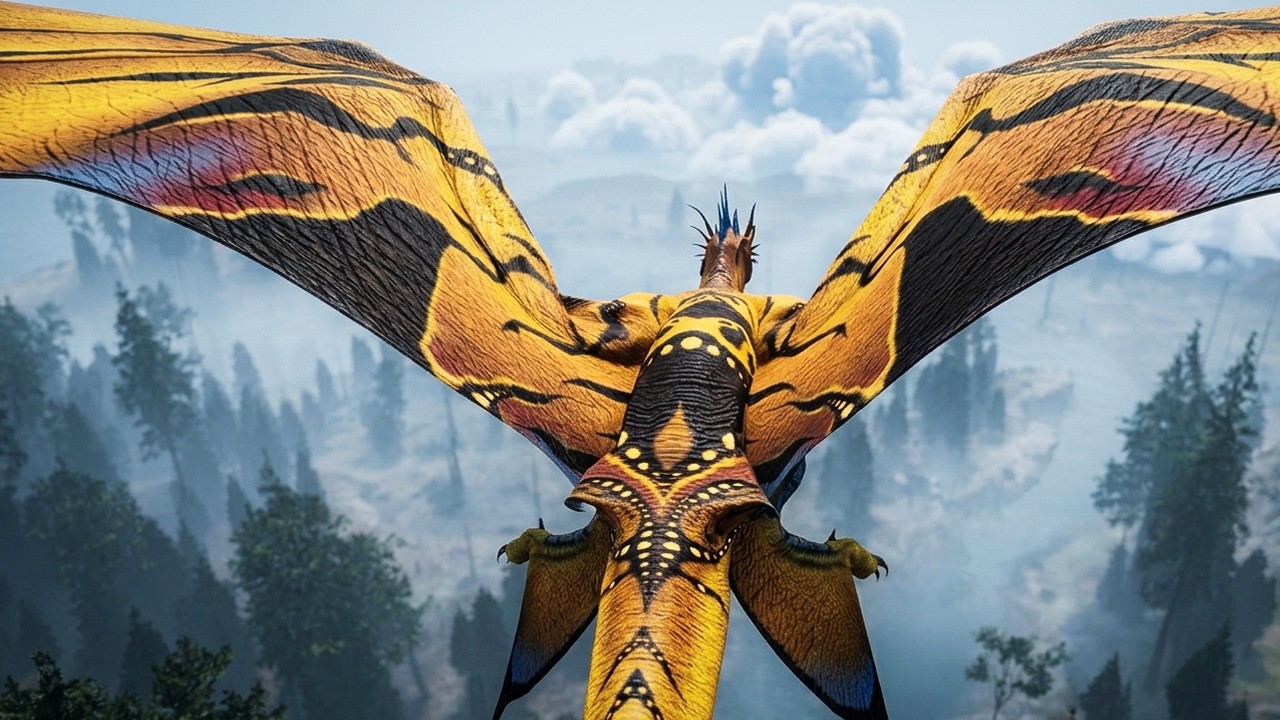
To defeat heavy dragon mods in Path of Titans using the Skyshroud Ikran, stay behind the enemy's line of sight by cutting inside their wide turn radius and attacking their dorsal blind spots. The Ikran has a lean health pool and cannot survive more than two or three direct hits or head-on trades from an adult dragon. Winning requires tight pitch adjustments, disciplined stamina conservation, and vertical hit-and-run passes.
Flight Dynamics: Ikran Agility vs. Dragon Bulk
Custom community servers often feature large dragon mods with massive combat weight, long-range breath attacks, and heavy frontal bite damage. In contrast, the Skyshroud Ikran functions as an agile skirmisher. Because a head-on clash results in swift defeat, you must force the dragon into extended turning contests where its wide arc and sluggish yaw leave it vulnerable.
| Combat Attribute | Skyshroud Ikran | Heavy Dragon Mods | Tactical Reality |
|---|---|---|---|
| Hitbox Profile | Narrow, compact body | Broad wingspan, large mass | Ikran easily slips through wide attacks |
| Turn Radius | Sharp pitch and tight banking | Wide, drifting turning circles | Ikran consistently holds rear blind spots |
| Damage Output | Moderate bite and talon strikes | High-damage bites and breath | Dragons easily win frontal trades |
| Stamina Usage | Efficient gliding, fast recovery | Rapid drain during hard turns | Ikran outlasts dragons in long dogfights |
How to Establish and Hold Tail Lock
Tailing a dragon eliminates its ability to aim forward breath or bite attacks while allowing continuous strikes to its rear. Because dragons cruise at high base speeds, you must actively brake to prevent overshooting into their attack cone.
- Approach from Above: Enter the engagement slightly above the target to preserve kinetic energy and dictate the angle of descent.
- Brake on Close Approach: Tap your air-brake as you close the distance to match the dragon's cruising velocity rather than colliding with its tail.
- Turn Inside the Arc: When the dragon banks to escape, mirror the bank angle and pitch up immediately to cut across the inner circle of its turn.
- Target Blind Spots: Focus peck and talon attacks on the dorsal ridge, wing roots, hips, and the base of the neck.
If the enemy dragon attempts a vertical loop to reverse direction, pitch up alongside them. Cutting across their inner loop allows you to hit their underbelly safely outside their forward bite range.
Vertical Hit-and-Run Passes
Remaining glued to a dragon's tail for too long exposes you to defensive stalls, reverse wing-buffets, or tail whips. To minimize risk against experienced players, use vertical hit-and-run runs:
- High-Altitude Dives: Begin high above the dragon and dive toward its upper back to build speed.
- Rapid Strike Delivery: Land a fast sequence of talon rakes and bites as you pass the dragon's blind spot.
- Zoom-Climb Recovery: Use dive momentum to pull into an immediate climb back above the target. Converting speed into altitude keeps you beyond the dragon's upward pitch limit while forcing the opponent to burn stamina trying to follow.
Flight Stamina Management and Perch Selection
Running out of stamina mid-air against dragons is fatal. Gliding consumes almost no stamina compared to continuous wing flapping. Keep your wings level to maintain cruise speed through momentum, reserving active flapping strictly for tight banking, vertical climbs, and evasive bursts.
Disengage immediately whenever your flight stamina drops to 30%. Never fight below this threshold. Break off with a downward glide toward high-altitude terrain where heavy flyers cannot easily land:
- Spire Pinnacles: Narrow cliff needles and rock spikes offer small perches that large dragons cannot land on without sliding off.
- Overhanging Rock Ledges: High cliff alcoves provide overhead cover against diving dragon attacks and keep you out of reach of grounded carnivores.
- Dense Forest Tops: Deep canopy cover breaks line of sight if you need to escape pursuit, though perching low near the forest floor risks ambushes.
Rest until stamina refills completely before re-engaging.
Ground Disengagement Limits
Avoid landing on flat ground during combat. The Ikran suffers from low ground traction, slow walking sprint speeds, and an extended takeoff animation that leaves it defenseless against both grounded dragons and terrestrial predators.
If an emergency forces a landing, target steep cliff faces or water edges. The Ikran can launch almost instantly off steep inclines by pitching straight down into a glide. By comparison, flat-ground takeoffs require a wind-up run that dragons can easily intercept. When heavily damaged, glide into deep canyons or break line of sight around rock formations, perch on a sheer rock face, and rest until fully healed.

Free Path of Titans Codes
Current active codes and how to redeem them.

Sarah Williams
Sarah specializes in RPG and collection games, explaining team building, character growth, and beginner-friendly ways to avoid expensive early mistakes.
COMMUNITY
Player Comments
148 players commented on this guide.
Can you add more details about strategy in a future update?
Good guide for Path of Titans players. The strategy part was useful.
The explanation is clear, especially for beginners.
I tried this today and it worked better than my old setup.