
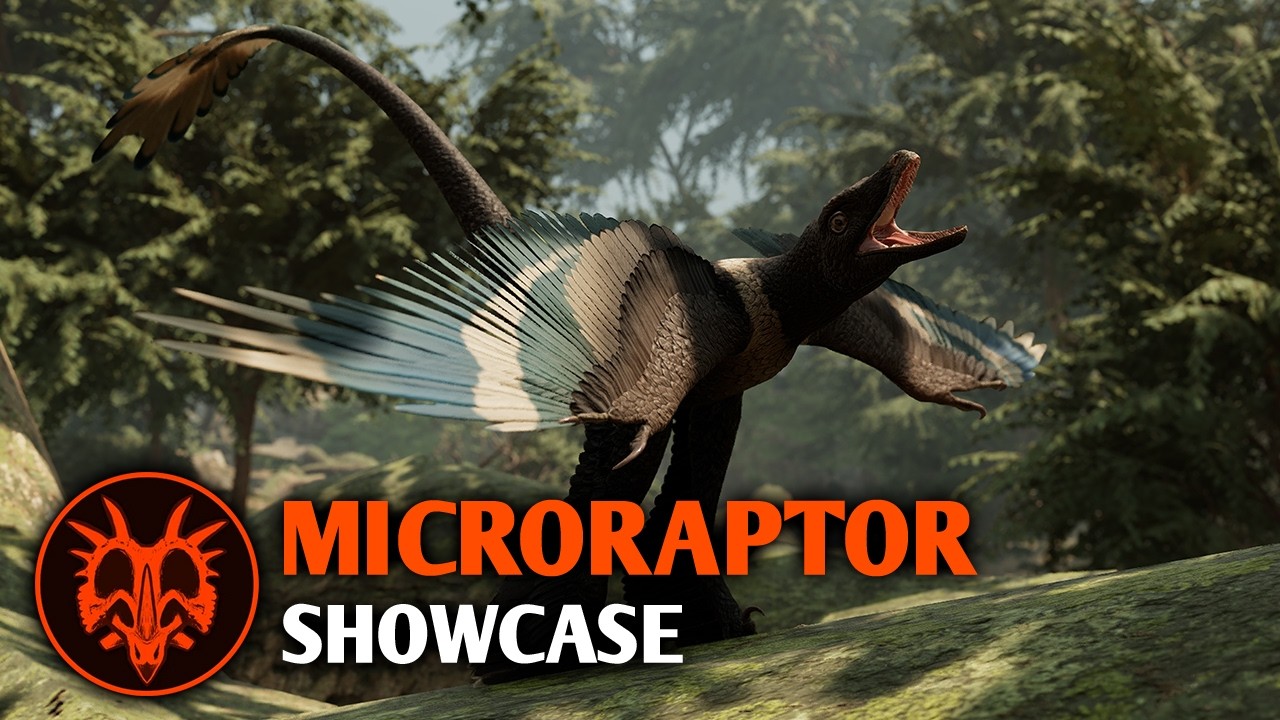
To survive as the Microraptor in Path of Titans, immediately abandon ground-level travel in favor of vertical tree climbing and canopy gliding. Because the Microraptor has fragile health and low combat weight, direct fights against terrestrial carnivores will result in near-instant death. Your primary survival loop relies on using tree trunks as escape routes, monitoring your climbing stamina, and leaping between branches to forage safely.
Scaling Trunks and Selecting Safe Perches
Tree climbing serves as your primary defense against grounded predators like Ceratosaurus and Megalania. Sprinting toward a tree trunk and initiating a climb lifts you out of standard ground hitboxes.
Not all flora offers equivalent protection:
- Coniferous and broad deciduous trees: Provide wide trunk surfaces and elevated branches, allowing you to perch horizontally and regenerate stamina without remaining attached to the trunk.
- Stunted or thin trees: Keep your elevation low, leaving you vulnerable to tail swipes and tall bipedal bites.
- Dense forest biomes: Offer tightly packed canopies that let you chain movements from trunk to trunk without landing on the forest floor.
Before climbing, look upward to locate bifurcated branches where you can perch safely. Resting horizontally stops the stamina drain associated with clinging to vertical surfaces.
Gliding Mechanics and Route Planning
Unlike pterosaurs, the Microraptor cannot sustain powered flight. Gliding relies on height, gravity, and pitch control to translate altitude into horizontal distance.
- Launch from height: Leap from high branches while angling forward to convert initial drop speed into forward travel.
- Pitch moderately: Tilt upward slightly to extend flight time across ravines or rivers. Avoid pitching too sharply upward, as this bleeds momentum and causes an early stall.
- Target the next trunk: Always aim your glide path toward a nearby climbable tree rather than open ground.
Landing in open terrain exposes you to swift mid-tier predators such as Deinonychus or Latenivenatrix. Plan each glide as a link to another trunk so you never touch the ground.
Stamina Economy for Vertical Movement
Climbing continuously drains stamina. If your stamina completely depletes while clinging to a trunk, you lose your grip and fall to the ground. Never begin a vertical climb with less than half of your stamina pool remaining, especially during an active chase.
| Movement Action | Stamina Cost | Tactical Purpose | Critical Limitation |
|---|---|---|---|
| Vertical Trunk Climb | Continuous drain | Rapid escape from ground predators | Drops player if stamina reaches zero |
| Canopy Gliding | Low continuous drain | Long-distance gap crossing | Stalls if pitched upward too steeply |
| Perch Resting | None (Regenerates) | Full stamina recovery on flat limbs | Leaves you stationary against pterosaurs |
| Ground Sprinting | Moderate drain | Short dashes between nearby trees | High vulnerability due to low combat weight |
Scavenging and Threat Evasion
Direct combat is unviable for the Microraptor. Even incidental hits from small carnivores deal severe damage to your small health pool.
- Opportunistic Feeding: Monitor combat zones or carcass sites from the safety of the upper canopy. Wait until large predators finish feeding and disperse, or swoop down during active fights to snatch a piece of meat before retreating back into the branches.
- Critters and Foraging: Hunt burrows and collect quest items along high, forested ridges to grow without lingering in high-traffic lowlands like Grand Plains or Impact Crater.
- Pterosaur Awareness: While apex land carnivores like Tyrannosaurus cannot reach high branches, flying predators such as Hatzegopteryx and Thalassodromeus can pluck you from exposed perches. When large pterosaurs patrol overhead, remain hidden in dense leaf canopies where large wingspans cannot navigate.
Free Path of Titans Codes
Current active codes and how to redeem them.

James Brown
James focuses on Android gaming on PC, emulator setup, controls, performance tuning, and practical troubleshooting for longer play sessions.
COMMUNITY
Player Comments
54 players commented on this guide.
This helped me understand strategy much better.
Can you add more details about strategy in a future update?
Nice guide. I am checking the other Path of Titans articles next.
The explanation is clear, especially for beginners.