
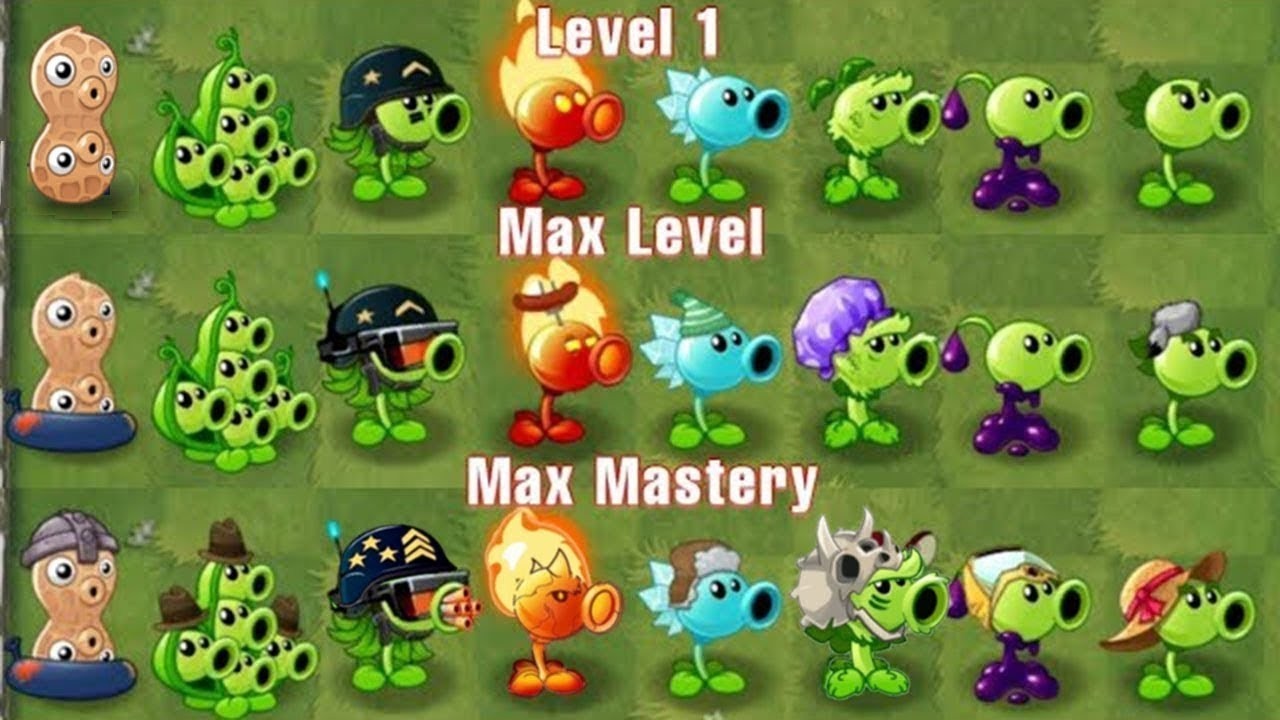
To get the highest return on seed packets and coins in Plants vs. Zombies™ 2, prioritize leveling multi-shot and utility attackers over single-lane shooters. While basic Peashooter remains restricted to a single lane even at high investment, plants such as Mega Gatling Pea, Threepeater, and Primal Peashooter scale multiplicatively through sun cost reductions, projectile damage increases, and Mastery mechanics.
---
How Pea Plants Scale Across Progression Tiers
Pea plants evolve across three distinct progression stages: baseline Level 1, Max regular level, and Mastery 200 (M200).
- Level 1 (Base State): High sun costs and slow recharges limit early deployment. Single-target peas struggle against clustered or armored zombies like Bucketheads, requiring stall plants or defensive barriers to buy time. Inherent knockback (Primal Peashooter) or multi-projectile output (Repeater, Threepeater) are the only ways to handle dense early waves.
- Max Regular Level: Sun costs drop dramatically (often by roughly 40% to 75%), recharge times become near-instantaneous, and base damage per pea roughly doubles or triples. Because damage increases apply to every projectile fired, multi-shot plants gain massive total damage per second compared to single-shot plants.
- Mastery 200 (Endgame): Unlocked after standard level caps, Mastery introduces Damage Pierce and a Plant Food boost chance. Damage Pierce allows projectiles to bypass zombie armor traits and defensive thresholds. The bonus trigger grants a chance to unleash an immediate Plant Food burst upon planting without consuming your Plant Food inventory.
| Pea Plant | Level 1 Base State | Max Regular Level State | Mastery 200 (M200) Impact |
|---|---|---|---|
| Peashooter | 100 Sun, 20 dmg/pea, slow recharge | 25 Sun, ~110 dmg/pea, fast recharge | High Damage Pierce, but restricted to a single lane |
| Repeater | 200 Sun, 2 peas/volley, 20 dmg/pea | 125 Sun, ~110 dmg/pea, fast recharge | Strong single-lane burst damage against heavy armor |
| Threepeater | 300 Sun, 3-lane spread, 20 dmg/pea | 175 Sun, ~110 dmg/pea per lane | Full-board coverage with massive damage-buff synergy |
| Primal Peashooter | 175 Sun, 50 dmg/pea, knockback | 100 Sun, ~150 dmg/pea, frequent stun | High armor bypass with consistent knockback stall |
| Mega Gatling Pea | 400 Sun, 4 peas, random Plant Food | 300 Sun, heavy burst damage | Frequent Plant Food triggers and rapid boss takedowns |
---
Why Multi-Lane and Utility Peas Dominate
Single-lane shooters fall behind in late-game modes like Arena and Penny's Pursuit because they cannot keep pace with high-density zombie swarms.
Multi-projectile plants multiply external damage amplifiers like Torchwood and Appease-mint across every pea they fire. A Max-level Threepeater firing boosted projectiles across three lanes clears entire boards far faster than an upgraded single-lane Peashooter.
Utility scaling operates on mechanics rather than raw numbers alone. Primal Peashooter remains a top-tier choice from Level 1 to M200 because its heavy stone peas physically knock zombies back and disrupt movement animations. In high-difficulty content where inflated zombie health pools absorb standard pea damage, Primal Peashooter's crowd control pins tough targets like Gargantuars near the lawn entrance.
---
Investment Priorities: Which Peas to Upgrade First
Because leveling requires an increasing amount of coins and seed packets, focus your resources where damage multiplication and utility are highest.
- Top Priority (Mega Gatling Pea, Threepeater, Primal Peashooter): Mega Gatling Pea provides unmatched single-column burst output. Threepeater delivers superior multi-lane coverage in competitive modes. Primal Peashooter provides permanent knockback stalling regardless of enemy health.
- Secondary Priority (Repeater, Pea Pod, Fire Peashooter): Repeater is an efficient mid-tier attacker for single-lane challenges, while Pea Pod gains strong sun efficiency once its base cost is reduced through standard leveling.
- Low Priority (Peashooter, Snow Pea, Pea-nut): Keep standard Peashooter and single-target elemental variants at baseline or mid levels until primary attackers are maxed. Even at M200 with low sun costs, single-target peas lack the lane coverage and burst potential needed for dense endgame waves.

Free Plants vs. Zombies™ 2 Codes
Current active codes and how to redeem them.

Emily Johnson
Emily writes practical mobile strategy guides with a focus on resource planning, base progression, and the early decisions that shape a long-term account.
COMMUNITY
Player Comments
83 players commented on this guide.
Can you add more details about strategy in a future update?
Nice guide. I am checking the other Plants vs. Zombies™ 2 articles next.
This helped me understand strategy much better.
I tried this today and it worked better than my old setup.