
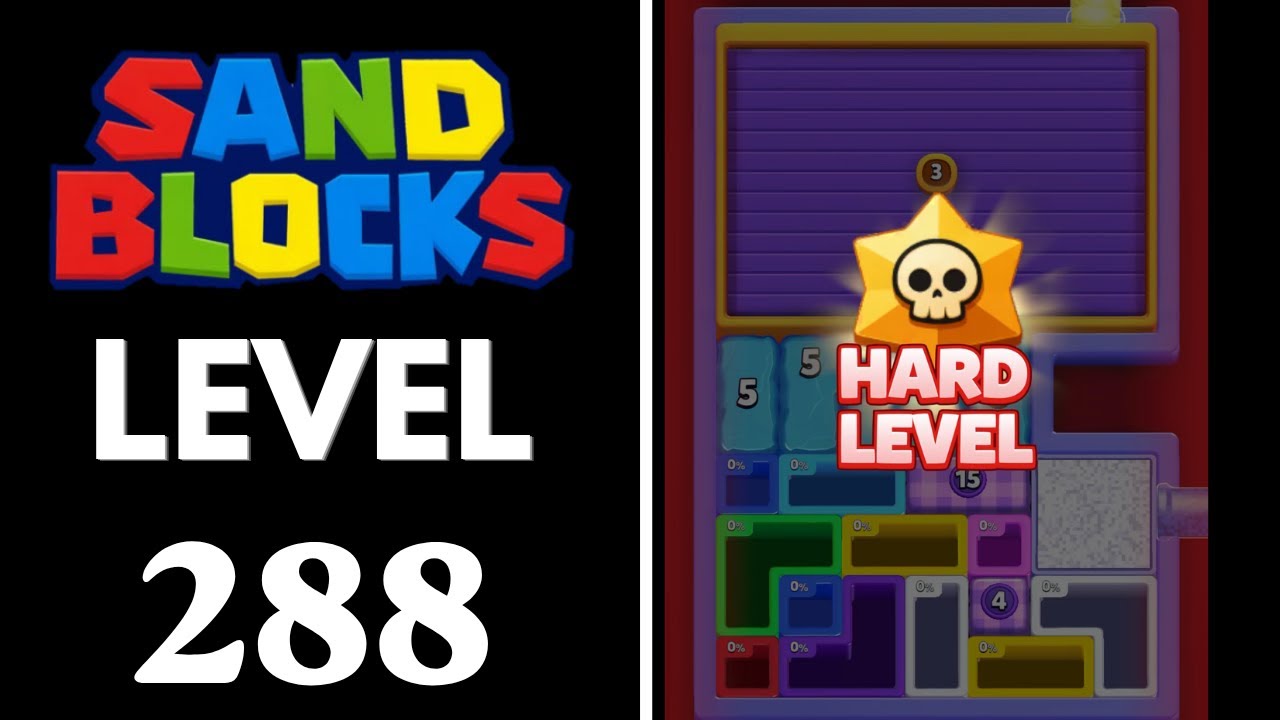
To clear Level 288 in Sand Blocks: Drop Puzzle, group incoming colors into dedicated vertical sections of the board, drop shapes on their flat sides to limit loose particle drift, and build continuous horizontal lines of a single color stretching completely from the left wall to the right wall. Completing a full wall-to-wall line instantly dissolves that sand layer, resetting your vertical space before incoming pieces pile up against the top loss boundary.
How Line Clears Work on Level 288
Pieces enter the board as solid polyomino shapes, but they dissolve into physics-driven sand particles immediately upon landing. Sand grains naturally slide down peaks and settle into low open pockets.
To clear sand and maintain board space, you must form a single, unbroken horizontal strip of one matching color extending from the left boundary to the right boundary. When that connection is made:
- The matching continuous line dissolves and disappears.
- Any sand resting above the cleared band immediately drops into the vacated space below.
- If the newly settled sand completes another unbroken horizontal line of a single color, it dissolves automatically in a cascade clear.
A line will not dissolve if a single foreign grain interrupts the continuous color band or if the color stops short of either boundary wall.
Controlling Color Zones and Sand Drift
Level 288 frequently presents mixed color sequences that can cause rapid vertical crowding if dropped carelessly across the center. Dropping contrasting pieces on top of uneven piles causes particles to spill sideways, creating thin, fragmented color caps that block full-line clears.
To maintain clean separation across the grid:
- Anchor colors to the outer walls: Direct distinct primary colors toward the left and right walls rather than dumping them across the middle.
- Keep the center lower than the flanks: A slight depression in the center directs sliding grains inward into controlled troughs rather than letting them roll over your side piles.
- Rotate shapes to match color contact: Rotate incoming L-blocks, T-blocks, or Z-blocks so the dominant color touches matching settled sand below.
- Prioritize flat landings: Dropping shapes on their widest flat edges absorbs impact and distributes sand evenly across an existing bed, preventing high peaks that split falling grains across different color zones.
| Block Shape | Optimal Placement | Main Risk on Level 288 |
|---|---|---|
| Straight Bar (I-Block) | Lay flat across depressions to bridge horizontal gaps | Dropping vertically creates a steep spike that sheds sand sideways |
| Square (O-Block) | Drop directly into wide, color-matched channels | Dropping onto sharp peaks splits sand into two adjacent columns |
| L-Block / J-Block | Align the long side flat against the floor or outer walls | Corner edges catching high terrain and spilling into foreign zones |
| S-Block / Z-Block | Fit stepped sections into matching low indentations | Uneven steps breaking across different colors and capping lines |
Clearing Layer Caps and Recovering Headroom
When foreign particles scatter over an unfinished layer, do not drop random blocks in an attempt to bury the mistake. Capping a blocked line with unrelated colors raises the entire stack closer to the top fail boundary and requires more clears to dig out.
- Clear the thin capping layer first: Check the drop preview for narrow pieces that can fill gaps without dropping excess material onto blocked sections.
- Use gravitational displacement: Deposit matching sand adjacent to a minor blockage until the weight and volume settle across the remaining gap to bridge the wall-to-wall connection.
- Prioritize immediate lines when near the ceiling: If any sand mound reaches within two block-heights of the top line, pause long-term combo setups. Focus entirely on executing any available horizontal clear to open up vertical breathing room.
Free Sand Blocks: Drop Puzzle Codes
Current active codes and how to redeem them.

Sarah Williams
Sarah specializes in RPG and collection games, explaining team building, character growth, and beginner-friendly ways to avoid expensive early mistakes.
COMMUNITY
Player Comments
137 players commented on this guide.
I tried this today and it worked better than my old setup.
This helped me understand strategy much better.
Nice guide. I am checking the other Sand Blocks: Drop Puzzle articles next.
I wish I had read this before upgrading the wrong thing.