
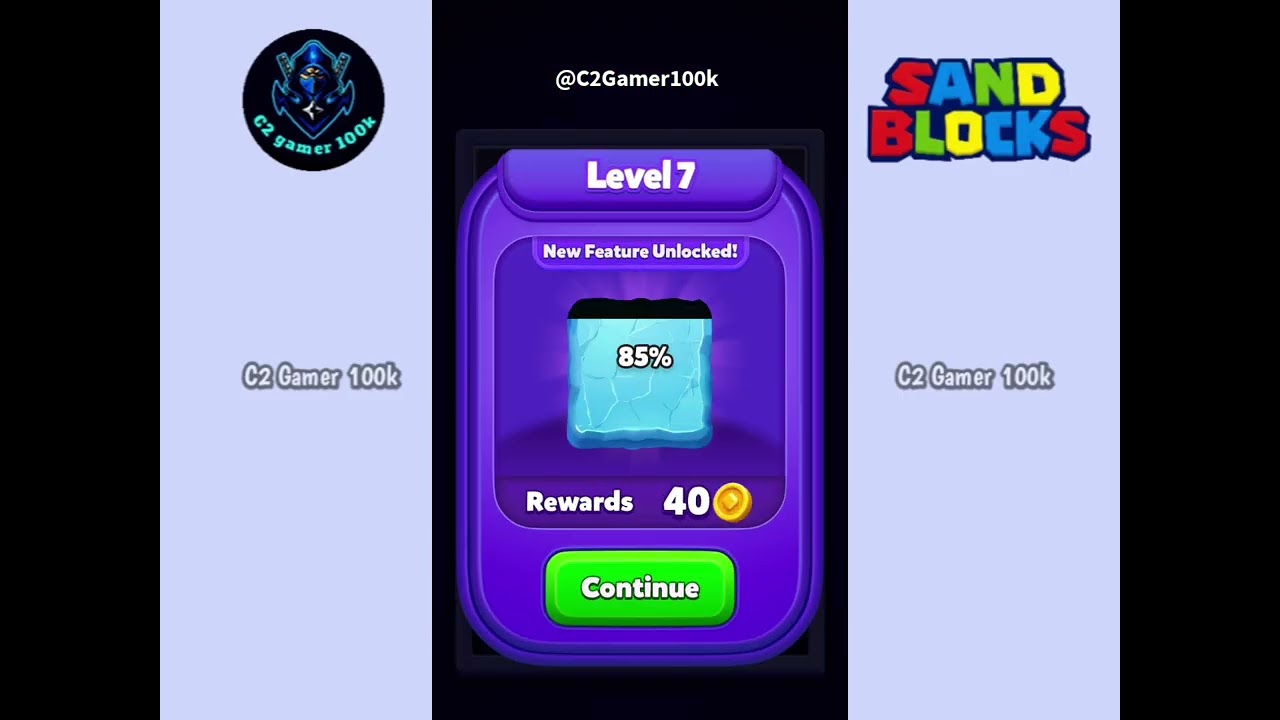
To clear Levels 1 through 10 in Sand Blocks: Drop Puzzle, you must form an unbroken, single-color band of sand spanning directly from the left wall to the right wall. The core strategy in these opening levels centers on rotating pieces to land flat, sorting separate colors into distinct sides of the container, and filling depressions to avoid vertical peaks that cause premature top-outs.
Core Sand Physics and Clearing Rules
Falling blocks maintain their geometric tetromino shapes while dropping and rotating, but they break down into loose grains the moment they touch the floor or an existing pile. The resulting sand particles slide down steep inclines according to simulated gravity until settling.
Unlike traditional grid-based block puzzle games, row clears require strict color uniformity across the entire width of the board. An entire row will not clear if a single grain of another color interrupts the path or if the sand stops short of either boundary wall.
| Mechanic | In-Game Behavior | Practical Impact |
|---|---|---|
| Granular Disintegration | Solid blocks dissolve into loose grains upon contact | Dropping flat minimizes spreading; dropping points creates ramps |
| Wall-to-Wall Continuity | Matching sand must reach both sides simultaneously | Partial rows remain in place until the missing edge is connected |
| Gravitational Cascades | Upper sand drops down when supporting sand clears | Clearing a lower band allows higher sand to settle into new lines |
Strategy for Levels 1 Through 5
Levels 1 through 5 teach fundamental placement and early color segregation using wide container layouts and simple block sequences.
- Rotate long bars horizontally: In Levels 1 and 2, the game primarily provides single-color or dual-color shapes like long I-blocks and square O-blocks. Orient long blocks horizontally before dropping them. A flat drop spans most of the floor base, requiring only minimal additional grains to reach both outer walls and trigger a clear.
- Commit to one base color: Levels 3, 4, and 5 introduce frequent color changes, commonly alternating among yellow, green, and red sand. Focus on completing an active line of one color before spreading a new shade across the playfield.
- Corner off secondary colors: If the board forces a color swap before the bottom row clears, direct the mismatched block into an outer corner rather than the center. This preserves an open clearing lane across the main floor.
Strategy for Levels 6 Through 10
Levels 6 through 10 introduce irregular tetromino shapes, such as L-pieces, T-pieces, and Z-pieces, which form uneven mounds if dropped without proper alignment.
- Orient flat edges downward: Dropping angled shapes vertically creates sharp peaks that cause sand to roll outward into thin, useless layers. Rotate L-blocks and T-blocks so their broadest flat surface faces the bottom to build stable layers.
- Set up vertical cascades: In Levels 9 and 10, use settling sand to create chain reactions. If a lower row is nearly complete, distribute a uniform layer of a matching color directly above it. Once the bottom row dissolves, the overhead layer drops straight down, completing an immediate secondary clear.
- Fill low depressions first: Steer incoming blocks toward valleys on the board rather than stacking them onto high points. Keeping the overall sand line level prevents grains from spilling into the wrong sections.
Color Sorting and Top-Out Prevention
Board overflows occur when blocks stack into a central spire that crosses the upper loss threshold while the outer edges remain empty. Because sand rolls down steep slopes, dropping blocks onto high peaks disperses thin trickles toward the walls that rarely bridge the full container.
To prevent overflow and keep sand clean:
- Build dedicated color zones: Group matching colors against the left or right walls rather than dropping them into mixed piles across the middle.
- Recovering from mixed sand: If a mismatched block lands on top of an active clearing row, avoid piling more pieces randomly. Lay a wide block of the dominant color directly over the spill to establish a fresh, flat baseline across the top.
- Maintain a low profile: Keep the average sand height within the lower half of the playfield to leave adequate space for rotating larger pieces.
Free Sand Blocks: Drop Puzzle Codes
Current active codes and how to redeem them.

James Brown
James focuses on Android gaming on PC, emulator setup, controls, performance tuning, and practical troubleshooting for longer play sessions.
COMMUNITY
Player Comments
158 players commented on this guide.
The tips are practical and easy to follow.
Nice guide. I am checking the other Sand Blocks: Drop Puzzle articles next.
Good guide for Sand Blocks: Drop Puzzle players. The early game part was useful.
Can you add more details about early game in a future update?