
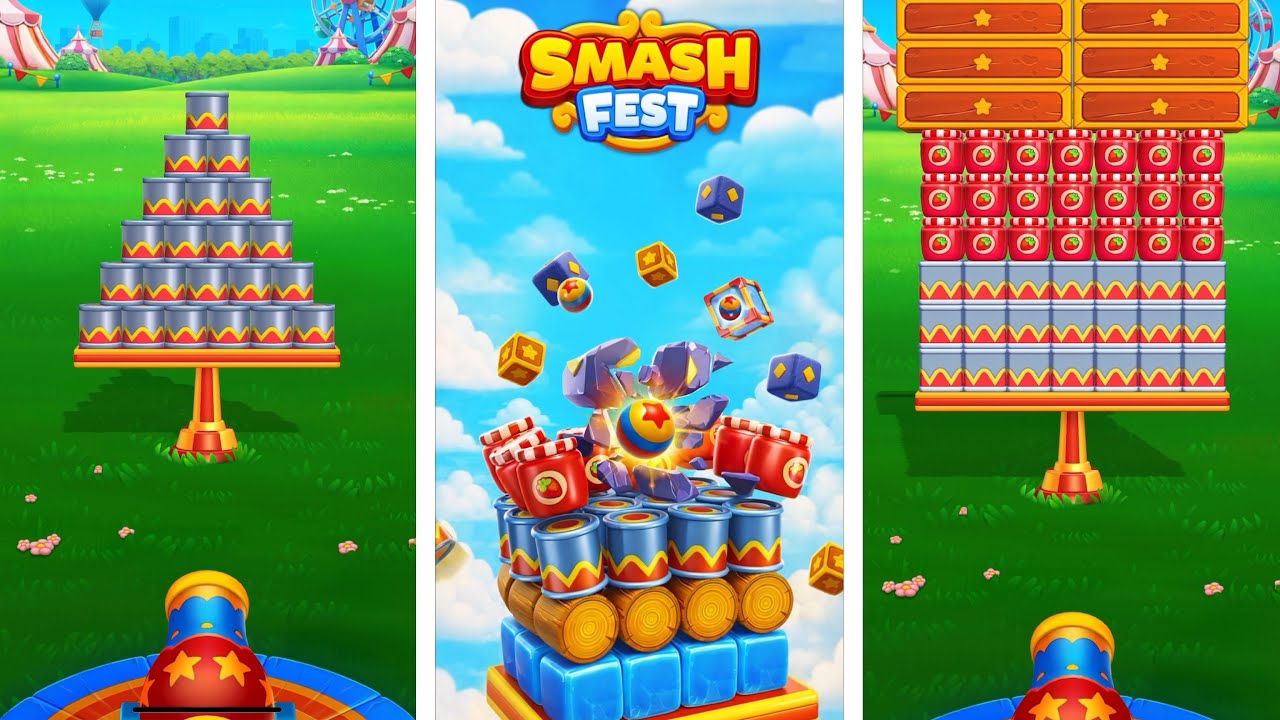
Success in Smash Fest! is not about how hard you hit, but how intelligently you manipulate the game's physics engine. In the first twenty levels, the game introduces the fundamental interactions between your cannon, the projectiles, and the various block materials. To clear these stages efficiently, you must shift your focus from "destruction" to "destabilization." By identifying the weakest structural links and utilizing the environment to your advantage, you can clear boards in fewer shots than you might think possible.
Mastering Projectile Trajectories and Impact Physics
The core of Smash Fest! revolves around kinetic energy and collision angles. When your projectile hits an object, the force is transferred based on the angle of incidence. A direct, perpendicular hit pushes blocks straight back, which is rarely ideal for clearing a crowded board.
To maximize your efficiency:
- Target the Gaps: Instead of aiming for the center of a block, look for the seams where two blocks meet. Hitting these gaps often forces the blocks apart, creating a chain reaction that destabilizes the entire stack.
- Calculate the Bounce: Before you fire, visualize the trajectory line. If the path is obstructed, look for wall surfaces that can act as banking points. A projectile retains significant energy even after one bounce, allowing you to hit "blind" spots behind tall barriers.
- Avoid Over-Aiming: In the early levels, players often make the mistake of dragging their finger across the screen with too much force. Use small, micro-adjustments. A shift of just a few pixels can be the difference between a direct hit and a glancing blow that does nothing.
Structural Strategy: The Foundation Collapse Method
One of the most common pitfalls for new Smash Fest! players is "top-down" destruction. You might feel tempted to clear the highest blocks first, but this is usually a waste of ammunition. Because the game utilizes a physics-based gravity system, blocks are only supported by what is beneath them.
The Foundation Principle: If you see a tall tower or a wide structure, ignore the top layers. Aim for the base blocks or the support columns holding the structure up. Once the base is removed, the upper layers will collapse naturally. This is the single most effective way to clear multiple obstacles with one shot. If a structure is held up by a single anchor block, prioritizing that target will cause the entire formation to fall, potentially clearing the level in a single move.
Strategic Target Prioritization
Not all objects in Smash Fest! are purely aesthetic. As you progress from level 1 to 20, you will notice different block types—some are light and flimsy, while others are reinforced and heavy.
- Identify the Anchor: In every level layout, there is usually one or two "critical" blocks. These are the pieces that, if displaced, will cause the largest amount of collateral damage. Scan the screen for these anchors before taking your first shot.
- Watch for Moving Parts: As you approach level 15 and beyond, you will encounter rotating platforms and moving obstacles. Never fire immediately when the level begins. Observe the platform's cycle for at least five seconds. Wait for the "open window"—the moment when the path to your primary target is clearest—before committing your shot. Patience here is a weapon in itself.
Managing Rebounds and Environmental Hazards
Walls are not just boundaries in Smash Fest!; they are essential tools. When your direct line of sight is blocked by a wall or a reinforced obstacle, you should look for a bank shot.
However, be aware of the "Energy Loss" factor. While your projectile is powerful, every bounce reduces its velocity.
- The Two-Bank Rule: For the first 20 levels, avoid shots that require more than two bounces. If you find yourself calculating a three- or four-wall ricochet, you are likely overcomplicating the puzzle. There is almost always a simpler, two-bounce solution that retains enough force to actually move the target blocks upon impact.
- Corner Traps: Sometimes, you can trap a projectile in a small alcove by bouncing it off a side wall and then the back wall. This creates a "pinball" effect that can clear a dense cluster of blocks in one go.
Refining Your Consistency: Avoiding Common Mistakes
The transition from level 1 to level 20 is designed to build your muscle memory. To ensure you aren't picking up bad habits, keep these tips in mind:
- Stop "Spray and Pray": Do not simply fire at the center of the screen to see what happens. Every shot should have a specific intent. If you miss, analyze exactly why: Was your angle too shallow? Did you hit the wrong side of the block?
- Avoid Over-Correcting: If you miss a target, don’t drag your aim across the entire screen. Shift your aim by only a tiny fraction for your next attempt. The game’s physics are consistent; if you hit the same pixel twice, you will get the same result.
- Use the "Stress Point" View: View the board as a single physical entity rather than a collection of blocks. Look for the "stress points"—the areas where a single hit would cause the most movement. Often, this is the center-bottom of a cluster.
Why This Matters for Late-Game Success
Mastering the mechanics in the first 20 levels is vital because Smash Fest! scales quickly. The techniques you learn now—such as identifying foundations, utilizing wall banks, and timing your shots for moving platforms—are the exact same skills required for the much more complex layouts you will encounter later.
By building a mental library of successful shots now, you won't have to relearn the basics when the screen becomes packed with reinforced, heavy, and moving obstacles. Treat these early levels as a training ground for precision. If you can consistently clear these stages in the minimum number of shots, you will find yourself well-equipped for the higher-level challenges that lie ahead. Remember: Smash Fest! rewards the player who takes a second to think before they fire.
Free Smash Fest! Codes
Current active codes and how to redeem them.

James Brown
James focuses on Android gaming on PC, emulator setup, controls, performance tuning, and practical troubleshooting for longer play sessions.
COMMUNITY
Player Comments
125 players commented on this guide.
This guide answered the exact question I had.
Can you add more details about early game in a future update?
Nice guide. I am checking the other Smash Fest! articles next.
I wish I had read this before upgrading the wrong thing.