
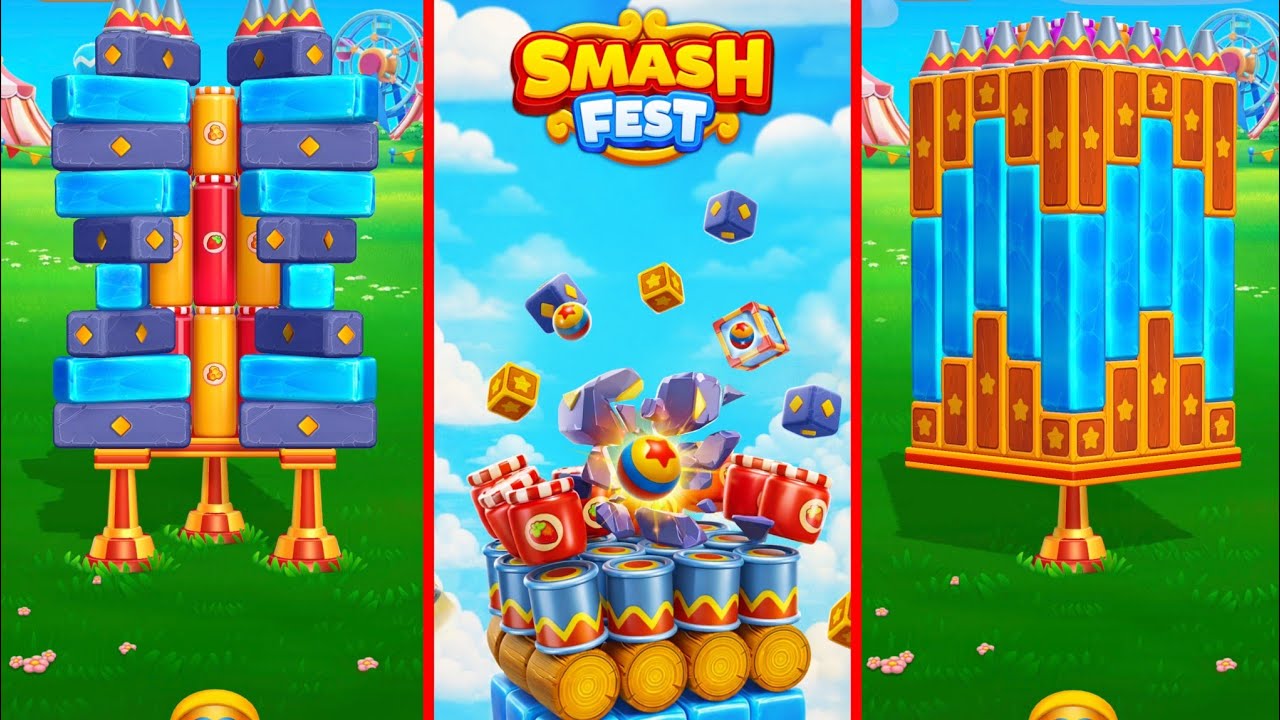
Clearing levels 101 through 150 in Smash Fest! requires a fundamental shift in your approach. While the early game allows for a "spray and pray" methodology, this mid-game bracket functions as a skill gate designed to test your understanding of geometric precision, structural engineering, and physics-based momentum. To succeed, you must move away from brute-force destruction and toward calculated, efficiency-focused gameplay.
The transition from level 100 to 150 introduces reinforced materials, complex obstacle layouts, and significantly tighter ammunition constraints. This guide provides the tactical framework required to dismantle these structures systematically and achieve three-star ratings consistently.
The Physics of Structural Weak Points
The most common mistake players make in Smash Fest! is targeting the outer perimeter of a structure. In the 101–150 range, the game engine uses gravity and structural integrity to determine how debris falls. If you strike an outer wall, you are often just wasting shots on individual blocks.
Instead, you must identify the "anchor" blocks. These are the foundational pieces—usually at the base or the central support pillars—that bear the weight of the entire construction.
- The Base-Collapse Strategy: By targeting the bottom-most center block, you destabilize the entire vertical column. Once the foundation fails, the upper structure collapses under its own weight, often clearing the surrounding perimeter items as a secondary effect.
- Seam Targeting: When structures feature reinforced or high-durability materials, do not hit the center of the block. Aim for the seams where two blocks meet. This minimizes the energy absorption of the projectile and maximizes the displacement of the connection point, which is the most effective way to cause a structural failure.
Mastering Projectile Trajectory and Ricochets
Because Smash Fest! utilizes a sophisticated physics engine, your trajectory angle is just as important as your impact point. A 45-degree angle is rarely the best choice for a direct shot, but it is the gold standard for creating ricochet effects.
If you are faced with a target that is shielded by a barrier, do not fire directly at the barrier. Instead, calculate the trajectory to hit the floor or an adjacent angled surface just before the target. The resulting ricochet can bypass front-facing shields, allowing your projectile to hit the structure from the side or underneath, where it is inherently less stable.
Pro-Tip: If a structure tilts but fails to collapse, do not adjust your aim significantly. The physics engine tracks "damage" or displacement. If your first shot moved the structure, a second shot in the exact same location is significantly more likely to cause a total collapse than a shot placed elsewhere.
Prioritizing Target Order in Crowded Environments
As you approach level 150, the screen becomes increasingly crowded with both stationary debris and dynamic, high-value targets. Attempting to hit high-value targets through a mess of foreground debris is a recipe for wasted ammunition.
Follow these rules for managing crowded boards:
- Clear the Canopy First: If there is a "roof" or horizontal platform covering your primary objective, remove it. A canopy acts as a shock absorber; by removing it, you expose the underlying structure to the full force of your subsequent projectiles.
- Isolate Vertical Pillars: In multi-story structures, look for the load-bearing columns. Clearing one vertical column can cause an entire half of the structure to lean and fall, triggering a massive chain reaction that clears the board without needing to hit every individual item.
- Explosives as Force Multipliers: Many levels in this bracket contain unstable items or explosive barrels. Treat these as your primary tools. A well-placed shot into an explosive item at the base of a tower is often worth three or four standard shots.
Navigating Moving Barriers and Rotating Obstacles
Levels 140–150 introduce dynamic elements: rotating platforms, swinging pendulums, and moving barriers. These elements are not just there to frustrate you; they are timing puzzles.
- The Waiting Game: Do not feel pressured to fire immediately. Many players fail because they fire the moment an opening appears. Instead, watch the cycle of the moving parts. Often, the best opening occurs just before the barrier reaches its full rotation, as this allows your projectile to pass through the gap and hit the structure as the barrier moves out of the way of the falling debris.
- Environmental Patience: If a structure is complex, fire one shot and wait. Often, a collapse will trigger a chain reaction that continues for several seconds. If you fire your second shot too quickly, you may hit a piece of debris that was already destined to fall, effectively wasting a move.
Optimizing for Three-Star Completions
In Smash Fest!, your score is primarily determined by two factors: the value of destroyed items and the number of shots remaining. To consistently hit three stars in the 101–150 range, you must prioritize shot economy.
- The "Shortcut" Mindset: Every level has a "perfect" path. If you finish with only one star, it means you used too many shots. Go back and experiment with a completely different starting angle. If you usually start by hitting the base, try an arching shot to the top-heavy side of the structure to induce a "top-down" collapse.
- Score Multipliers: Chain reactions are the key to high scores. When a structure falls and hits other targets, the game awards multipliers for every collision. By collapsing a structure in a way that it crashes into other areas of the map, you can rack up thousands of extra points that a direct, surgical shot would never provide.
Common Mistakes to Avoid
- Targeting High-Durability Blocks: If a block is glowing or reinforced, do not waste ammo on it. Go around it. The game design almost always provides a path to the weak point that avoids these blocks entirely.
- Ignoring the Background: Sometimes, the solution involves hitting a background element—like a hanging object—that swings down to impact the main structure. Always survey the entire play area before taking your first shot.
- Panic Firing: When you have only one shot left, the game increases the visual intensity. Stay calm, re-examine the structural supports, and trust the physics-based mechanics of the game.
By applying these principles of structural analysis and trajectory management, you will find that even the most daunting levels in Smash Fest! become manageable. Focus on the foundation, respect the physics engine, and always look for the chain reaction that saves you the most ammunition.
Free Smash Fest! Codes
Current active codes and how to redeem them.

Michael Smith
Michael covers live-service games, events, reward systems, and efficient daily routines, turning frequent updates into clear actions for players.
COMMUNITY
Player Comments
104 players commented on this guide.
This saved me time in the early game.
Good guide for Smash Fest! players. The resources part was useful.
Can you add more details about resources in a future update?
This guide answered the exact question I had.