
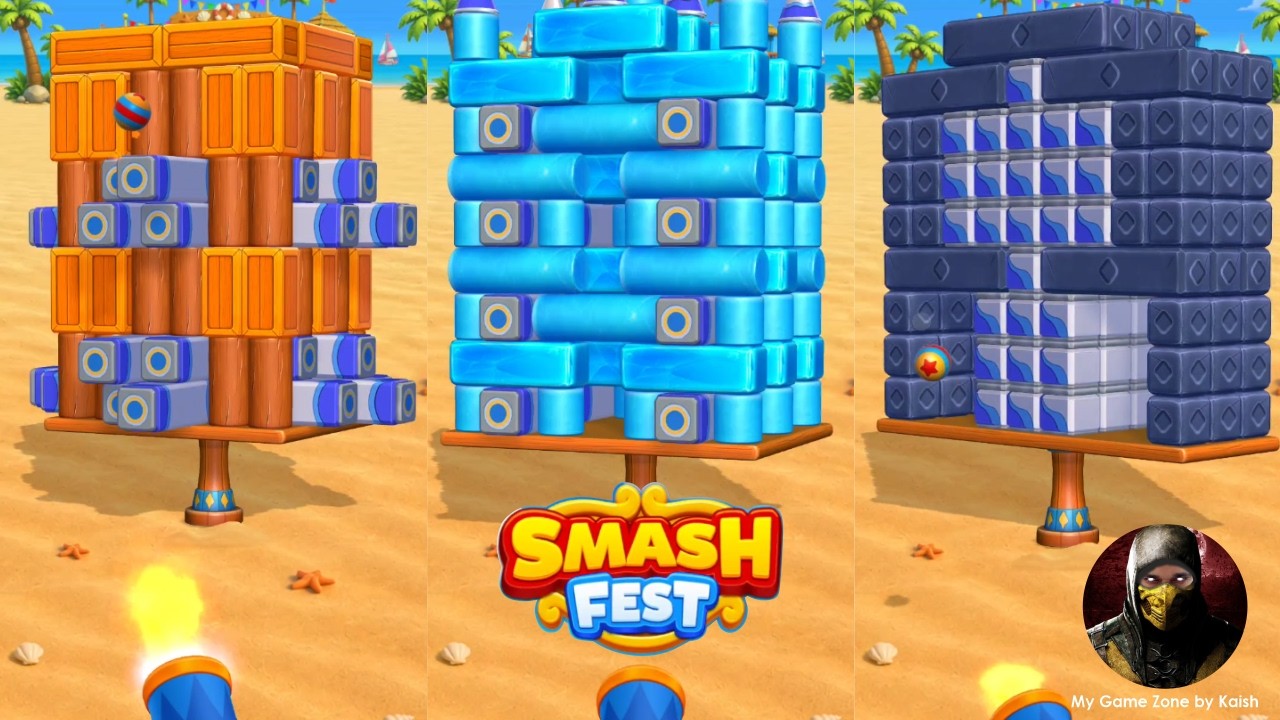
Mastering levels 301 through 350 in Smash Fest! requires a fundamental shift in your approach: moving away from brute-force destruction and toward calculated, precision-based target acquisition. As you progress through this mid-game bracket, the structural integrity of your targets increases, necessitating a deeper understanding of bounce mechanics and projectile physics. By identifying load-bearing components early and managing your remaining ammunition effectively, you can bypass the most resilient obstacles and maintain your momentum through this challenging fifty-level progression milestone.
Identifying Structural Weak Points for Efficiency
The most effective way to clear levels in the 301–350 range is to stop aiming for the center of mass. Instead, focus your first shots on the base or the connection points between platforms. Many structures in this tier are designed with a "top-heavy" philosophy; by targeting the support pillars or the lowest blocks, you trigger a chain reaction that causes the upper components to collapse under their own weight, saving you valuable shots for subsequent stages.
When you encounter layered platforms, prioritize removing the vertical supports before attempting to clear the horizontal surface. If a target is suspended, observe the anchor points. A single well-placed shot at an anchor usually results in the entire section falling, which is significantly more efficient than trying to chip away at the blocks themselves. This strategy is essential for levels 301–320, where the game introduces more complex geometry that penalizes players for wasting projectiles on non-essential decorative blocks.
Managing Projectile Trajectory and Bounces
As you move into the 321–340 range, you will face obstacles that cannot be destroyed with a direct line of sight. Utilizing the environment is the only way to reach these protected targets. Use the side walls to create bank shots, allowing your projectile to travel behind barriers or underneath overhangs. Calculating these angles requires patience, as the Smash Fest! physics engine rewards players who account for the slight arc of the projectile and the surface friction of the blocks.
If you find yourself struggling with a specific bounce, try adjusting your launch angle by only a few degrees. Often, the difference between a direct hit on a core block and a complete miss is a marginal adjustment in the launch arc. For levels 341–350, look for "choke points" where the architecture funnels your projectile into a specific path, increasing the probability of hitting multiple targets simultaneously after a successful bank shot.
Dealing with Increased Structural Density
Levels 301–350 see a significant increase in the sheer volume of blocks per stage. To prevent running out of ammo, you must prioritize clearing paths that expose the most critical structural nodes. If a level is densely packed, aim for the center of gravity. Collapsing a central stack will often destabilize the surrounding perimeter, potentially clearing the board without requiring individual hits on every single block.
Tactical Priorities for Dense Levels:
- Verticality: Always look for the highest point of a structure to see if it can be tipped over.
- Chain Reactions: Look for explosive or unstable blocks that can be triggered to clear wide areas.
- Ammo Conservation: If a structure is near the edge of the screen, use the perimeter to trap the debris and prevent it from soaking up extra shots.
Adapting to Mid-Game Difficulty Spikes
The transition toward level 350 introduces more frequent "staggered" setups where targets are placed on alternating platforms. This design is intended to force players to switch between high and low aiming profiles. Do not feel obligated to clear everything from the top down; if the bottom-most target is the most vulnerable, clear it first to remove the support for everything above it. This "bottom-up" approach is a staple for clearing the final ten levels in this sequence.
Finally, keep a close watch on your projectile count. In levels 345–350, the margin for error shrinks significantly. If you have a surplus of shots, use them to clear out remaining debris that might be blocking your path in future attempts. However, if your count is low, focus exclusively on the remaining "core" blocks required to trigger a level completion, ignoring any remaining peripheral obstacles that do not prevent the level from finishing.
Troubleshooting Common Level 301-350 Failures
Players often hit a wall between levels 330 and 345 because they over-rely on power shots. In Smash Fest!, force is rarely a substitute for placement. If you fail a level, analyze the wreckage. Did the structure fail to collapse because you missed the support, or because the projectile hit a "shielded" block?
- Avoid "Over-Killing": If a target is already falling, do not waste a shot on it. Let gravity do the work.
- Master the Ricochet: Practice your wall-bank shots on earlier, easier levels. You will need this skill to clear the shielded targets found in the 340s.
- Analyze the Architecture: Every level in Smash Fest! has a "solution path." If you are failing, look for the block that, if removed, causes the most significant collapse. That is your primary target.
By applying these principles, you will find that the difficulty spike in levels 301–350 is not an impossible barrier, but a test of your tactical decision-making. Focus on the structural integrity of the objects, use the environment to reach hidden targets, and always prioritize the bottom-up collapse to clear the screen with efficiency.

Free Smash Fest! Codes
Current active codes and how to redeem them.

Emily Johnson
Emily writes practical mobile strategy guides with a focus on resource planning, base progression, and the early decisions that shape a long-term account.
COMMUNITY
Player Comments
119 players commented on this guide.
The explanation is clear, especially for beginners.
The tips are practical and easy to follow.
This helped me understand strategy much better.
This saved me time in the early game.