
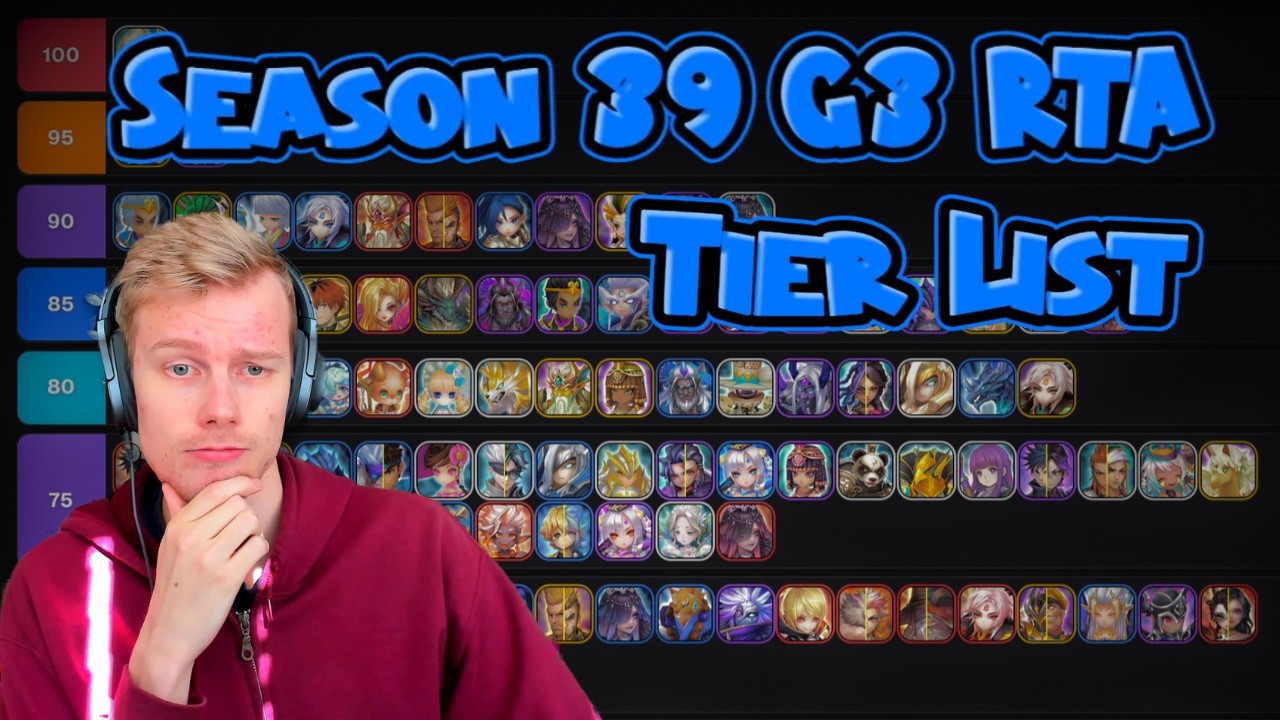
To evaluate monster power accurately in Summoners War World Arena (RTA), assess competitive units through a mathematical formula that balances win rate, pick rate, and ban rate rather than relying on subjective tier lists. Subjective community rankings often overvalue situational units based on memorable losses or inflated win rates from low match volume. To optimize your draft strategy, identify true meta anchors that sustain winning records under high pick frequency, reserve situational counter picks for late-draft slots, and eliminate high-volume draft traps from your monster box.
How the Objective Power Formula Evaluates RTA Performance
An objective ranking model calculates competitive impact by analyzing how three interdependent statistics interact:
- Win Rate Deviation from 50%: A monster's baseline performance is measured by how far its win rate deviates above or below a neutral 50% baseline.
- Pick Rate Volume Weighting: Multiplying the win-rate deviation against total pick volume prevents low-sample counter picks from outranking universal staples. A 56% win rate across a 0.5% pick rate indicates narrow drafting conditions, whereas a 52% win rate across a 30% pick rate demonstrates broad viability against prepared opponents.
- Ban Rate Draft Pressure: Factoring in how frequently an opponent bans a monster accounts for the draft leverage it exerts. Opponents forfeit their ban to remove dominant threats, confirming that the monster's kit warped the match before combat began.
Statistical World Arena Monster Categories
Organizing match data through this formula categorizes monsters into four functional draft tiers based on their pick volume and performance stability.
| RTA Category | Statistical Profile | Primary Draft Function | Kit Archetype |
|---|---|---|---|
| S-Tier Anchors | >20% Pick Rate, >50% Win Rate, High Ban Rate | First-pick foundations; safe blind picks | Universal speed leads, turn-cycling controllers, versatile bruisers |
| Pocket Punishers | <3% Pick Rate, >54% Win Rate, Low Ban Rate | Fifth-pick counter-tech against exposed teams | Passive bruisers, anti-control units, heavy elemental counters |
| Draft Traps | >15% Pick Rate, <49% Win Rate, Moderate Ban Rate | Comfort picks that fail against standard meta drafts | Outdated control units, predictable single-target damage dealers |
| Low-Impact Units | <1% Pick Rate, <48% Win Rate, Negligible Ban Rate | Non-viable choices requiring balance adjustments | Units lacking base speed, turn cycling, or team utility |
Draft Execution Rules
Applying statistical rankings to live matches requires aligning your pick order with each monster's operational category:
- Open drafts with high-volume anchors: Units such as Oliver, Moore, or Cheongpung maintain stable 51% to 53% win rates despite pick rates exceeding 25% to 40%. Because opponents constantly counter-draft these units, their positive win rates confirm superior mechanical reliability. Select these versatile monsters in early turns to keep your strategy flexible.
- Save pocket punishers for the final pick: Situational counters boast inflated win rates because they punish specific opponent weaknesses. Never draft them early. Drafting a low-volume counter in early turns alerts the opponent, allowing them to select natural answers and neutralize the unit before the match starts.
- Drop high-pick, sub-49% trap units: Monsters that absorb high draft volume while losing the majority of their matches actively lower your rank. If a familiar comfort pick regularly underperforms against standard meta drafts, replace it with a higher-efficiency anchor or dedicated counter.
Adjusting Data for Rune Quality and Sample Size
Statistical formulas aggregate global ladder data, predominantly reflecting Conqueror and Guardian rune efficiencies. Apply two critical filters when translating formula rankings to your account:
- Rune and Artifact Thresholds: Swift initiators and Violent turn-cyclers achieve their recorded win rates only when backed by top-tier base speed, high survivability, and precise artifact substats. If your rune inventory cannot meet the stat benchmarks required for an S-tier anchor, its performance will fall well below the statistical average.
- Light and Dark Sample Sizes: Rare Light and Dark Nat 5 monsters (LD5s) like Ragdoll, Giana, or Tian Lang often feature small match samples. A single specialist with elite rune depth can distort an LD5's win rate. Rely on standard elemental distributions for general drafting baselines, and only prioritize rare units if your rune box supports their exact build requirements.

Free Summoners War Codes
Current active codes and how to redeem them.

James Brown
James focuses on Android gaming on PC, emulator setup, controls, performance tuning, and practical troubleshooting for longer play sessions.
COMMUNITY
Player Comments
87 players commented on this guide.
I tried this today and it worked better than my old setup.
The explanation is clear, especially for beginners.
This helped me understand strategy much better.
I wish I had read this before upgrading the wrong thing.