
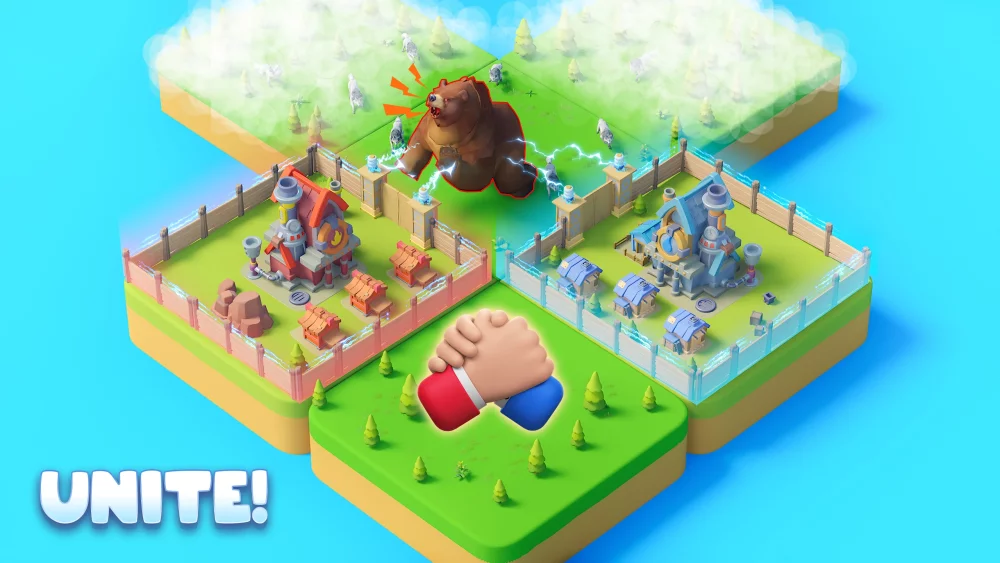
To dominate the competitive arena in Tiles Survive!!, you must transition from reactive movement to proactive territory control. Success in this high-tempo environment isn't just about speed; it is about manipulating the physics of the game to force opponents into traps of your own design. By mastering directional shifts, spatial management, and the "reversal" technique, you can turn the tide of any skirmish, even when outnumbered or outmaneuvered.
Understanding Arena Dynamics and Movement Physics
In Tiles Survive!!, your character’s momentum is your most valuable asset and your greatest liability. Understanding how the game calculates movement is the first step toward mastery. Because the game relies on grid-based synchronization, sudden changes in direction cause a momentary "drift" or lag in opponent tracking.
High-level players treat movement as a series of calculated vectors rather than continuous motion. When you move in a straight line, you are predictable and easy to corner. When you oscillate or move in jagged, unpredictable patterns, you force the game’s synchronization engine to catch up, which often creates small windows of invulnerability or pathing confusion for your rivals. To master this, stop holding down directional keys for long durations; instead, use short, rhythmic pulses to keep your movement vector fluid yet erratic.
The Art of the Tactical Reversal
The "reversal" is the cornerstone of Tiles Survive!! defensive-offensive play. This maneuver is specifically designed to punish aggressive players who blindly chase you across the arena.
How to Execute a Perfect Reversal
- Baiting: Move in a slight, non-aggressive arc toward an open area of the arena, keeping an opponent just behind your tail. Maintain a consistent speed to encourage their pursuit.
- The Commitment: Wait for the opponent to commit to a straight-line sprint to close the distance. You will know they have committed when their movement speed increases or they stop adjusting their pathing.
- The Pivot: Execute a sharp 180-degree turn precisely when the opponent is within one to two tiles of your current position.
- The Collision: Because the opponent is locked into their momentum, they will be unable to react in time to avoid your new path, resulting in a direct collision and their immediate elimination.
Spatial Awareness: Beyond the Screen Center
Many players lose in Tiles Survive!! because they focus exclusively on their own character. This tunnel vision is a fatal mistake. To win consistently, you must maintain a "wide-angle" perspective of the entire grid.
- Grid Density Mapping: Mentally divide the arena into four quadrants. As you move, keep a running tally of which quadrants are becoming overcrowded. Use high-density areas as a weapon—lead aggressive opponents into these zones, forcing them to navigate through other players while you maintain a safe, wide path.
- Buffer Zone Maintenance: Always aim to keep a two-tile buffer between yourself and the nearest player. This is the "Safety Threshold." Any closer, and you lose the reaction time necessary to dodge surprise maneuvers or sudden lag spikes.
- The Corner Trap: Never retreat into a corner unless you are baiting. Instead, force your opponents to retreat into them. When an opponent is backed against an arena boundary, their movement options are reduced by 50%, making them significantly easier to predict and eliminate.
Managing Aggression and Risk Trade-offs
Aggression is necessary to claim territory, but it must be calculated. The primary trade-off in Tiles Survive!! is between "Expansion" and "Containment."
Expansion involves moving quickly into neutral territory to claim tiles and resources. This is best done in the early game when the arena is wide open. However, expansion leaves you vulnerable to flanking. Containment is a late-game strategy where you focus on denying movement space to rivals.
When choosing your strategy, consider the "Arena Population Index":
- Low Population: Prioritize Expansion. Secure as much space as possible to maximize your score and resource pool.
- High Population: Prioritize Containment. Stop trying to grab territory and start focusing on moving parallel to your closest opponents to force them into collision courses with one another.
Adapting to Late-Game Shrinkage
As the arena in Tiles Survive!! shrinks, the mechanics of the game shift from "territory control" to "survival density." In the final minutes of a match, your movement should become tighter and more deliberate.
Avoid sweeping, wide turns that expose your flank. Instead, focus on "micro-movements"—tiny, rapid adjustments that keep you centered in the remaining safe zone. When space is at a premium, the player who controls the center of the remaining area dictates the movement of everyone else. If you can hold the center, you force your opponents to circle the periphery, where they are more likely to run into map boundaries or each other.
Common Mistakes to Avoid
- Over-committing: Chasing a kill for too long often leads to your own death. If an opponent successfully evades your trap for more than five seconds, break off the engagement and reset your position.
- Ignoring the "Lag Shadow": In high-tempo matches, your character's physical position might be slightly behind where your input suggests. Always account for this "Lag Shadow" when calculating if you have enough space to make a turn.
- Predictable Pathing: Even if you aren't being chased, never move in a straight line for more than three seconds. Vary your rhythm to keep other players guessing about your intentions.
By applying these tactics, you will transition from a reactive player to a master of the Tiles Survive!! arena. Remember that every movement you make sends a signal to your opponents—make sure that signal is designed to lead them into a defeat.

Free Tiles Survive! Codes
Current active codes and how to redeem them.

Emily Johnson
Emily writes practical mobile strategy guides with a focus on resource planning, base progression, and the early decisions that shape a long-term account.
COMMUNITY
Player Comments
120 players commented on this guide.
I wish I had read this before upgrading the wrong thing.
Can you add more details about strategy in a future update?
The explanation is clear, especially for beginners.
This guide answered the exact question I had.