
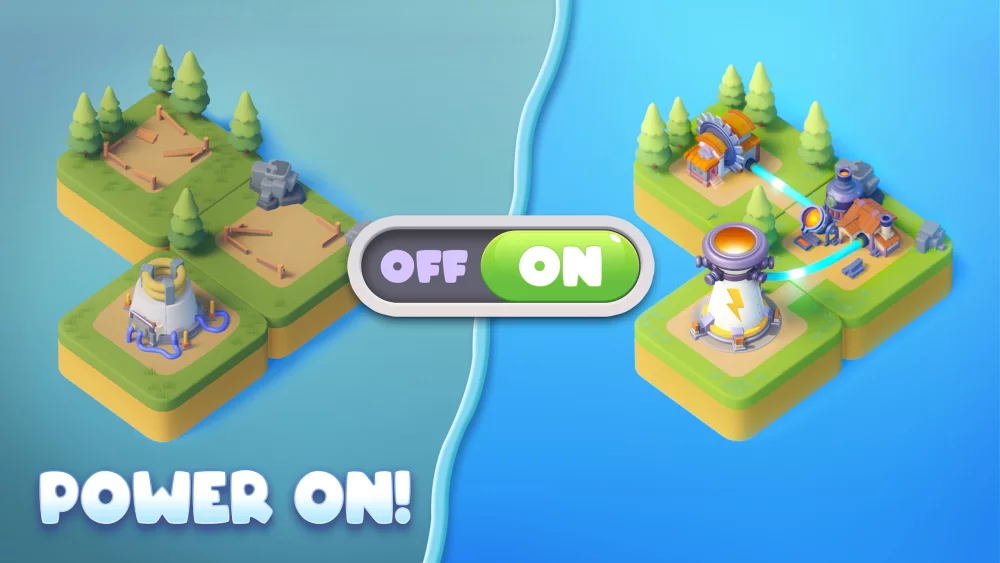
Transitioning from manual survival to an automated, high-output industrial base is the most critical milestone for mid-game players in Tiles Survive!!. As the game’s environment grows increasingly hostile, your ability to sustain operations depends entirely on your power infrastructure. This guide covers how to leverage mid-game power mechanics to transition from basic resource gathering to a sophisticated, self-sustaining base that supports long-term survival.
Prioritizing Power Station Construction
The core of your mid-game progression in Tiles Survive!! is the deployment of a functional power station. This structure serves as the heart of your base, unlocking technology tiers that are otherwise inaccessible. Without a dedicated energy grid, your advanced processing machines remain dormant, stalling your growth and leaving you vulnerable to the harsh wilderness environment.
When constructing your first power station, placement is everything. You should position it at the absolute center of your primary resource-processing zone. In Tiles Survive!!, energy efficiency is tied to proximity; placing your generator near your industrial machines minimizes "latency," a mechanic where energy throughput is lost or delayed across long grid segments. By minimizing the distance between the source and the consumer, you ensure that your production cycles remain consistent, even when the base is under heavy load.
Optimizing Energy Distribution for Production
Once your power station is online, the game shifts from a "scavenge-to-survive" loop to an "energy-management" challenge. The most common mistake mid-game players make is over-extending their grid by connecting low-priority structures—such as decorative tiles or excessive storage units—to the main power line.
To maintain peak efficiency, follow these guidelines:
- Segment Your Grid: Only connect essential resource converters (smelters, fabricators, and extractors) to your primary power grid.
- Load Monitoring: If you notice a stutter in production speeds or a "power flickering" animation on your machines, your current output is insufficient for your active load.
- Prioritize Upgrades: Before building new, non-essential structures, invest your resources into upgrading the power station’s capacity.
- Buffer Management: Utilize energy storage tiles as a temporary bridge to handle spikes in demand during high-intensity crafting phases.
By strictly prioritizing high-output machines, you ensure that your most critical survival assets remain functional even during periods of fluctuating energy supply.
Structural Trade-offs: Density vs. Vulnerability
Expanding your base in Tiles Survive!! requires navigating a constant trade-off between power capacity and defensive security. Every tile occupied by a generator is a tile that cannot be used for defensive barriers or storage.
When planning your layout, consider these two schools of thought:
- The Dense Cluster Approach: Placing all generators in a single, reinforced square. This makes defense easier because you only need to protect one "heart," but it creates a single point of failure. If an enemy breach hits your power center, your entire base loses function simultaneously.
- The Distributed Grid Approach: Spreading smaller power units throughout the base. This provides redundancy; if one area is damaged, the rest of your base remains powered. However, this increases your defensive perimeter, forcing you to stretch your resources thin to guard multiple power points.
For most players, a hybrid approach is best: keep your primary power hub in the center, protected by your thickest walls, and place secondary "backup" generators near critical defensive turrets to ensure they stay powered during a raid.
Scaling for Late-Game Success
As you progress deeper into the research tree, your power requirements will grow exponentially. A base that functions perfectly at Level 10 may fail completely at Level 15 because it lacks the energy overhead to support advanced tech.
To scale effectively, you must practice "Future-Proofing":
- Reserve Growth Tiles: Always leave a 2-tile buffer around your power stations. This allows you to place efficiency-boosting modules or structural upgrades without having to demolish and reorganize your entire base later.
- Research Priority: Look for research nodes that increase "Energy Efficiency" rather than just "Energy Output." Increasing efficiency means you get more work out of every watt, effectively scaling your power without needing more physical space.
- Automated Shut-off: If your base supports it, use smart-switches to disable non-essential machines (like advanced printers) when you are focused on defense or resource gathering.
Common Mistakes to Avoid
Even experienced players often fall into these traps when managing their Tiles Survive!! infrastructure:
- Ignoring the Power-to-Machine Ratio: Trying to run four high-tier machines on a single tier-one generator. This leads to constant brownouts and wasted resources.
- Neglecting Perimeter Power: Forgetting to power your perimeter defenses until a raid has already begun. Always ensure your defensive grid is on a separate or prioritized power circuit.
- Over-Expansion: Building a base that is too large to defend. A smaller, highly efficient, and well-powered base is significantly more survivable than a sprawling, under-powered complex.
By treating your power grid as a dynamic, evolving system rather than a static piece of furniture, you will master the logistical challenges of Tiles Survive!!. Keep your layout tight, prioritize energy-efficient research, and always maintain a clear, defensible path between your power source and your production lines. This level of planning is the key to enduring the harsh environments of the game and achieving true long-term survival.

Free Tiles Survive! Codes
Current active codes and how to redeem them.

Emily Johnson
Emily writes practical mobile strategy guides with a focus on resource planning, base progression, and the early decisions that shape a long-term account.
COMMUNITY
Player Comments
110 players commented on this guide.
This helped me understand base building much better.
The tips are practical and easy to follow.
Good guide for Tiles Survive! players. The base building part was useful.
I tried this today and it worked better than my old setup.