
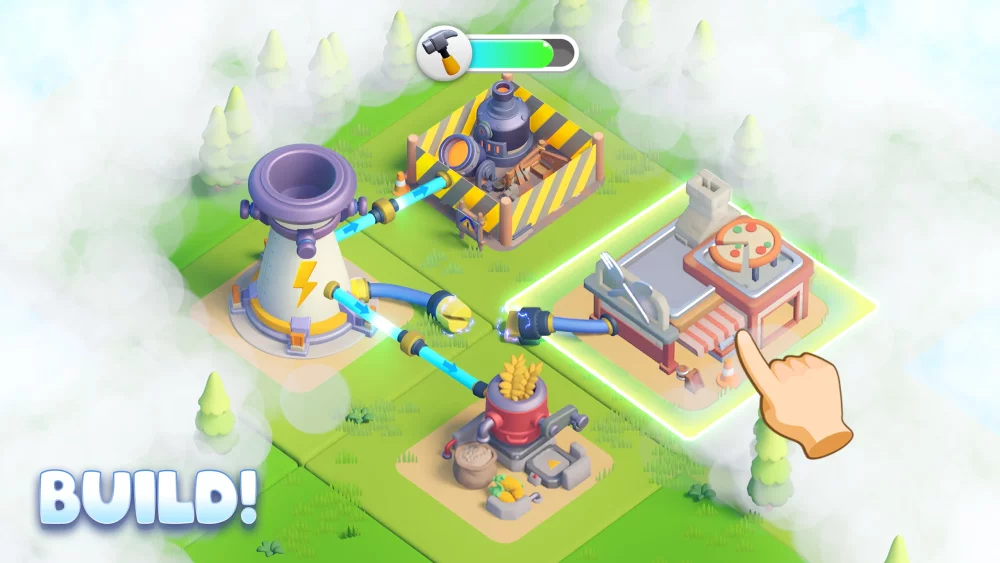
Survival in Tiles Survive!! is dictated by your ability to interpret and navigate a grid-based environment where every step carries the risk of triggering lethal hazards. Unlike free-roaming survival games, Tiles Survive!! operates on a strict, incremental movement system. Success depends on your capacity to read the grid, manage your character’s positioning, and prioritize safety over speed until you have fully internalized the game’s unique tile-interaction logic.
Understanding Basic Character Movement
Movement in Tiles Survive!! is not fluid; it is a discrete, turn-based transition between squares. Your character moves one tile at a time, and the game processes each input as a deliberate action. This incremental system is the most common point of failure for new players who attempt to "flick" or swipe across the screen impulsively.
- Grid Alignment: The world is segmented into precise squares. Your character must fully occupy a tile before the game registers the next movement command. Attempting to input a second movement before the first animation concludes can lead to "input queuing," where your character moves into an unintended adjacent tile.
- The Proximity Rule: The camera movement is tied to your character’s position. If you rush, the camera may struggle to keep up, potentially obscuring hazards or interactive triggers located at the edges of the screen. Always center your character to maintain a clear line of sight.
- Input Precision: Because the game relies on grid-locked navigation, accuracy is prioritized over speed. Practice moving one tile at a time to build the muscle memory required for later levels where the grid becomes more complex.
Navigating Environmental and Interactive Tiles
In Tiles Survive!!, the floor is rarely just a floor. Environmental tiles act as triggers, traps, or puzzle elements that change the state of the level. Identifying these before you step onto them is the core skill of a survivor.
Identifying Hazard Markers
Look for visual cues that differentiate stable ground from dangerous territory. Hazards often exhibit:
- Flickering Textures: A subtle pulse or change in color intensity often precedes a trap activation.
- Geometric Irregularities: Tiles that appear slightly raised or lowered compared to the standard grid are usually interactive.
- Proximity Triggers: Some traps remain dormant until your character is within a one-tile radius. If you notice a tile changing state when you step near it, do not step onto it; instead, circle around it if the level geometry allows.
The "Wait and Observe" Strategy
When you encounter a new, unfamiliar tile, stop movement entirely. Many hazards follow a rhythmic cycle. By spending three to five seconds observing the pattern, you can often determine the "safe window"—the precise timing where a hazard retracts or deactivates, allowing for safe passage.
Advanced Pathing and Efficiency
Efficiency in Tiles Survive!! is defined as "pathing economy." Every unnecessary step increases your exposure to hazards and limits your ability to react to sudden level changes.
- Map the End-Goal First: Before moving, scan from your current position to the exit. Identify the "bottleneck" tiles—those that are mandatory to cross—and map your route around the perimeter of the grid to reach them.
- The Perimeter Strategy: In the majority of levels, the edges of the grid are significantly safer than the center. Designers often concentrate complex traps and high-tempo hazards in the middle to punish players who take the direct, "straight-line" path.
- Backtracking Risks: Every time you move backward, you are potentially moving into a tile you have already cleared but may have "triggered" to change state. Avoid backtracking at all costs; if you reach a dead end, it is usually a sign that your initial routing choice was flawed.
Troubleshooting Common Early-Game Pitfalls
New players often lose runs due to avoidable mistakes. By understanding why these errors happen, you can refine your gameplay loop.
- The "Panic Swipe": When a trap activates, the natural reaction is to swipe away quickly. However, because movement is grid-locked, a panic swipe often moves you into another hazard. If you make a mistake, stop, breathe, and re-evaluate the tile sequence.
- Ignoring Peripheral Hazards: Players frequently focus on the tile directly in front of them while ignoring the tile to their left or right. Use the camera to pan slightly if the UI allows, ensuring you have a 360-degree view of the immediate grid before committing to a move.
- Over-Prioritizing Speed: While Tiles Survive!! has a survival theme that implies urgency, the game does not penalize you for taking your time to analyze the board. Speed is a byproduct of mastery; do not attempt to play fast until you can clear levels without error.
Strategic Decision Making: Safety vs. Speed
As you progress, you will encounter scenarios where you must decide between a "slow/safe" route and a "fast/risky" route.
- The Safe Route: Involves navigating the perimeter and waiting for hazard cycles to reset. This is the recommended strategy for 90% of your playtime. It guarantees survival but may result in lower time-based scores.
- The Risky Route: Involves timing your movement to sprint through hazard cycles while they are active. This is only recommended for advanced players attempting to break speed records or those who have fully memorized the specific timing of a level’s trap layout.
Expert Reasoning: The primary objective of Tiles Survive!! is to survive the environment. If you die, the run ends. Therefore, the "optimal" path is always the one that maintains the highest margin of error. Until you have unlocked late-game upgrades that might mitigate damage or provide movement bonuses, prioritize the safe route to ensure consistent progression. By treating each tile as an individual puzzle piece rather than a path to be rushed, you will find that the game’s difficulty becomes manageable through logic and observation rather than frantic reflex.

Free Tiles Survive! Codes
Current active codes and how to redeem them.

Emily Johnson
Emily writes practical mobile strategy guides with a focus on resource planning, base progression, and the early decisions that shape a long-term account.
COMMUNITY
Player Comments
104 players commented on this guide.
Nice guide. I am checking the other Tiles Survive! articles next.
This saved me time in the early game.
I wish I had read this before upgrading the wrong thing.
Good guide for Tiles Survive! players. The base building part was useful.