
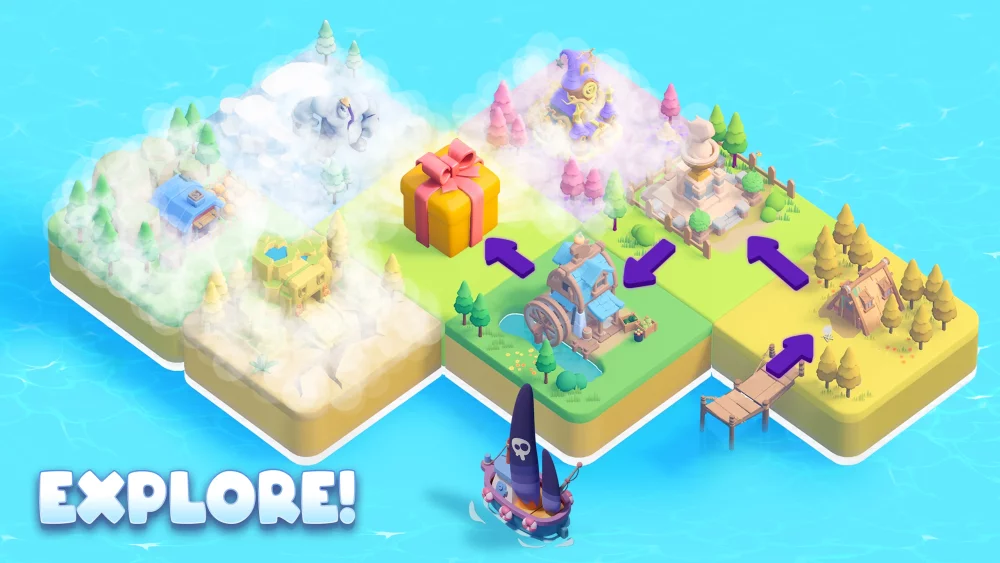
In Tiles Survive!!, the difference between a thriving survivor colony and a fallen settlement is defined by your ability to manage your grid expansion. As a 4X survival management game, Tiles Survive!! forces players to constantly weigh the need for new resources against the looming threat of zombie incursions. Whether you are playing on the Windows version or mobile, the core mechanics of systematic expansion remain the same.
To succeed, you must move beyond reactive gameplay. This guide provides the tactical framework required to master the game’s rhythm, optimize your structural placement, and maintain a sustainable base that can withstand the increasingly difficult waves of the undead.
The Logic of Grid Expansion: Why "Slow and Steady" Wins
Many players fall into the trap of rapid, chaotic expansion, uncovering tiles as fast as their energy allows. In Tiles Survive!!, this is a recipe for disaster. Every tile you reveal potentially introduces new threats or complicates your defensive perimeter.
The Golden Rule of Expansion: Only expand when your current resource production can support the cost of the new tile and the added defensive pressure it brings.
When you reveal a new tile, you aren't just gaining land; you are creating a new point of entry for threats. By clearing in a "block" or "circle" pattern—keeping your base as compact as possible—you minimize the number of exposed edges. A circular base layout reduces the surface area that zombies can attack at once, effectively creating a natural defensive bottleneck.
Leveraging PC Controls for Superior Management
The Windows version of Tiles Survive!! offers a significant advantage in input precision and screen real estate. On a PC, you are not limited by thumb-reach or obscuring your view with your hand.
- Precision Targeting: Use your mouse to quickly cycle through tile resource data. Before committing to a clear, hover over the tile to check the potential payout versus the risk.
- Macro-Management: The wider view allows you to see the "big picture" of your base. Use this to identify potential choke points on the map edges where you can concentrate your turrets and barricades.
- Keybind Efficiency: If the version supports it, map your most frequent building actions to hotkeys. During a high-tempo rhythm event, the milliseconds saved by not clicking through menus can be the difference between a successful wall repair and a base breach.
Resource Management: Avoiding the Stagnation Trap
Resource scarcity is the most common cause of early-game failure. Players often spend all their energy clearing tiles, leaving nothing for the construction of essential infrastructure.
To avoid this, adopt a Tiered Resource Approach:
- Tier 1 (The Foundation): Prioritize tiles that yield basic materials (wood, scrap, food). Never expand into unknown "high-tier" tiles until these are fully automated.
- Tier 2 (The Buffer): Once your foundation is stable, focus on tiles that provide defensive utility or space for defensive structures.
- Tier 3 (The Deep Expansion): Only push into deep-map sectors when you have a surplus of energy and a standing army ready to defend the new territory.
Always keep a "Safety Reserve" of energy. Never spend your last point of energy on an expansion; keeping a buffer ensures that if a zombie wave spawns unexpectedly, you can immediately initiate emergency repairs or unit production.
Structural Placement: The "Choke Point" Strategy
Your base design should act as a funnel. In Tiles Survive!!, zombies will naturally move toward the nearest "noisy" or "productive" structures. You can exploit this pathfinding behavior.
- Centralize Production: Keep your most valuable resource-generating buildings as close to the center of your territory as possible.
- Defensive Layering: Place your walls and towers on the outer perimeter, but leave "gaps" in your internal layout. If a wall is breached, zombies will follow the path of least resistance. If you leave a path leading toward a secondary defensive trap or a lure, you can manipulate enemy movement to keep them away from your core assets.
- The Compact Rule: A small, well-defended base is always superior to a sprawling, porous one. Never expand your walls until your interior is fully packed with essential buildings.
Balancing Exploration and Maintenance
The rhythm of Tiles Survive!! relies on the 2:1 cycle:
- Cycles 1 & 2 (Expansion/Exploration): Focus on revealing new tiles and establishing resource nodes. This is your "Active Phase."
- Cycle 3 (Maintenance/Defense): Halt all exploration. Use this time to repair walls, upgrade towers, and train survivors. This is your "Stabilization Phase."
Ignoring the Stabilization Phase is the fastest way to lose. High-level zombies will eventually overwhelm basic wooden walls; if you haven't used your third cycle to upgrade to reinforced defenses, your base will collapse during the next major wave.
Common Mistakes to Avoid
- Over-extending: Opening too many tiles at once creates too many fronts to defend. Keep your active map footprint small.
- Neglecting Upgrades: A low-level wall is effectively a non-existent wall in the late game. Upgrade existing structures before adding new ones.
- Ignoring Resource Decay: Remember that some resources or productivity nodes may require constant maintenance. Check your resource tab frequently to ensure you aren't running a deficit.
- Reactionary Play: Don't wait for the zombies to arrive to start building defenses. Use the "calm" periods between waves to proactively build your walls.
Conclusion: Mastering the Apocalypse
Mastering Tiles Survive!! is about discipline. By controlling your expansion rate, utilizing the precision of the Windows interface, and strictly adhering to the 2:1 exploration-maintenance cycle, you will transform your small, vulnerable start into an impenetrable fortress. Remember: every tile you reveal is a new responsibility. Expand with intent, defend with strategy, and never underestimate the value of a well-placed turret.

Free Tiles Survive! Codes
Current active codes and how to redeem them.

Michael Smith
Michael covers live-service games, events, reward systems, and efficient daily routines, turning frequent updates into clear actions for players.
COMMUNITY
Player Comments
63 players commented on this guide.
I tried this today and it worked better than my old setup.
Good guide for Tiles Survive! players. The base building part was useful.
Can you add more details about base building in a future update?
This saved me time in the early game.