
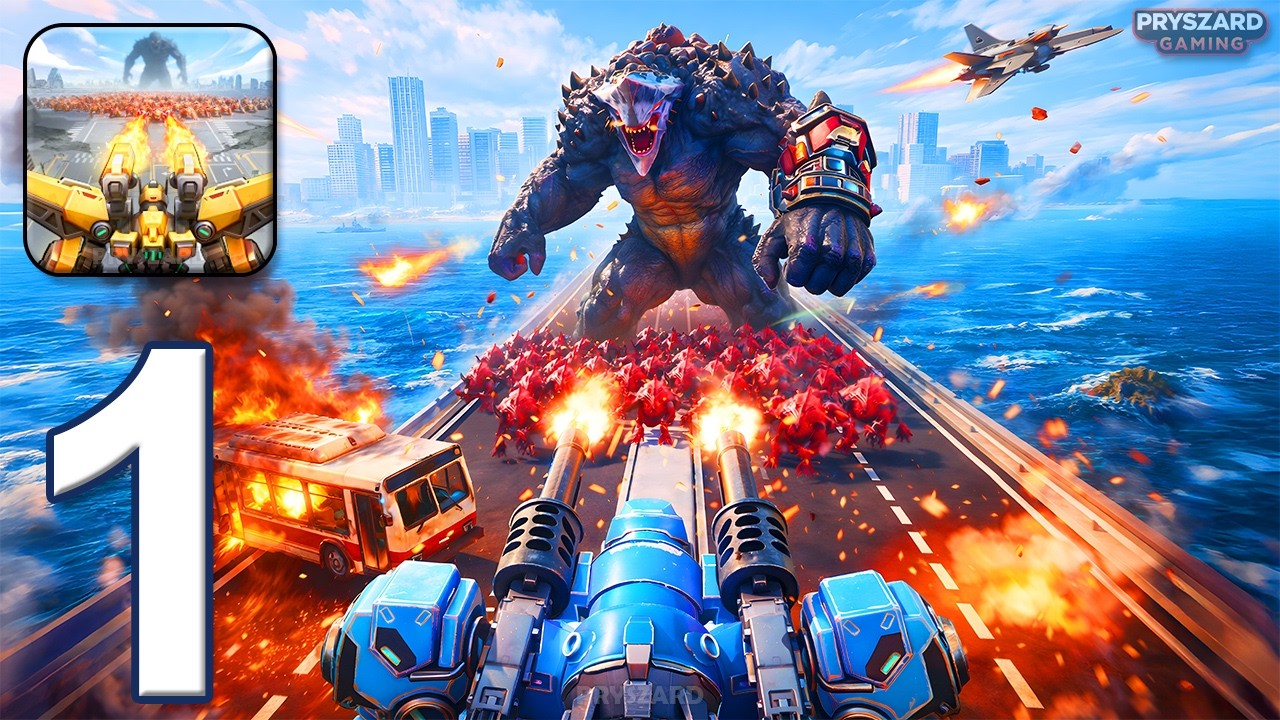
To succeed in Titan Rush: Survival, you must treat every combat encounter as a dynamic puzzle where your primary goal is to maintain a defensive perimeter far from your base. Success hinges on a "front-loaded" defensive philosophy: if you wait for enemies to reach your doorstep, you have already lost the strategic advantage. By mastering the lane-based deployment system, balancing your gold economy, and understanding the specific roles of your mech units, you can neutralize the encroaching abyss before your structural integrity is compromised.
Mastering the Lane-Based Combat System
Titan Rush: Survival utilizes a lane-based defense architecture. Enemies spawn on the right and move toward your base on the left. Your defensive threshold is the ultimate "fail state"—once an enemy reaches the far-left boundary, your base takes direct damage.
The game rewards proactive, rather than reactive, play. When an enemy icon or visual indicator appears on the right side of the screen, you should immediately assess the lane intensity. The most common mistake beginners make is deploying units too close to their own base. By deploying units closer to the enemy spawn point, you create a "buffer zone." This allows your mechs to engage in combat while giving you extra seconds to deploy support units if the lane becomes overwhelmed. Always view the screen as a series of individual battlegrounds; if one lane is clear, hold your gold to reinforce lanes under immediate threat.
Resource Management: The Gold Economy
Gold is the lifeblood of your survival. In Titan Rush: Survival, your gold generation is constant, but your deployment capacity is finite. To manage this effectively, follow these three rules:
- Avoid Over-Commitment: Resist the urge to flood a single lane with cheap units early on. If you spend all your gold on a minor wave in lane one, you will have nothing left to defend lane two or three, where a larger group might spawn seconds later.
- The "Reserve" Threshold: Always keep a small buffer of gold (roughly 20–30% of your maximum capacity) to react to unexpected enemy spawns. This reserve is your "emergency fund" for deploying a heavy-hitting unit to save a collapsing lane.
- Scaling vs. Spawning: As the waves progress, enemy health pools increase. Your gold expenditure must shift from high-volume, low-cost units to higher-tier mechs. If you find your units are dying too quickly, you are likely falling behind the "power curve" and need to prioritize saving for a high-damage unit rather than spamming weak ones.
Strategic Unit Placement and Synergy
Not all mechs are designed for the same task. Effective defense requires a mix of "Anchors" and "Strikers."
- Front-Line Anchors (High-HP Mechs): These units should always be placed first. Their primary role is to act as a damage sponge, forcing the enemy to stop moving and initiate a melee animation. By stalling the enemy in the middle of the lane, you provide your back-line units with the necessary window to deal damage safely.
- Back-Line Strikers (Ranged/DPS Mechs): These units have lower health but higher damage output. They should never be placed in front. If they are in the front, they will take damage meant for your high-HP units, leading to a quick loss of your offensive firepower.
- The Kill Zone Concept: The most efficient way to clear a wave is to overlap the attack range of your units. By placing a tanky mech just in front of a ranged mech, you create a "Kill Zone." The tank holds the enemy in place, while the ranged unit chips away at their health without being targeted.
Advanced Tactical Decisions
As you progress past the tutorial, the complexity of the enemy waves will increase. You will face "Swarm" enemies (many units with low health) and "Titan" enemies (single units with massive health pools).
Managing Swarm Waves
Against high-density waves, you need units with splash damage or high attack speed. Do not waste your heavy-hitting, slow-attacking units on swarm enemies; they are inefficient because they "overkill" individual targets, wasting their high damage potential on weak units while being swamped by the rest of the group.
Managing Titan Waves
Against singular, high-health threats, your goal is to chain your CC (crowd control) or high-DPS units. Use a "meat shield" of cheap units to keep the Titan occupied while your strongest units focus it down. If you do not have enough damage to kill the Titan before it reaches your base, you must utilize your lane-switching strategy to keep it occupied across multiple lane transitions.
Common Mistakes to Avoid
- Panic Deployment: Deploying units the moment you have enough gold, regardless of where the enemy is. This often leads to your units walking into enemy lines and dying before they can even engage.
- Ignoring the "Lane Shift": Many players tunnel-vision on the lane that currently has the most enemies. Always pan your camera across all lanes to ensure a secondary, smaller group isn't sneaking past a neglected lane.
- Unit Bloat: You cannot win by simply deploying every unit you have. If your units are dying faster than you can replace them, your strategy is flawed. Evaluate if you need more damage (strikers) or more durability (tanks) before the next wave begins.
Conclusion: The Path to Survival
Survival in Titan Rush: Survival is a game of efficiency. By optimizing your gold usage, understanding the specific role of each mech, and prioritizing proactive interception, you negate the abyss's ability to overwhelm your defenses. Remember: the base is your final line, not your starting line. Stay aggressive, keep your gold reserves healthy, and always build your kill zones in the middle of the lane. As you advance, continue to adapt your composition to the specific threat types, and you will find that even the most overwhelming waves can be managed with the right tactical approach.
Free Titan Rush: Survival Codes
Current active codes and how to redeem them.

Michael Smith
Michael covers live-service games, events, reward systems, and efficient daily routines, turning frequent updates into clear actions for players.
COMMUNITY
Player Comments
47 players commented on this guide.
This guide answered the exact question I had.
This saved me time in the early game.
This helped me understand resources much better.
Nice guide. I am checking the other Titan Rush: Survival articles next.