
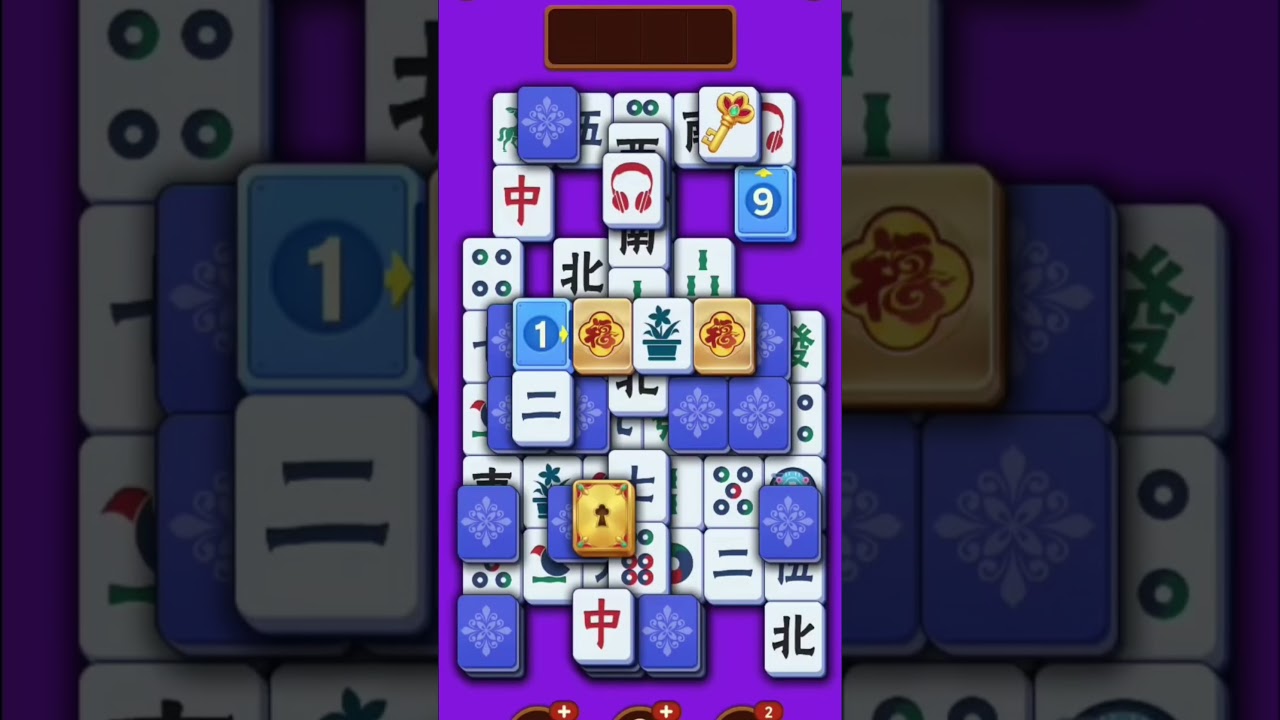
To clear lock and key tiles in Vita Mahjong, locate the key tile and match the specific stacks covering it before exhausting other matches on the board. Padlocked tile clusters remain frozen and unmatchable until the key tile is collected. Clearing peripheral pairs too early shrinks your available move pool and risks a dead end once the locked section finally opens.
How the Lock and Key Mechanic Works
Standard Vita Mahjong rules allow you to match any exposed tile that has an unblocked left or right edge and no tile resting on top. Lock tiles alter this rule:
- Locked tiles stay inactive: Even if both lateral edges and top surfaces are completely open, tiles marked with padlocks cannot be selected or paired.
- Keys trigger instant unlocks: Matching or collecting the key tile immediately triggers an unlock animation that removes all padlocks from that cluster, returning them to standard playable tiles.
- Clusters hold large inventories: Locked sections often contain deep stacks and essential matching pairs needed to clear the rest of the board.
Tapping locked tiles before retrieving the key will not clear them. Your board progression remains halted in that quadrant until the key is collected.
Step-by-Step Priority for Reaching Key Tiles
Do not clear obvious, easy matches on the sides of the board at the start of a stage. Instead, follow this clearing sequence:
- Locate the key tile: Scan the layout at the opening of the puzzle to find where the key is placed and whether it sits on an open layer or beneath a stack.
- Trace the covering path: Identify the exact tiles that rest directly on top of the key or block its exposed lateral edges.
- Clear path blockers first: Match only the tiles necessary to free the key. If two identical tiles are available to match with a third, choose the tile blocking the key over one located in an isolated wing.
- Collect the key immediately: Match the key tile as soon as it becomes accessible to unfreeze the locked stack right away.
| Board Element | State Before Key Collection | Role in Puzzle | Clearing Priority |
|---|---|---|---|
| Key Tile | Active or buried under open layers | Unlocks sealed tile clusters instantly | Highest |
| Path Blockers | Playable tiles covering or boxing in the key | Must be cleared to access the key | High |
| Locked Tiles | Inactive, grayed out, or padlocked | Holds matching pairs for late-stage clearing | Locked until key is matched |
| Peripheral Tiles | Open and freely matchable on outer edges | Safety reserve for matches when paths stall | Low to situational |
Preserving Free Pairs to Avoid Dead Ends
The primary failure point in lock-and-key stages is running out of valid moves. If you clear all outer matching pairs while digging toward the key, the newly unlocked tiles may have no compatible partners left on the table.
To prevent board lockouts:
- Save peripheral tiles as utility reserves: Leave accessible pairs on outer wings untouched unless you need them to clear a blocker directly obstructing the key.
- Inspect locked layers before unlocking: Check visible faces within the locked cluster. If an exposed blocker requires a specific symbol, check whether its partner is trapped behind the lock.
- Avoid burning tools prematurely: If the path to the key is temporarily blocked by an unmatched tile, use your peripheral reserve to find alternate legal moves before resorting to shuffle or undo tools.

Free Vita Mahjong Codes
Current active codes and how to redeem them.

Sarah Williams
Sarah specializes in RPG and collection games, explaining team building, character growth, and beginner-friendly ways to avoid expensive early mistakes.
COMMUNITY
Player Comments
79 players commented on this guide.
Good guide for Vita Mahjong players. The strategy part was useful.
Nice guide. I am checking the other Vita Mahjong articles next.
I tried this today and it worked better than my old setup.
This helped me understand strategy much better.