
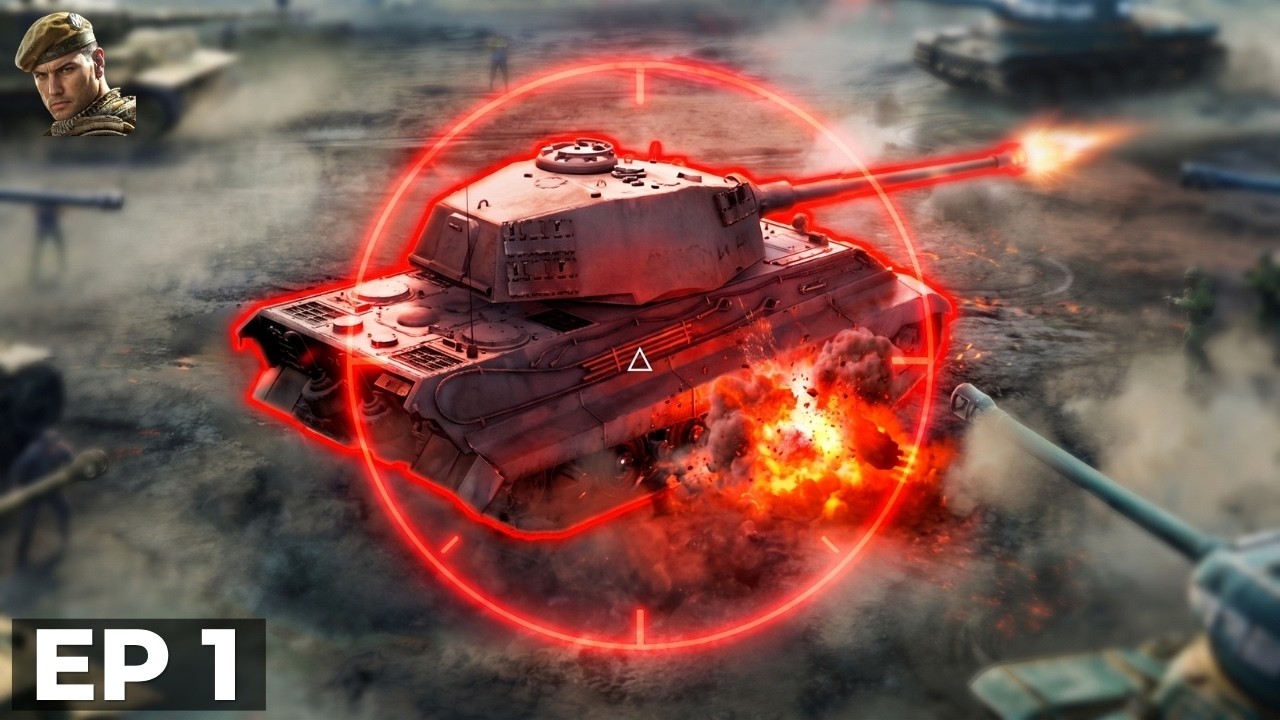
To dominate in Warline: Sniper Strike, players must move beyond basic marksmanship and embrace the game's unique fusion of tactical sniping and real-time strategy. Success hinges on your ability to maintain lane control through precise weapon loadouts and disciplined engagement patterns. By prioritizing weapons that balance stopping power with rapid follow-up capabilities, you can neutralize high-priority threats before they breach your defensive perimeter.
Mastering Sniper Rifle Selection for Lane Dominance
The backbone of your combat efficiency in Warline: Sniper Strike is your primary sniper rifle. Your choice here dictates the "rhythm" of your defense. When evaluating rifles, ignore raw damage numbers in isolation; instead, prioritize the time-to-kill (TTK) against standard infantry.
A rifle that deals massive damage but requires a three-second bolt-action cycle is often inferior to a semi-automatic model that can clear two targets in the same timeframe. When selecting your primary:
- Prioritize Stability over Burst: If a weapon’s scope drift is significant, your accuracy will plummet during high-intensity waves. Choose models with high base stability to ensure your follow-up shots land on target.
- Identify the One-Shot Threshold: Investigate which rifles can one-shot standard units at your current mission level. If a rifle leaves an enemy with 5% health, you are wasting ammunition and time. Upgrade that specific weapon until it hits the one-shot breakpoint.
- Assess Mobility: In missions with frequent flanking maneuvers, heavier rifles may slow your target acquisition speed. Always test how quickly your reticle snaps onto a target when you move from a stationary position.
Strategic Secondary Weapon Usage
Many players fail in Warline: Sniper Strike because they treat their secondary weapon as an afterthought. This is a fatal mistake. Your secondary weapon is your insurance policy against being overrun.
Your "break point" is the distance at which an enemy is too close for your sniper scope’s minimum zoom. Once an enemy crosses this threshold, your primary rifle becomes a liability due to tunnel vision. You must master the instant-switch mechanic:
- Map Out Distances: Learn the visual cue for when an enemy enters your "danger zone."
- Upgrade in Tandem: Do not neglect your secondary weapon’s damage stats. A high-level pistol or SMG can save your run when your primary rifle’s magazine is empty.
- Reload Cycling: If you are caught in a reload animation on your primary, switch immediately to your secondary to finish off low-health enemies. This keeps your DPS uptime at 100%.
Advanced Recoil and Fire Rate Mechanics
Recoil in Warline: Sniper Strike is not just a visual effect; it is a mechanical barrier to accuracy. Every weapon possesses a specific "recoil recovery" rate. If you fire as quickly as the trigger allows, your crosshair will naturally climb, causing you to miss subsequent shots.
To master your weapon’s rhythm:
- The "Wait-to-Settle" Technique: Instead of spam-firing, train yourself to wait the fraction of a second required for the reticle to return to the center point. This ensures every shot is a precision hit rather than a spray-and-pray attempt.
- Manual Compensation: For high-caliber rifles, develop the muscle memory to pull your aim downward slightly after each shot. This counteracts the upward kick, allowing you to stay locked onto enemy heads.
- Shot Pacing: In low-density waves, prioritize slow, deliberate, accurate shots. In high-density "swarm" scenarios, accept a slight decrease in accuracy for a higher fire rate to suppress the enemy advance.
Tactical Utility and Positioning
Weapon choice must align with your environment. Warline: Sniper Strike features diverse sectors, and a weapon optimized for open-field sniping will perform poorly in urban corridors.
- High-Ground Advantage: Always prioritize positioning that grants you a clear line of sight over the entire lane. If your current rifle has a variable zoom, use the lowest setting for close-range sectors and max zoom for long-distance defense.
- Terrain Awareness: If you find yourself constantly struggling with vision, your scope magnification is likely too high for the map geometry. Adjust your loadout between missions to account for the physical constraints of the sector.
- Managing Enemy Density: When facing large waves, prioritize weapons with higher magazine capacities. Nothing ends a successful run faster than a forced reload while three enemies are rushing your position.
Resource Management and Long-Term Upgrades
Progression in Warline: Sniper Strike requires careful resource allocation. You will rarely have enough materials to keep every weapon in your inventory at peak performance.
- The "Workhorse" Strategy: Select one primary and one secondary weapon to serve as your "workhorse" pair. Focus 80% of your upgrade materials on these two items. This guarantees that your damage output keeps pace with the increasing health pools of late-game enemies.
- Prioritize Damage and Stability: When upgrading, ignore minor buffs like reload speed or clip capacity until you have maximized raw damage and stability. These two stats are the primary determinants of your win rate.
- Test Before Investing: Before committing your hard-earned resources to a new weapon, run a low-level mission to test the feel of the recoil and the utility of its scope. If the weapon doesn't "click" with your playstyle, do not sink materials into it.
By focusing on these tactical fundamentals, you will significantly improve your efficiency in Warline: Sniper Strike. Remember, the game rewards the player who maintains their composure and disciplines their fire over the player who relies on raw firepower alone. Maintain your lane, master your recoil, and always keep your secondary ready.

Free Warline: Sniper Strike Codes
Current active codes and how to redeem them.

James Brown
James focuses on Android gaming on PC, emulator setup, controls, performance tuning, and practical troubleshooting for longer play sessions.
COMMUNITY
Player Comments
153 players commented on this guide.
I wish I had read this before upgrading the wrong thing.
This saved me time in the early game.
This helped me understand strategy much better.
I tried this today and it worked better than my old setup.