
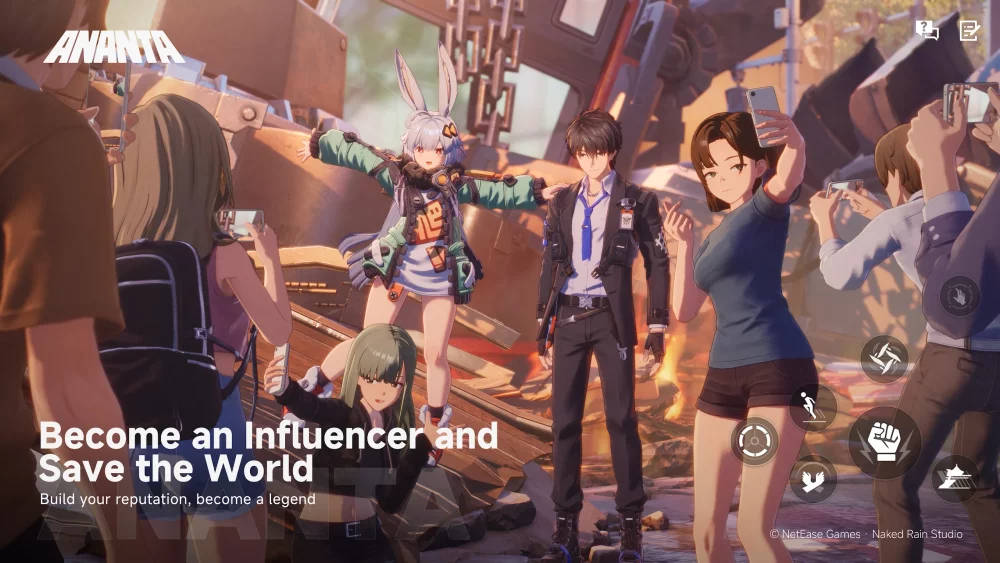
In the strategic simulation and high-intensity combat world of ANANTA, success is rarely found by standing still. Combat is a rhythmic, high-speed discipline where static positioning is a liability. To thrive, you must view your character not as a stationary turret, but as a kinetic force that uses the environment and animation sequences to sustain pressure. This guide explores the mechanical interplay between traversal and offensive output, providing you with the expert insights needed to master the flow of battle.
Understanding the ANANTA Combat Rhythm
The core of combat in ANANTA lies in the transition between offensive actions and movement. New players often fall into the trap of completing full attack animations before initiating movement. This "animation lock" leaves you vulnerable to counter-attacks and slows your overall damage-per-second (DPS) output.
High-level play in ANANTA requires "animation canceling." By inputting a traversal command—such as a dash, jump, or vault—immediately after an attack’s impact frame, you truncate the recovery animation. This allows you to reset your position while your character model is still technically "finishing" the previous strike, creating a fluid, uninterrupted stream of movement and damage.
The Flow State: 3 Keys to Chaining
- Input Buffering: Learn the timing of your primary attack animations. Input your movement command just as the damage number registers on the screen.
- Directional Weaving: Never dash in a straight line. Use your dash to pivot 90 or 180 degrees around your target to force them to manually adjust their camera and aim.
- The Skill-to-Movement Loop: Always trigger abilities while in motion. Abilities that can be activated mid-air or mid-dash are superior because they do not require you to sacrifice your momentum.
Leveraging Environmental Traversal as a Weapon
In ANANTA, the environment is a primary tactical resource. The game’s arenas are built with verticality and complex geometry specifically to reward players who look up or utilize wall-geometry.
When engaged in a skirmish, stop looking at the floor and start looking for "anchor points"—ledges, crates, or walls that can be vaulted. By jumping off a wall toward an enemy, you can engage from an aerial angle that is difficult for most players to track. This verticality isn't just for movement; it acts as a defensive reset. If you are low on health, a high-speed vertical ascent often breaks line-of-sight faster than lateral movement, allowing you to reposition or heal safely.
Momentum as a Defensive Resource
In ANANTA, momentum is your primary defensive stat. The faster you move, the harder you are to hit. Many enemy abilities, both AI and player-controlled, rely on predictive pathing. If you move in a predictable, linear fashion, you are essentially walking into damage.
- Maintain Velocity: Use your dash not just for closing gaps, but for "jitter-stepping"—rapid, short-range dashes in non-linear directions during a firefight.
- The High-Ground Tax: When you hold the high ground, you dictate the pacing of the encounter. You can choose when to drop down for an aggressive strike or when to stay elevated to observe the battlefield.
- Avoid "Stopping" Frames: Every time you stop moving to cast a long-range skill, you become a target. Learn which of your skills have the shortest "cast-to-move" recovery time and prioritize those during intense combat.
Tactical Decision-Making in Arena-Specific Challenges
Not every ANANTA map allows for the same movement style. To maintain a competitive edge, you must adapt your movement strategy to the geometry of your current arena.
Adapting to Map Geometry
- Cramped/Indoor Arenas: In tight corridors, verticality is limited. Your focus here should be on "corner-peeking" and dash-canceling. Use dashes to peek around a corner, fire a burst, and dash back into cover.
- Open Plazas: In wide-open spaces, speed is king. Utilize long-range movement abilities to circle your targets. If you find yourself in the center of an open area, you are in danger; always prioritize moving toward the perimeter or a piece of cover.
- Vertical Zones: If the map is layered, your ability to quickly switch between levels is your greatest asset. Use your jump-vaults to rotate between layers, forcing your opponents to constantly re-orient their vertical aim.
Common Mistakes to Avoid
Even experienced players often fall into habits that limit their potential in ANANTA. Avoiding these three common pitfalls will immediately improve your win rate:
- Over-committing to a Combo: Players often try to land a full three-hit combo even when the enemy has already started a counter-attack. Learn to cut your combo short to dodge. A partial combo you survive is better than a full combo that leads to your death.
- Dashing Toward the Target: Dashing directly at an opponent makes you an easy target for shotgun-style or melee attacks. Always dash at an angle or behind the target to force them to turn their character.
- Ignoring Sound Cues: ANANTA is an audio-rich experience. Listen for the sound of enemy traversal (dashes and jumps). If you hear an enemy dash, they have entered their "cooldown" phase where they are most vulnerable. That is your window to strike.
Final Strategy: The "Hit-and-Shift" Philosophy
The ultimate goal in ANANTA is to create a "Hit-and-Shift" loop. You strike, you move to a new position, you strike again. By never staying in the same coordinate space for more than two seconds, you force your opponents to play a reactive game. When they are reacting to your movement, they aren't focusing on their own offensive rotations, which gives you the opening you need to secure victory.
Mastering these mechanics takes practice, but by treating ANANTA as a game of kinetic flow rather than static button-mashing, you will find yourself outperforming players who rely solely on gear or raw stats. Keep moving, stay vertical, and dictate the tempo of every engagement.

Free ANANTA Codes
Current active codes and how to redeem them.

Emily Johnson
Emily writes practical mobile strategy guides with a focus on resource planning, base progression, and the early decisions that shape a long-term account.
COMMUNITY
Player Comments
51 players commented on this guide.
Can you add more details about strategy in a future update?
This guide answered the exact question I had.
Nice guide. I am checking the other ANANTA articles next.
This saved me time in the early game.