
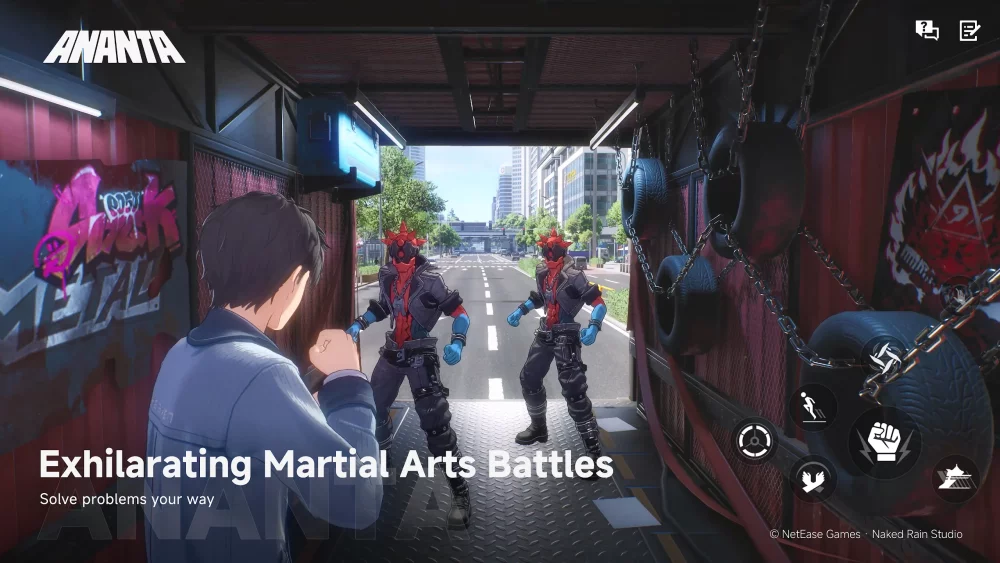
In ANANTA, the environment is far more than a static backdrop for your progression; it is a complex, reactive system designed to reward players who understand its underlying physics. To truly excel, you must pivot away from standard movement patterns and begin treating every crate, barrier, and architectural feature as an interactable asset. By mastering the art of environmental manipulation, you can bypass traditional choke points, solve intricate spatial puzzles, and maintain a seamless flow of movement that keeps you ahead of the game's challenging pacing.
Understanding the Physics Engine in ANANTA
The core of ANANTA’s gameplay loop lies in its physics-enabled environment. Unlike many simulation or strategy games where obstacles are binary—either pass-through or blocked—ANANTA uses a weight and friction system that dictates how objects behave.
When you encounter an object, its movement is governed by its mass and your character’s current velocity. Understanding this is crucial for efficient navigation. Heavy objects require more force—often gained by building momentum before impact—while lighter objects can be nudged with precision. Recognizing these physics properties allows you to clear paths without losing valuable time, turning what might look like a dead end into an improvised bridge or a cleared pathway.
Strategic Object Manipulation: Clearing the Path
Success in ANANTA often comes down to your ability to recognize which items are meant to be moved. The game’s visual language is specifically designed to highlight these objects.
- Visual Contrast: Look for objects with slightly higher saturation or unique lighting reflections. If an item looks "cleaner" or more detailed than the surrounding debris, it is likely a physics-based asset.
- Collision Feedback: As you move, pay attention to the subtle wobbles or rattles. If a crate tilts when you brush against it, the game is signaling that this object is not nailed to the floor.
- Audio Cues: The sound engine provides vital feedback. Listen for metallic scraping or the muffled thud of plastic or wood. These sounds confirm that an object has hit a physics threshold and can be pushed or pulled.
By actively clearing "loose" clutter in corridors, you prevent the common issue of getting snagged during high-speed traversal, ensuring your character maintains a consistent rhythm.
Exploiting Verticality for Faster Progression
Verticality in ANANTA is not just aesthetic; it is a mechanical shortcut. Many of the game's most difficult puzzles are bypassed entirely if you learn to "climb the geometry."
Look for pipes, narrow ledges, and stacked environmental assets. These are often placed as deliberate "stepping stones" by the developers. When you reach a height barrier, don't immediately look for a switch or a door. Instead, scan the walls for textures that suggest interactable surfaces. If you can identify these sequences, you can reach higher tiers of the game world, effectively bypassing combat-heavy zones or gated floor-level paths that require more tedious resource management to open.
Maintaining Momentum During Interaction
One of the most common mistakes in ANANTA is stopping to interact with the world. Stopping breaks your momentum and resets your "flow state," which can make navigating complex environments feel sluggish.
To play efficiently, you must master "on-the-fly" manipulation. This involves vaulting or sliding while simultaneously nudging objects out of your way. By incorporating these actions into your movement, you maintain your kinetic energy.
- Sliding into objects: Use the slide mechanic to push aside mid-sized obstacles without losing your running speed.
- Vault-and-nudge: When vaulting over a low obstacle, shift your camera angle to push light debris aside mid-air.
This requires practice, as it demands high precision while moving at speed, but it is the fastest way to traverse the game’s layered environments.
Solving Spatial Puzzles Through Repositioning
When you encounter a hard stop in progression, you are likely facing a spatial puzzle. These are rarely solved by finding a key; they are solved by rearranging the room.
If you are stuck, stop moving and analyze the environment for "anchor points." These are specific locations where an object needs to be placed to trigger a mechanism or create a bridge.
- Survey the room: Identify all movable objects.
- Determine the weight: Is the object heavy enough to hold down a pressure-sensitive trigger?
- Calculate the trajectory: If you need to move an object to a high ledge, can you use other, smaller objects to create a ramp?
Treating the environment as a set of building blocks is the key to solving ANANTA’s most complex gating systems. Remember: if the game provides an object, it has a purpose. If you don't immediately see that purpose, look at it from a different angle or try moving it to a different area of the room.
Avoiding Common Mistakes
Even experienced players fall into traps that hinder their efficiency. Here is how to avoid them:
- The Over-Search Trap: Don't waste time inspecting every single object. Focus only on those that show signs of physics feedback. If an object doesn't rattle or move when you collide with it, it is likely static geometry.
- Ignoring the Shadow/Lighting Cues: Sometimes the most important interactable objects are hidden in the shadows. Use your flashlight or adjust your gamma to spot the subtle silhouettes of movable items.
- Neglecting the "Reset" Potential: If you accidentally push a key object into a corner where it cannot be reached, don't panic. Simply moving far enough away from the area usually triggers a reset of the physics assets, allowing you to try the puzzle again with a clean slate.
Final Thoughts on ANANTA Mastery
Mastering the environment in ANANTA is a process of unlearning traditional "door-and-key" logic. The game rewards those who experiment with the physics engine. By consistently prioritizing your momentum, keeping an eye out for visual cues, and treating every object as a potential solution to a spatial problem, you will find that the world of ANANTA becomes a playground rather than a series of barriers. Practice your movement-interaction rhythm, stay observant, and always look for the vertical path—that is where the most efficient routes are hidden.

Free ANANTA Codes
Current active codes and how to redeem them.

Emily Johnson
Emily writes practical mobile strategy guides with a focus on resource planning, base progression, and the early decisions that shape a long-term account.
COMMUNITY
Player Comments
39 players commented on this guide.
I wish I had read this before upgrading the wrong thing.
This helped me understand base building much better.
The explanation is clear, especially for beginners.
Can you add more details about base building in a future update?