
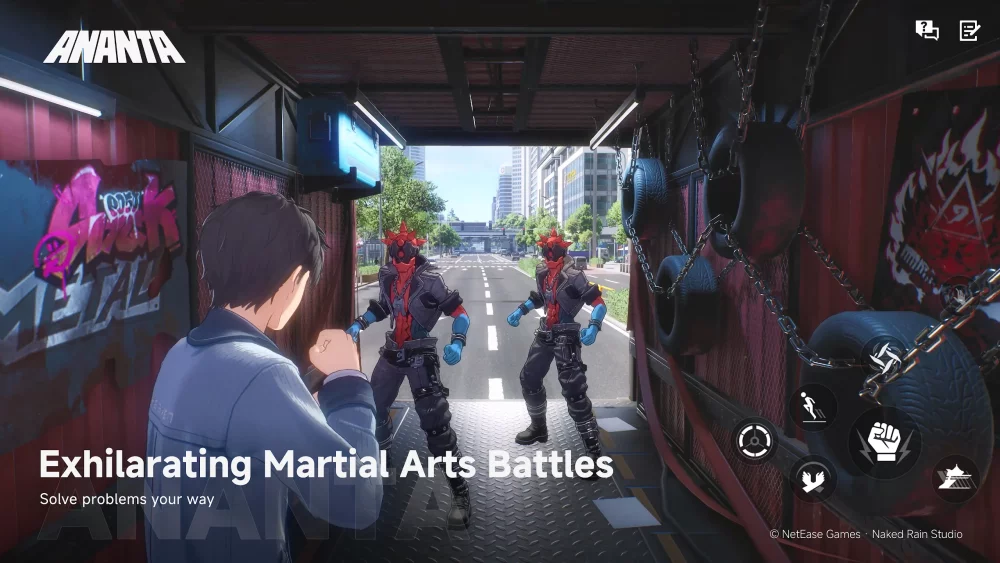
In ANANTA, the strategic simulation experience is defined by your ability to manage resources and operations across two distinct urban landscapes: Xinke and Chongxiao-Lingyun. Mastery of the game does not come from combat prowess alone; it is born from your logistical efficiency and your understanding of the unique spatial dynamics of these two iconic cities. Whether you are optimizing long-term project development or navigating critical mission paths, understanding how to transition and operate within these environments is the difference between a thriving organization and a stagnant one.
The Geography of Success: Xinke vs. Chongxiao-Lingyun
To maintain a competitive edge, players must recognize that ANANTA treats Xinke and Chongxiao-Lingyun as functional opposites.
Xinke is designed around horizontal expansion and sprawling infrastructure. It is the ideal environment for high-volume resource collection and wide-area logistics management. The city’s layout encourages players to establish stable, defensible nodes that facilitate consistent production. When operating in Xinke, focus on breadth; your goal is to connect disparate districts to build a robust economic network.
Chongxiao-Lingyun, conversely, is defined by its intense verticality. This city demands a shift in tactical thinking. Navigation here is not about the distance between points on a map, but the elevation gain and architectural accessibility. The vertical layers of Chongxiao-Lingyun often hide critical resources and project opportunities that are inaccessible from the ground level. Mastering this city requires a keen eye for pathways that bypass conventional congestion, turning the environment into a tool for rapid deployment.
Strategic Squad Deployment and Mobility
A common mistake for new players is tethering a "main team" to a single city. ANANTA is a game of shifting priorities, and your squad composition should mirror the environment you are currently navigating.
Deployment Principles
- Terrain-Matched Specialization: Assign units with high-mobility or climbing-focused perks to your Chongxiao-Lingyun squads. In Xinke, prioritize units with high carry capacity or area-control abilities, as these are essential for managing the expansive, open-street combat encounters.
- Dynamic Rotation: Do not allow your units to stagnate. If you find your progress slowing in one city, it is often a sign that your current squad is ill-suited to the urban architecture. Rotate your specialists to ensure that your team’s unique strengths are always aligned with the geography.
- The Logistical Buffer: Always keep a "flexible squad" ready for rapid transit. Because moving between Xinke and Chongxiao-Lingyun requires deliberate time allocation, having a team that can handle both environments prevents you from being caught off-guard by emergent, multi-city objectives.
Mastering Environmental Traversal
In ANANTA, traversal is a strategic skill, not a background process. To optimize your objective completion speed, you must view the cities as a collection of vectors rather than static backdrops.
Efficient Pathfinding Strategies
- Scout the Verticality: In Chongxiao-Lingyun, look for elevators, ventilation shafts, and scaffolding that act as shortcuts. Players who spend time identifying these "vertical veins" can cut transit time by up to 30% compared to those who stick to the primary street-level paths.
- Xinke’s Flow Control: In Xinke, traffic density is your primary enemy. Utilize off-peak hours (in-game time) to move large resource loads. Map out the high-density combat zones and treat them as obstacles to be routed around, rather than through.
- The Hub-and-Spoke Approach: Identify the central point of each city that connects to the transit gateway. By basing your primary operations near these hubs, you significantly reduce the "travel overhead" when the game demands you switch between the two urban centers.
Planning for Long-Term Progression
As you prepare for the global launch on January 15, 2027, your success will be predicated on how quickly you synthesize the game’s geographical information. Treat the early-game period as a mapping exercise. Do not focus solely on your current objective; take time to document where the transit nodes are located and how the architecture of each city impacts your movement speed.
Decision-Making Under Pressure
When a time-sensitive event triggers in a different city, you must immediately assess the cost-benefit of that mission. Is the reward worth the logistical disruption of moving your team?
- If the mission is critical: Use your most mobile units to reach the location, even if they aren't your strongest combatants. Reach is often more important than raw power in time-sensitive scenarios.
- If the mission is secondary: Utilize your regional specialists who are already stationed in that city. Never move your entire operation across the map for a minor objective, as the time lost in transit can lead to a compounding deficit in your primary project goals.
Common Pitfalls to Avoid
Even seasoned strategy gamers can fall into traps when navigating the complexities of ANANTA. Avoid these common errors to stay ahead:
- The Static Mindset: Treating Xinke and Chongxiao-Lingyun as "level 1" and "level 2" zones is a mistake. Both cities have high-level challenges; the difference is in the style of play, not the difficulty curve.
- Ignoring Environmental Clues: The game hides context-rich information in the environment. If you are rushing through the streets, you will miss the clues that reveal hidden pathways or shortcuts. Spend your first few hours of gameplay simply observing the flow of the city.
- Underestimating Transit Time: Every move between cities has a cost. Factor this cost into your project timelines. A task that takes one hour in-city might take three hours when you factor in the transit time required to get your team there.
By internalizing the structural differences between Xinke and Chongxiao-Lingyun, you transform the world of ANANTA from a series of obstacles into a playground for your strategic ambitions. Focus on maintaining a flexible roster, mapping the urban veins of each district, and prioritizing tactical movement over brute-force navigation. As you head toward the global launch, this foundational knowledge will ensure your rise to the top of the competitive landscape.

Free ANANTA Codes
Current active codes and how to redeem them.

Emily Johnson
Emily writes practical mobile strategy guides with a focus on resource planning, base progression, and the early decisions that shape a long-term account.
COMMUNITY
Player Comments
97 players commented on this guide.
Nice guide. I am checking the other ANANTA articles next.
I tried this today and it worked better than my old setup.
Can you add more details about strategy in a future update?
Good guide for ANANTA players. The strategy part was useful.