
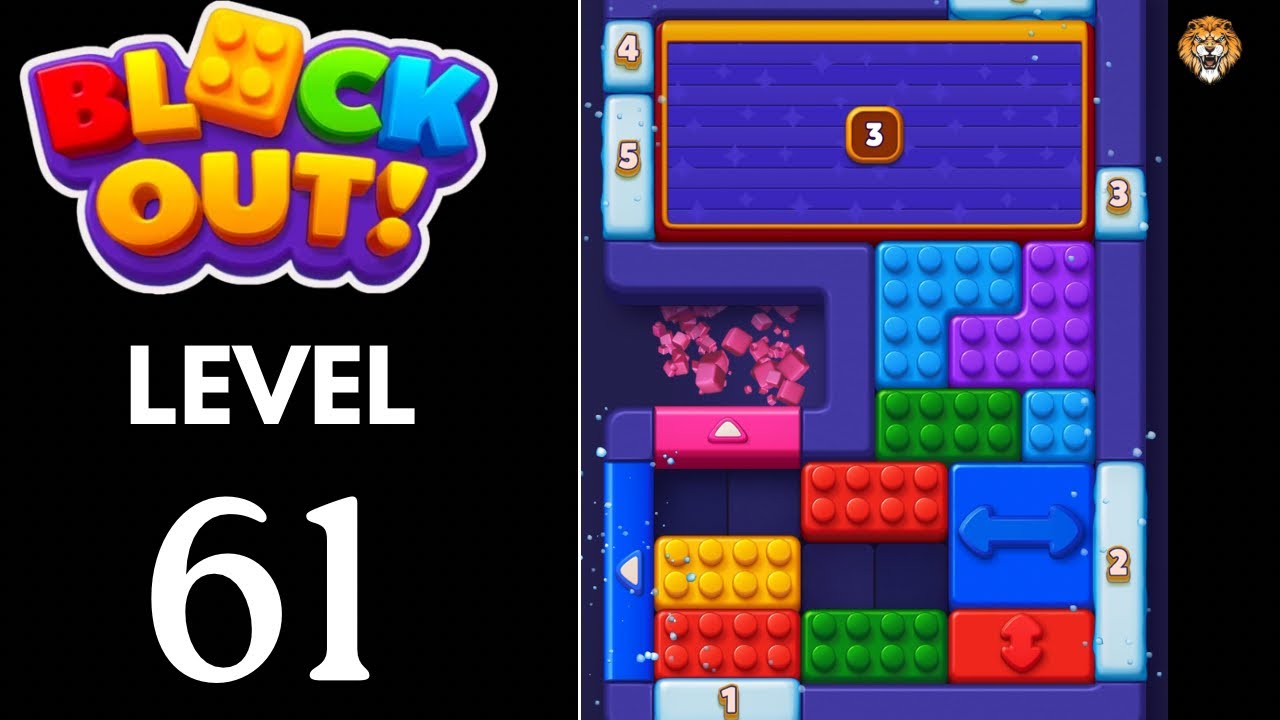
To clear Level 61 in Block Out, your immediate objective is to empty a single tube completely to create a working buffer. Once an empty tube is secured, use it exclusively as a temporary transit lane to unearth buried base colors and merge matching segments. Never scatter mixed single blocks across the board, as filling your open spaces without completing matches leads directly to an unsolvable deadlock.
How to Empty Your First Buffer Tube
Level 61 starts with nearly every tube filled with fragmented, mixed-color layers. Because blocks can only be placed on top of an identical color or into an entirely empty tube, your initial movement options are strictly limited.
To generate an empty tube without locking your board:
- Scan for minimal variety: Identify the tube that contains the fewest distinct color layers (ideally only two colors).
- Check for open landing spots: Look across the board to confirm that the top blocks in that target tube can immediately shift onto matching colors at the top of adjacent stacks.
- Transfer the top layers: Move those blocks directly onto matching stacks.
- Preserve the empty slot: Once the target tube is cleared of all blocks, leave it vacant. Do not place an arbitrary block into it unless that move immediately uncovers another block that can be matched elsewhere.
Priority Order for Uncovering Buried Colors
After establishing a buffer tube, focus on revealing base colors that are trapped beneath single-unit caps. Level 61 splits major color groups across multiple tubes, hiding key foundation blocks at the bottom of tall columns.
- Target large foundations: Check the bottom segments of each column. If two columns share the same foundation color (such as blue), prioritize clearing the caps off those specific tubes over shifting miscellaneous tiles.
- Cycle through the buffer: Move an obstructive cap into your empty buffer tube only if doing so lets you instantly move the revealed block onto a matching column.
- Consolidate immediately: Transfer matching segments together as soon as they become accessible. Combining identical blocks reduces overall stack height and restores headroom across your columns.
Consolidating Stacks Without Locking the Board
As mid-game clearing reduces board clutter, shift from uncovering pieces to assembling complete color sets. A tube completes and locks permanently once it holds four segments of the same color.
| Sorting Phase | Target Objective | Operational Rule |
|---|---|---|
| Opening | Empty a single tube | Transfer top blocks only if they land on an existing matching color. |
| Mid-Game | Expose buried base layers | Use the buffer tube temporarily to free up trapped matching segments. |
| End-Game | Lock finished stacks | Fill four-block tubes permanently only when remaining tubes retain enough headroom. |
Finalizing a stack removes that tube from play. If you lock a tube too early while multiple mixed colors are still scattered across the rest of the board, you eliminate a potential buffer space. Before locking your first four-block stack, confirm that your remaining unsolved tubes have enough empty capacity to handle the rest of your transfers.
Preventing and Recovering from Deadlocks
Deadlocks in Level 61 typically occur from mismanaging column headspace rather than running out of matches.
- Avoid splitting colors: Placing identical blocks into two separate partially filled tubes doubles the space they consume. Always combine matching blocks into the same column whenever possible.
- Do not strand blocks in the buffer: Never move a block into your empty tube if its matching partner is buried at the bottom of an untouched stack. An unusable buffer reduces your operational capacity to zero.
- Recovering from mistakes: If every column shows a different top color and no legal transfers remain, use the in-game undo function to step back to the moment your buffer tube was completely empty. If undo is unavailable, restart Level 61 and prioritize clearing base colors before locking any full stacks.

Free Block Out Codes
Current active codes and how to redeem them.

Sarah Williams
Sarah specializes in RPG and collection games, explaining team building, character growth, and beginner-friendly ways to avoid expensive early mistakes.
COMMUNITY
Player Comments
107 players commented on this guide.
This guide answered the exact question I had.
Nice guide. I am checking the other Block Out articles next.
This helped me understand early game much better.
The explanation is clear, especially for beginners.