
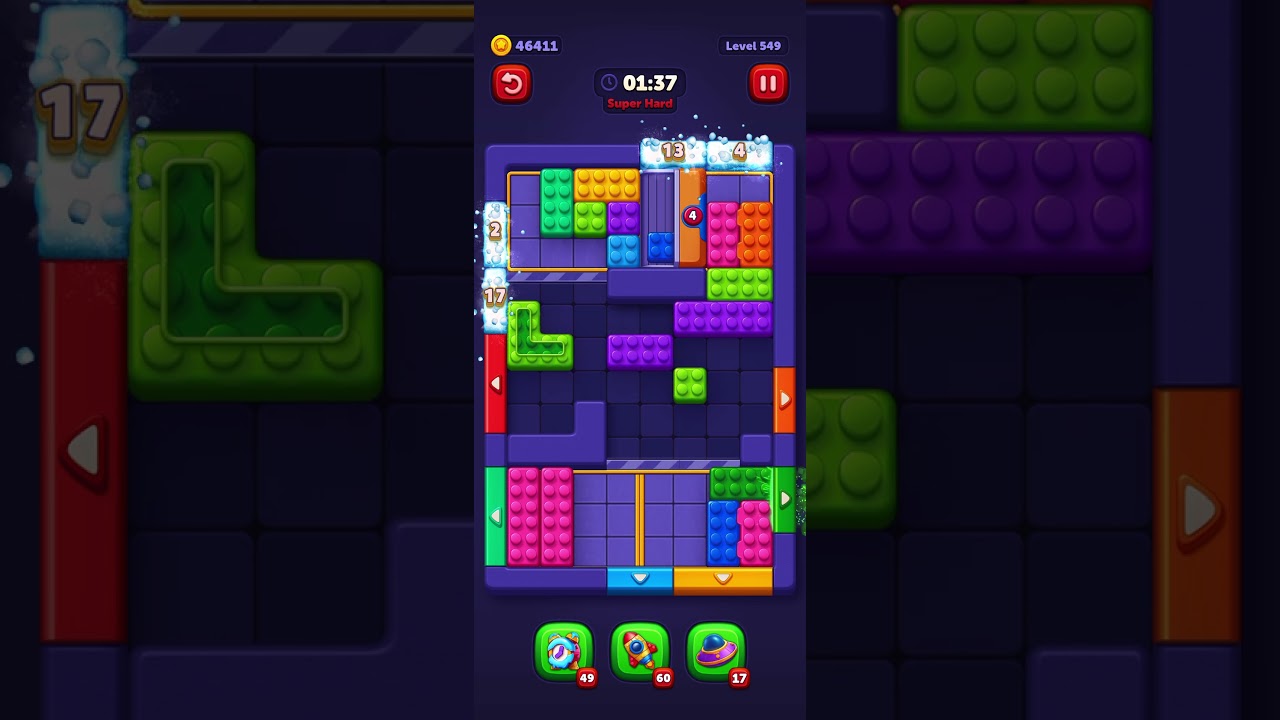
To clear Level 549 in Block Out, open a fully vacant column as early as possible, use that empty tube strictly as a temporary transit buffer, and avoid dropping mismatched blocks onto split stacks. Success requires identifying buried base colors before moving pieces, merging exposed matching blocks on the top layer, and systematically building four-block stacks from the bottom up.
Core Rules for Managing Buffer Columns
Empty columns serve as temporary sorting buffers rather than permanent storage. Committing an isolated block into an empty tube without an immediate follow-up move limits your board mobility and risks an early deadlock.
Apply these sorting rules on Level 549 to keep your columns functional:
- Reserve empty tubes for active chains: Only move a single cap block into an empty space if that action immediately uncovers a matching block that can transfer onto an existing column.
- Consolidate identical colors immediately: Once a color enters an empty column, move all other accessible blocks of that same color into that space to maximize room across the board.
- Avoid secondary split stacks: Never divide the same color across multiple partially filled columns. Group matching segments into a single target tube.
- Keep one column cycling: Designate one tube as your rotating shuttle, clearing it out as soon as a color transfer finishes so it remains ready for the next extraction.
Three-Phase Progression Strategy
Clearing Level 549 requires dividing the puzzle into three clear phases: establishing your initial buffer, consolidating mono-color stacks, and closing out the remaining tubes.
Phase 1: Clear the First Column
Scan the top layer of all columns to locate pairs of matching colors that can merge immediately without using an empty tube. Executing these direct merges frees space at the tops of your stacks.
Next, choose a nearly empty column or a stack where a single non-matching cap hides a large group of identical blocks. Move the cap into an open slot, then transfer the exposed blocks onto their matching color column elsewhere. Repeat this peeling process until one column is emptied completely down to its base. This vacated tube becomes your operational buffer.
Phase 2: Consolidate Primary Color Stacks
Once a permanent empty column is open, target stacks with solid single-color bases. Designate each as the permanent home for that specific color.
Use your buffer column to temporarily hold blocking segments while you extract buried pieces. Once a matching color is uncovered, transfer it directly onto the designated base stack. Work through one or two colors at a time rather than shifting pieces across the entire board at once.
Phase 3: The Closing Cascade
When a column reaches four matching blocks, it seals and leaves active play. This cleans up board clutter, but it also reduces the total number of columns available for maneuvering. Focus on the remaining mixed columns with the shallowest mismatches—stacks where removing only the top block exposes a uniform base. Lift the top cap, deposit the exposed stack into its matching tube, and place the cap into its final group.
| Sorting Phase | Primary Objective | Key Risk to Avoid |
|---|---|---|
| Phase 1: Opening | Clear one column down to its base to create a buffer | Dropping mismatched blocks into empty slots without a follow-up |
| Phase 2: Mid-Game | Build complete four-block stacks on matching base colors | Splitting identical colors across multiple half-filled columns |
| Phase 3: Endgame | Clear shallow top caps to route final blocks home | Sealing tubes while matching colors remain trapped underneath |
Avoiding Trapped Blocks and Deadlocks
Deadlocks on Level 549 occur when a player places a block on top of a different color without a clear plan to remove it. In Block Out, placing a block on top of a different hue traps the lower segment until the upper layer is cleared.
Before moving any block onto an active stack, check two moves ahead:
- Confirm that the move either completes a matching group or directly unblocks a critical piece below.
- Ensure you have an available empty space or a matching top layer ready to receive the capping block once it needs to move again.
- Never cover a base color with two different conflicting layers if your buffer tube is already occupied, as this eliminates any route to reach the bottom blocks.
Free Block Out Codes
Current active codes and how to redeem them.

Emily Johnson
Emily writes practical mobile strategy guides with a focus on resource planning, base progression, and the early decisions that shape a long-term account.
COMMUNITY
Player Comments
41 players commented on this guide.
Can you add more details about early game in a future update?
I tried this today and it worked better than my old setup.
Good guide for Block Out players. The early game part was useful.
The tips are practical and easy to follow.