
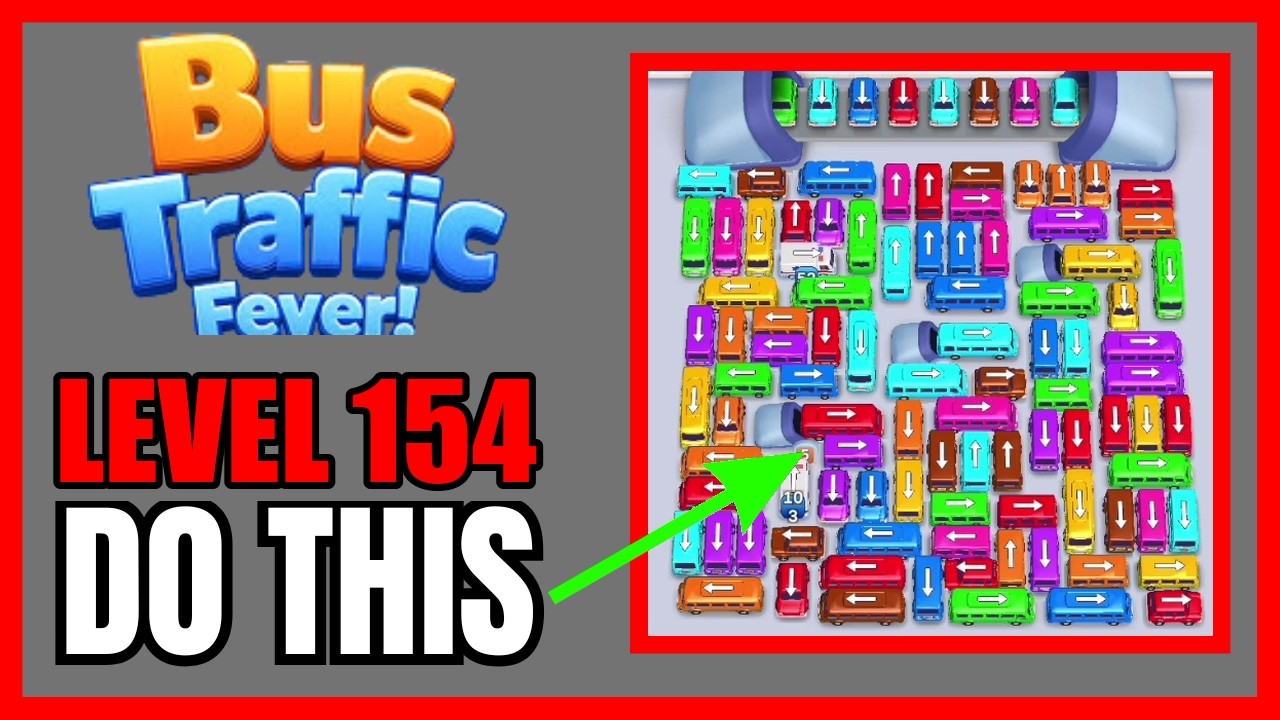
To beat Level 154 in Bus Traffic Fever! on your first try without spending hints, align every vehicle departure with the colors waiting in the passenger line. You lose the level if your docking bays fill with idle buses, so never tap an open bus unless it either picks up passengers immediately or directly unlocks a trapped bus that can.
---
Read the Passenger Queue First
Before tapping any vehicle, inspect the passenger queue from front to back. Passengers board strictly in arrival order. A bus matching the front of the line loads instantly and drives off, while a bus matching passengers further back sits in a holding bay until the line moves.
| Queue Position | Tactical Objective | Dock Bay Risk |
|---|---|---|
| Front Passengers | Match with clear perimeter vehicles for immediate clearance. | Zero: Loads and departs immediately without occupying a bay. |
| Middle Queue | Move blockers only if they expose buses sharing these colors. | Low: Occupies a bay temporarily until the front passengers clear. |
| Tail Passengers | Leave matching buses parked until the end of the puzzle. | High: Causes terminal gridlock by idling in a bay indefinitely. |
---
Step-by-Step Clearing Sequence
Level 154 features an interior grid locked in by perimeter vehicles facing opposing directions. Dismantle the grid in three disciplined phases:
- Clear Immediate Perimeter Matches:
Scan the outer edge for buses with unobstructed exit arrows whose colors match the front passengers. Dispatch these first. Because they board instantly, they exit without using holding bay slots, opening outer turn lanes for interior traffic.
- Sacrifice Bay Slots to Break Central Bottlenecks:
Once immediate direct exits are exhausted, identify the interior buses needed for the next passengers in line. If a non-matching bus blocks two or more required vehicles, send that blocking bus into a holding bay. Only make this move if the freed bus can board immediately or clear the next passenger set.
- Evacuate the Remaining Lot:
With the center unlocked, check the remaining tail of the passenger line. Route perimeter stragglers first to give deep corner buses clear turning paths, ensuring the remaining bays stay open through the final board clear.
---
Holding Bay Rules to Prevent Gridlock
Dock saturation is the primary failure condition on Level 154. Managing your buffer slots separates a first-try win from a failed attempt:
- Maintain a two-bay buffer: Keep at least two holding bays empty throughout the mid-game to absorb necessary blocker moves.
- Halt non-matching moves at one bay: If only one bay remains open, never dispatch a non-matching vehicle unless that exact move frees an immediate boarding bus that clears the queue.
- Count passenger capacity: Confirm the visible queue contains enough matching riders to fill the departing bus completely so it does not linger half-empty in a bay.
- Prioritize early-queue blockers: When forced to move one of two blocking buses into a bay, always move the one whose color appears earlier in the passenger sequence.
---
Recovering From a Stalled Board
If your holding bays are nearly full and play stalls, stop tapping vehicles based on open direction arrows alone. An open arrow pointing outward is a trap if the bus color belongs to the back of the queue.
To break a stall without boosters:
- Identify the specific passenger color currently stuck at the boarding gate.
- Trace backward into the lot to locate the vehicle matching that passenger.
- Count the minimum vehicle moves required to open an exit lane for that matching bus.
- If you have only one empty bay, commit it only if the extracted bus immediately loads and drives away, which reopens the bay slot and restores your operational margin.

Free Bus Traffic Fever! Codes
Current active codes and how to redeem them.

Sarah Williams
Sarah specializes in RPG and collection games, explaining team building, character growth, and beginner-friendly ways to avoid expensive early mistakes.
COMMUNITY
Player Comments
31 players commented on this guide.
This helped me understand strategy much better.
The explanation is clear, especially for beginners.
I wish I had read this before upgrading the wrong thing.
Can you add more details about strategy in a future update?