
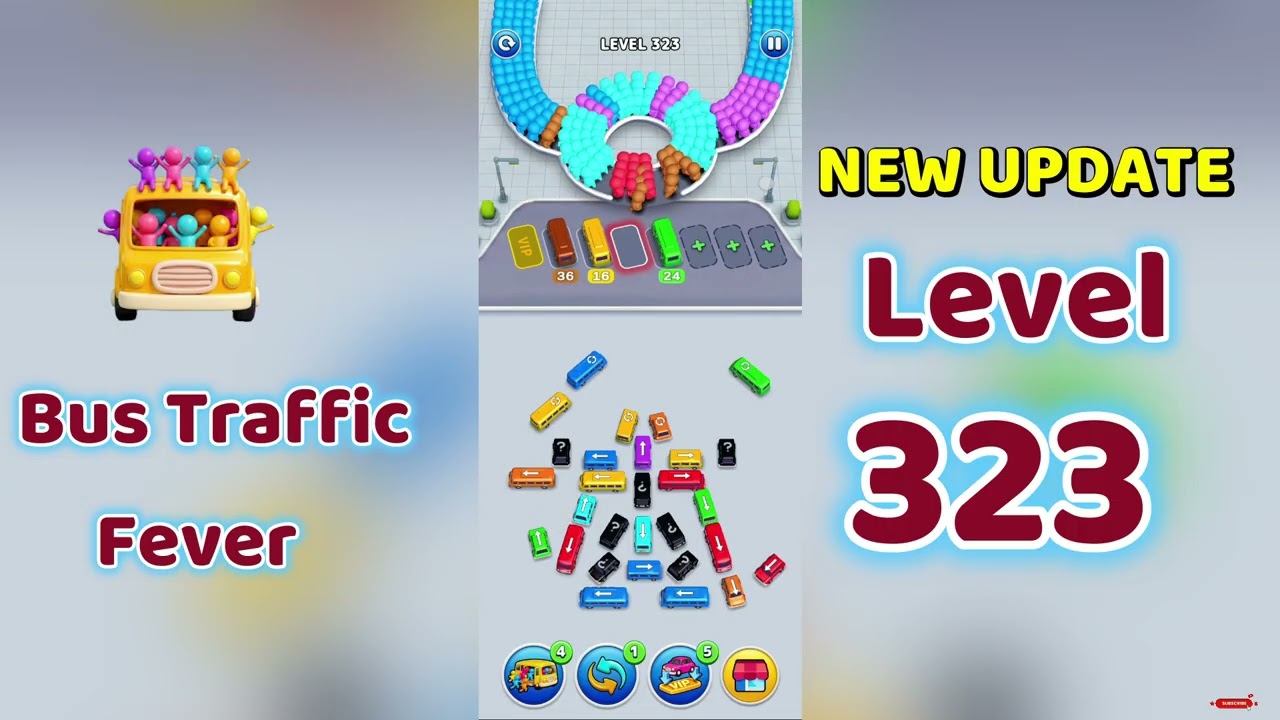
To beat Level 323 in Bus Traffic Fever!, dispatch only those unobstructed vehicles that match the colors of the immediate front passengers in line. Success requires keeping at least one loading bay open at all times and systematically dismantling outer vehicle rows to open escape corridors for locked interior units. Pulling vehicles without matching riders waiting at the curb quickly fills the loading docks and causes an unavoidable stall.
Core Rules for Level 323 Grid Management
Level 323 presents a congested parking grid where perimeter vehicles trap interior buses, while a limited passenger queue dictates which colors can successfully exit. Every bus pulled from the lot moves into an upper loading bay dock. If all docks fill with partially loaded or idling buses, the stage ends in a loss.
| Grid Element | Clearance Priority | Tactical Rule |
|---|---|---|
| Active Passenger Queue | Highest | Pull only vehicles whose matching riders currently sit at the front of the line. |
| Perimeter Vehicles | High | Clear unobstructed outer buses first to create exit corridors for interior rows. |
| Loading Bay Docks | Critical | Reserve at least one empty dock so you always have room to cycle trapped vehicles. |
| Interior Vehicles | Low until opened | Do not plan routes through interior buses until their blocking vehicles are removed. |
Step-by-Step Clearance Strategy
Follow this sequence to maintain lane flow and prevent the loading area from locking up:
- Verify the front queue colors: Look at the first three to four passenger clusters waiting at the curb before tapping any vehicle.
- Dispatch an instant-fill vehicle: Tap an outer bus that faces an open path and matches the front group. When a bus completely fills with its maximum passenger capacity, it leaves the bay immediately, freeing that dock for subsequent moves.
- Trace the exit path and directional facing: Buses only move straight along their front bumpers. Confirm that no other vehicle bumper or corner blocks the forward escape lane before tapping.
- Account for queue shifts: When a bus absorbs the front group, incoming passengers shift forward. Identify the next color set entering the line and select an unblocked bus matching that incoming group.
- Clear one flank toward the center: Rather than pulling vehicles randomly from all four sides, concentrate on clearing one perimeter corner completely. Opening a dedicated lane allows awkward, perpendicular interior vehicles to turn and exit freely.
Managing Bay Capacity
Bay saturation is the primary failure point on Level 323. To prevent gridlock:
- Maintain a flex dock: Never occupy every bay simultaneously with partially filled vehicles. If your bays fill entirely and the active passenger line does not match any docked bus, the level fails immediately.
- Avoid back-to-back partial pulls: If you must pull a vehicle that only partially fills to expose a trapped lane, ensure the queue directly behind the active group contains its remaining passengers. Do not pull a second partially matching bus until the first one departs.
- Match vehicle capacity to crowd size: Large buses require substantial passenger counts to clear a dock. Do not move high-capacity vehicles into the bays if only one or two riders of that color are visible near the front of the queue.

Free Bus Traffic Fever! Codes
Current active codes and how to redeem them.

Sarah Williams
Sarah specializes in RPG and collection games, explaining team building, character growth, and beginner-friendly ways to avoid expensive early mistakes.
COMMUNITY
Player Comments
128 players commented on this guide.
This guide answered the exact question I had.
This helped me understand strategy much better.
The tips are practical and easy to follow.
Nice guide. I am checking the other Bus Traffic Fever! articles next.