
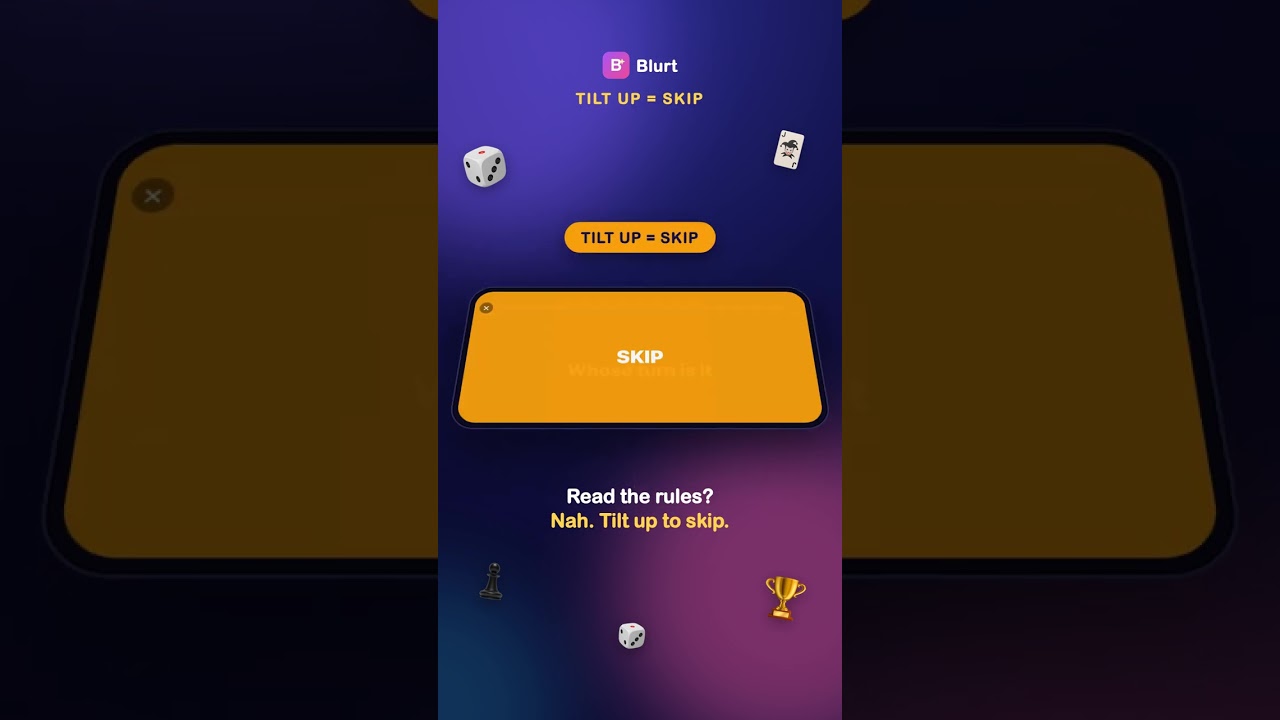
To solve conversational tabletop prompts like "No take backs!" in Charades - Family & Party Game, act out a physical board game scene rather than breaking the phrase into individual words. Prompts drawn from family game night disputes represent situational dialogue. If you attempt to mime abstract words such as "take" or "back," teammates often guess unrelated everyday vocabulary. Establishing an invisible game board immediately narrows your team's guesses to competitive tabletop arguments.
Establishing the Tabletop Setting
Establish the scene within the first three seconds of your turn. Without a clear physical setting, gestures of outrage or denial look like generic reactions. Use a three-step pantomime sequence before miming the specific quote:
- Outline the board: Trace a flat rectangular boundary in the air directly in front of your chest to define the tabletop surface.
- Perform a game mechanic: Shake and roll imaginary dice across the defined plane, or grip an invisible pawn and move it across spaces.
- Trigger the reaction: Freeze the action abruptly, show exaggerated shock or frustration, and execute the gesture specific to your prompt.
Common Family Game Night Prompts and Physical Anchors
Situational prompts usually fit into distinct tabletop archetypes. Grounding each prompt with a mechanical prop prevents teammates from falling into common guesser traps.
| Archetype | Card Prompt | Primary Physical Anchor | Common Guesser Trap |
|---|---|---|---|
| Move Retraction | "No take backs!" | Move a pawn forward, pull the hand back, and wave arms in refusal | Guessing "stealing" or "giving up" |
| Turn Dispute | "Whose turn is it?" | Point sequentially around an imaginary table with a puzzled face | Guessing "clock" or "spin the bottle" |
| Perimeter Fault | "You rolled off the board!" | Shake dice, fling them past the table edge, and point down to the floor | Guessing "dropping food" or "lost item" |
| Rulebook Dispute | "Read the rules!" | Unfold a paper pamphlet, squint at it, and stab a finger onto the text | Guessing "studying" or "reading the news" |
| Integrity Accusation | "Are you cheating?" | Peek sideways past cupped hands, then point an accusatory finger | Guessing "hide-and-seek" or "lying" |
Acting Out "No Take Backs!" and Retraction Disputes
Demonstrate both sides of the dispute by shifting your posture between the offending player and the opponent.
- Mime the illegal retraction: Lean forward, set a game piece onto a space, react with wide-eyed panic as if landing on a penalty, and yank your hand back to return the token to its starting spot.
- Mime the objection: Step back into an upright stance, scowl, cross your forearms into an "X," shake your head, and point firmly at the spot where the piece landed.
Splitting "No take backs!" into individual words—miming "no" with a finger wag, "take" by snatching the air, and "back" by pointing over your shoulder—wastes time on a syntax puzzle. Acting out the reversal prompts teammates to shout the exact idiom naturally.
Handling Rules and Boundary Violations
Technical protests require distinct spatial cues to differentiate game rules from ordinary reading or searching:
- Rule citations ("Read the rules!"): Do not hold your hands like an open novel. Pretend to pull a tightly folded accordion leaflet out of a small box, snap it open, run a finger down the column, and thrust the invisible sheet toward your teammates while tapping the print.
- Table boundaries ("You rolled off the board!"): Exaggerate the throw trajectory. Shake dice near your ear, toss them forcefully across the plane, and immediately drop your gaze past the table edge. Point down at the floor, shake your head, and signal an umpire's incomplete wave.
Guessing Strategy and When to Pass
As a guesser, call out tabletop actions the moment the performer establishes a board or shakes dice. Shout mechanical verbs first ("rolling," "doubles," "moving"), followed quickly by common disputes ("That's mine," "Whose turn," "No take backs," "You cheated").
If the performer spends more than eight seconds cycling through gestures without your team narrowing down the exact phrase, use the pass control if your current game mode allows it. Conversational quotes carry higher ambiguity than concrete nouns, and passing difficult cards protects your round score.
Free Charades - Family & Party Game Codes
Current active codes and how to redeem them.

Sarah Williams
Sarah specializes in RPG and collection games, explaining team building, character growth, and beginner-friendly ways to avoid expensive early mistakes.
COMMUNITY
Player Comments
75 players commented on this guide.
I tried this today and it worked better than my old setup.
This saved me time in the early game.
I wish I had read this before upgrading the wrong thing.
Good guide for Charades - Family & Party Game players. The strategy part was useful.