
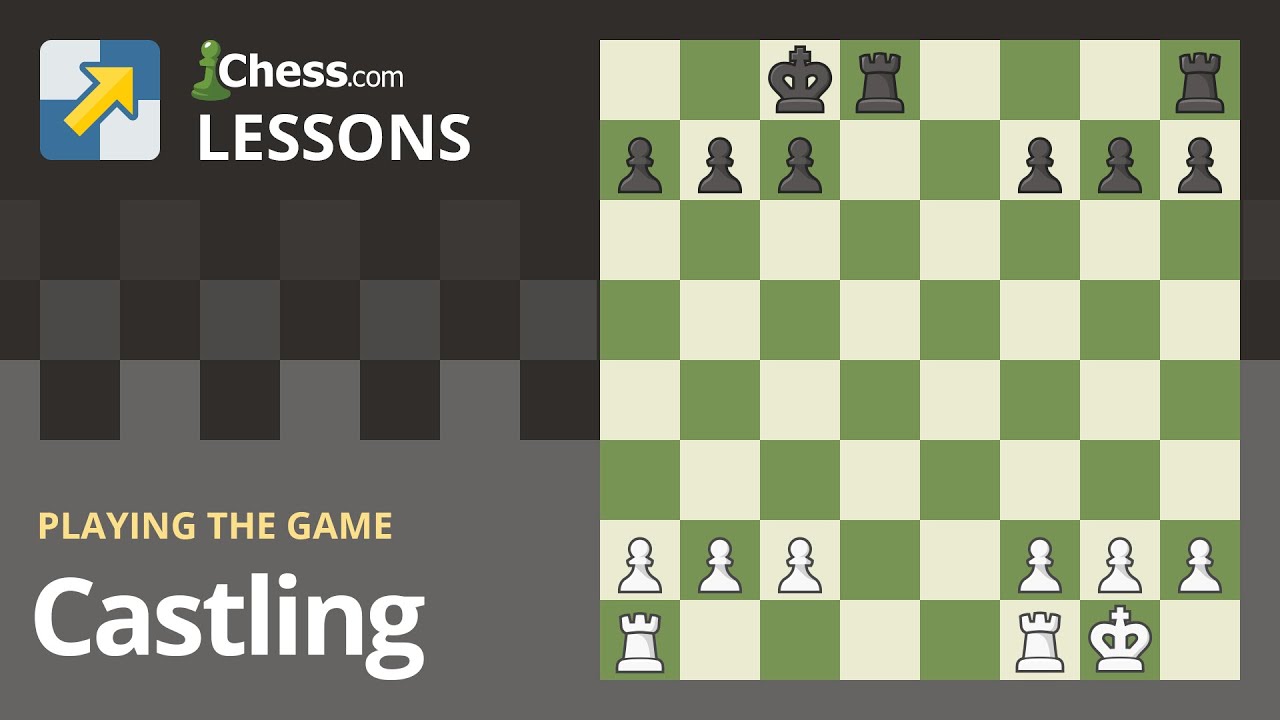
To castle in Chess.com - Play and Learn, drag or tap your king two squares toward an unmoved rook along your back rank. The platform automatically shifts that rook to the square the king just crossed. Castling is the only move in chess that repositions two pieces in a single turn, sheltering your king behind pawns while activating a rook toward the center.
Kingside vs. Queenside Board Coordinates
In both forms of castling, the king always moves exactly two squares, regardless of which side you choose. The rook then hops to the square immediately adjacent to the king's opposite side.
| Castling Type | King Movement | Rook Movement | Notation | Pieces to Clear |
|---|---|---|---|---|
| Kingside (Short) | White: e1 to g1<br>Black: e8 to g8 | White: h1 to f1<br>Black: h8 to f8 | O-O | 2 (Knight, Bishop) |
| Queenside (Long) | White: e1 to c1<br>Black: e8 to c8 | White: a1 to d1<br>Black: a8 to d8 | O-O-O | 3 (Queen, Bishop, Knight) |
Kingside castling requires vacating only two minor pieces, making it reachable in the early opening. Queenside castling requires developing the queen, bishop, and knight, placing your king on the c-file and shifting the rook directly onto the central d-file.
Five Requirements for a Legal Castle
All five conditions must be met at the moment you make the move:
- The king has never moved: Moving the king at any point permanently eliminates castling rights for the rest of the game, even if it returns to its original square.
- The selected rook has never moved: Moving a rook permanently eliminates castling on that specific wing. If your h-rook moves, you can still castle queenside with an untouched a-rook.
- The intervening squares are empty: Every square between the king and the selected rook must be clear of friendly and enemy pieces.
- The king is not currently in check: You cannot castle out of check. You must resolve the check by blocking, capturing, or moving the king.
- The transit and landing squares are safe: The king cannot cross any square attacked by an enemy piece, nor can it land on a square where it would be in check.
Non-Restricting Board Conditions
Certain attacked squares do not restrict your ability to castle:
- Attacked rooks: An enemy threat against your rook does not invalidate castling. If an opponent attacks your a1 rook, you can still castle queenside as long as e1, d1, and c1 are safe. The rook itself may start from, pass through, or land on an attacked square.
- The b-file during queenside castling: White's king travels across d1 to land on c1, never touching b1 (and Black travels across d8 to c8, never touching b8). An enemy piece attacking b1 or b8 does not prevent queenside castling because the king never enters that line of fire.
Strategic Objectives and Opening Hazards
Castling accomplishes two structural goals: it secures the king behind an intact pawn barrier away from the open e-file, and it connects both rooks along the back rank to contest central files.
Before committing your king, scan for these critical board states:
- Attacking batteries: Avoid castling directly into pre-aligned bishop and queen diagonals targeting h2 or h7. An undefended kingside pawn shield invites tactical sacrifices such as the Greek Gift (Bxh7+).
- Opposite-side castling races: When one player castles kingside and the other castles queenside, the game shifts into a tactical race. Both sides typically launch forward pawn storms against the opposing king, making move speed and precise calculation far more important than slow piece maneuvers.

Free Chess.com - Play and Learn Codes
Current active codes and how to redeem them.

Sarah Williams
Sarah specializes in RPG and collection games, explaining team building, character growth, and beginner-friendly ways to avoid expensive early mistakes.
COMMUNITY
Player Comments
98 players commented on this guide.
Nice guide. I am checking the other Chess.com - Play and Learn articles next.
The tips are practical and easy to follow.
This guide answered the exact question I had.
I wish I had read this before upgrading the wrong thing.