
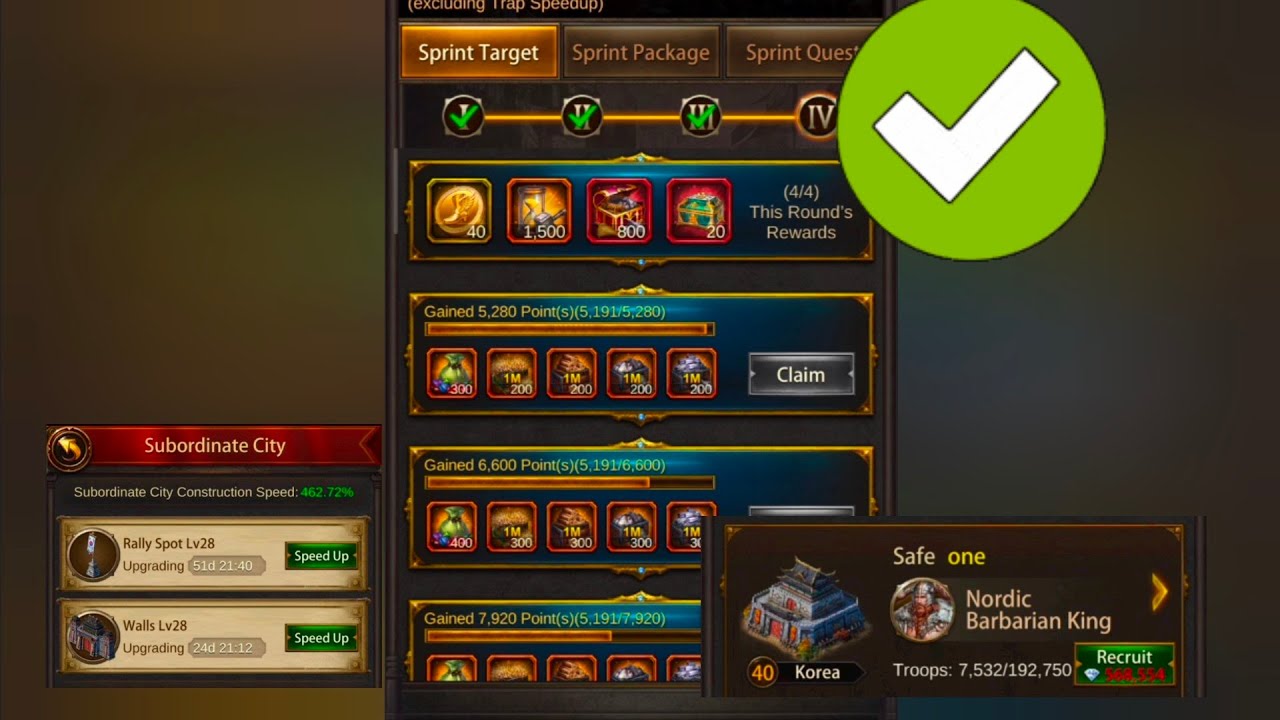
In Evony: The King’s Return, the Sprint Event is a recurring challenge that rewards players for rapid growth. While many players default to upgrading their main city’s buildings to earn points, this often leads to a massive depletion of hard-earned food, lumber, stone, and ore. The most efficient strategy for mid-to-late-game players is to pivot your construction focus toward your Subordinate Cities. By utilizing your accumulated speed-ups on Subordinate City upgrades, you can hit top-tier event milestones without draining your primary resource reserves, keeping your economy stable for critical troop training and research.
The Mechanics of the Sprint Event Point System
The Sprint Event in Evony operates on a point-per-action basis, primarily driven by power increases and building completions. Every time a building construction timer hits zero, the game awards points based on the level reached and the time invested.
Crucially, the game’s event engine does not distinguish between a building inside your main city walls and a building inside a Subordinate City. Both are classified as "Construction" activities. By focusing on your Subordinate Cities, you leverage a "soft cap" bypass: you are essentially performing the same mathematical action (completing a construction task) but doing so in an environment that requires significantly fewer resources than your main keep’s high-level structures.
Why Subordinate City Upgrades Are Superior for Events
The primary reason this strategy is favored by competitive players is the Resource-to-Point Ratio.
- Lower Resource Cost: As your main keep levels up, the resource cost for every subsequent building upgrade grows exponentially. Conversely, Subordinate City building costs remain relatively flat or scale much more slowly, meaning you can trigger dozens of building completions for the price of just one or two high-level main city upgrades.
- Speed-Up Efficiency: Players often accumulate thousands of hours in speed-ups from daily rewards, alliance gifts, and previous event chests. Using these on Subordinate Cities allows you to dump your time-reduction items into the event without sacrificing the "real" resources (RSS) needed for troop training or healing after PvP.
- Strategic Preservation: If you are preparing for Server Vs. Server (SvS) or Battlefield events, you cannot afford to have zero resources. Using this method allows you to complete the Sprint Event and claim the rewards—such as refinement stones, dragon crystals, or speed-ups—while keeping your main city’s warehouse and production sites stocked for military emergencies.
Step-by-Step Execution for Maximum Yield
To maximize your points during the Sprint Event, follow this disciplined workflow:
- Audit Your Subordinate Cities: Before the event begins, check all your Subordinate Cities. Identify which ones have buildings that are not yet at the max level allowed by your current main keep tier.
- Queue Lower-Level Buildings: Start by queuing the lowest-level buildings first. They take less time to complete, allowing you to cycle through more construction tasks quickly.
- Monitor Your Speed-Up Inventory: Categorize your speed-ups. Use your 1-minute, 5-minute, and 15-minute speed-ups to finish the short tasks. Save your 1-hour and 8-hour speed-ups for the final few levels of a building to maximize the efficiency of your clicks.
- Prioritize the Keep: If you have Subordinate Cities that are not yet at the maximum keep level for your current main city tier, prioritize those. The keep is the most "expensive" building in the sub-city, and leveling it grants the highest point yield per construction cycle.
- Stop at the Milestone: Don’t mindlessly burn your entire inventory. Calculate how many points you need to reach the final tier of the Sprint Event and stop once you hit that goal.
Comparing Strategies: Main City vs. Subordinate City
| Feature | Main City Upgrades | Subordinate City Upgrades |
|---|---|---|
| Resource Cost | Extremely High | Low to Moderate |
| Point Yield | High (per individual item) | Consistent (High volume) |
| Impact on Growth | Direct combat/production bonus | Primarily for event points |
| Risk | Can cause resource bankruptcy | Low risk to primary economy |
While main city upgrades are necessary for unlocking new troop tiers and higher research levels, they are "all-in" investments. Subordinate City upgrades should be viewed as "event fuel." Use your main city for long-term growth and your sub-cities for event-based point farming.
Common Mistakes to Avoid
- Wasting Speed-Ups on Finished Structures: Ensure you aren't wasting speed-ups on buildings that offer negligible progress. Always check the point contribution of a building level before committing your items.
- Ignoring Sub-City Quality: If you have low-quality (Green/Blue) subordinate cities, consider if it’s worth upgrading them. Ideally, you should focus this strategy on your higher-tier (Purple/Gold) subordinate cities, as these provide better permanent buffs (like troop attack or march size) once they are fully upgraded.
- Over-committing: The worst mistake is running out of speed-ups for a future, more important event (like a consumption event or a specific troop-training event). Only use what you need to hit the Sprint Event's top-tier rewards.
Strategic Limitations
This strategy is not a "magic bullet" for all circumstances. If your Subordinate Cities are already fully upgraded to match your current main keep level, you cannot use this method until you upgrade your main keep further. Furthermore, this strategy is purely for event points. It does not provide the immediate power spikes or troop capacity increases that main city upgrades provide. If you are in a situation where you need to boost your power urgently for a defensive or offensive maneuver, prioritize your main city instead.
By leveraging the building mechanics of your Subordinate Cities, you transform the Evony Sprint Event from a resource-draining chore into a sustainable growth exercise. This allows you to claim top-tier rewards while keeping your empire battle-ready and resource-rich for the conflicts that truly matter.

Free Evony Codes
Current active codes and how to redeem them.

Michael Smith
Michael covers live-service games, events, reward systems, and efficient daily routines, turning frequent updates into clear actions for players.
COMMUNITY
Player Comments
147 players commented on this guide.
This guide answered the exact question I had.
This saved me time in the early game.
This helped me understand resources much better.
Good guide for Evony players. The resources part was useful.