
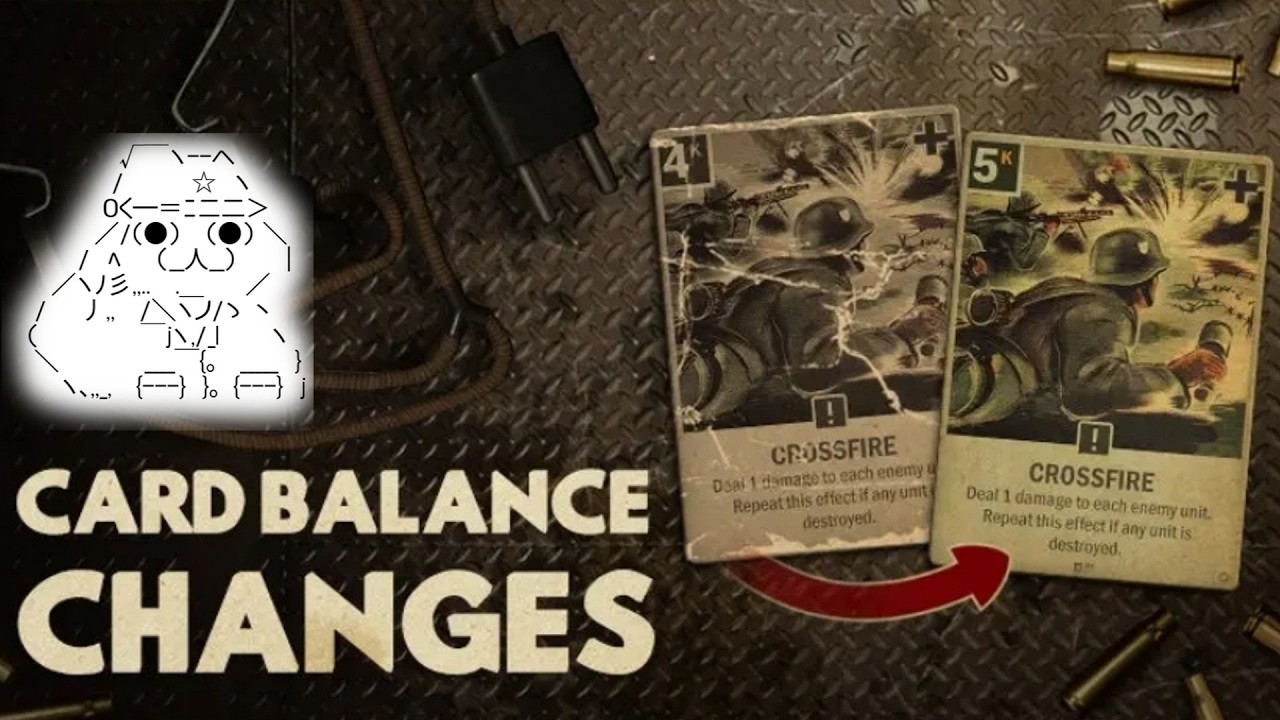
To adapt to the 12-card balance update in KARDS - The WW2 Card Game, players should immediately re-evaluate deck builds that rely on nerfed defensive staples like Crossfire and Kholm. With these reactive protective tools weakened, the patch shifts tactical priority toward active board control and combat trades. Incorporating newly buffed units with Destruction effects lets you maintain pressure across the frontline and support line while capitalizing on developer adjustments designed to foreshadow future card releases.
Replacing Nerfed Defensive Staples: Crossfire and Kholm
The balance patch directly reduces the defensive efficiency of Crossfire and Kholm, two cards that previously anchored defensive and control-heavy strategies. Because these cards offer reduced stopping power, relying on them to single-handedly halt enemy pushes leaves your Headquarters (HQ) vulnerable to faster frontline advances.
- Crossfire: Previously functioned as a reliable reactive counter to punish advancing enemy units. Its reduced performance means it less consistently neutralizes opposing assaults on trigger, making proactive removal orders or dedicated Guard units safer alternatives.
- Kholm: Long served as a mid-game bulwark that bought slow decks time to set up late-game win conditions. Its weakened durability allows aggressive opponents to breach defenses sooner, requiring you to contest the board earlier with active combat units.
| Card | Pre-Patch Role | Post-Patch Reality | Recommended Replacement |
|---|---|---|---|
| Crossfire | Universal reactive counter punishing unit movement | Reduced stopping power leaves surviving threats on board | Proactive direct-damage orders or low-cost Guard units |
| Kholm | Standalone defensive anchor stalling mid-game pushes | Lower durability allows attackers to breach lines faster | Early frontline contest units and secondary control orders |
Capitalizing on Buffed Destruction Effects
While defensive countermeasures were reined in, cards featuring the Destruction keyword received notable upgrades across the 12-card adjustment. The Destruction keyword triggers its effect whenever a unit is eliminated in combat or removed by enemy orders.
Deploying upgraded Destruction units creates difficult tactical choices for your opponent:
- If the opponent removes the unit: The Destruction trigger activates immediately, generating resources, damaging surviving enemies, or replacing board presence.
- If the opponent ignores the unit: You retain initiative to advance to the frontline or attack the enemy HQ directly.
Strengthening Destruction cards also hints at the design direction of future card releases. Developers frequently upgrade an existing mechanic across multiple factions to lay the groundwork for upcoming synergies, death-trigger archetypes, and token generators. Prioritizing these units now prepares your collection for the evolving meta.
How to Rebuild Your Decks
Follow these steps to adjust your decks following the balance patch:
- Audit Reactive Countermeasures: Cut or trim copies of Crossfire if they fail to cleanly answer common board threats. Shift toward versatile orders that you can trigger actively on your own turn.
- Secure the Frontline Early: Compensate for Kholm's reduced durability by adding resilient Guard units to your early curve to prevent opponents from seizing the frontline uncontested.
- Integrate Destruction Units: Slot in buffed Destruction units to turn combat trades and board attrition into tempo advantages.
- Tighten Your Kredit Curve: Ensure you have proactive plays on every turn. Without dependable stall cards to lean on, unspent Kredits against an established enemy line will quickly lead to defeat.
- Conserve Crafting Resources: Hold off on spending wildcards on weakened defensive shells. Reserve your crafting assets for high-utility Destruction cards and upcoming synergy cards that build on these mechanics.
Free KARDS - The WW2 Card Game Codes
Current active codes and how to redeem them.

James Brown
James focuses on Android gaming on PC, emulator setup, controls, performance tuning, and practical troubleshooting for longer play sessions.
COMMUNITY
Player Comments
109 players commented on this guide.
I tried this today and it worked better than my old setup.
This guide answered the exact question I had.
Can you add more details about updates in a future update?
This helped me understand updates much better.