
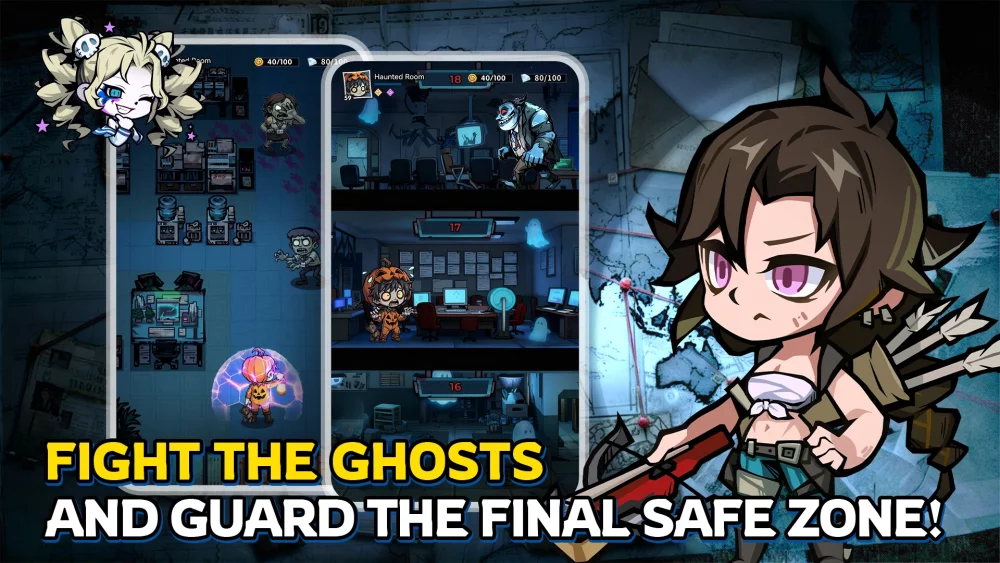
Clearing Stage 1-2 in the Haunted Room mode of Knock Knock: Room Defense is a test of your ability to balance aggressive economic growth with reactive defensive maintenance. Unlike standard stages, the Haunted Room mode features ghosts with higher health pools and more persistent attack patterns, making "panic-building" a quick path to failure.
To succeed, you must adopt an "Economy-First" mindset. By treating your bed as your most valuable strategic asset rather than just a survival requirement, you can outpace the ghost’s scaling damage. This guide details the exact tactical framework required to stabilize your room and survive the onslaught of Stage 1-2.
The Economy-First Philosophy: Why the Bed is King
In Knock Knock: Room Defense, your gold-per-second (GPS) is the primary determinant of your success. In Stage 1-2, the ghosts are designed to drain your resources by forcing you to spend gold on low-level door repairs.
To overcome this, your opening sequence must be disciplined:
- Initial Placement: Select a room spot that allows for maximum turret coverage later.
- Immediate Investment: Spend your starting capital on your bed immediately. Do not buy a turret unless the ghost is actively attacking and your door health is below 30%.
- Aggressive Scaling: Your goal is to reach Level 2 and then Level 3 on your bed before the ghost’s damage output forces you to commit to more than two door repairs.
By prioritizing the bed, you create a compounding interest effect. A Level 3 bed generates enough passive income to fund a mid-game turret array, whereas a player who spends their early gold on basic turrets will find themselves "gold-starved" by the time the ghost reaches its mid-stage damage tier.
Strategic Door Fortification: Knowing When to Repair
The door in Knock Knock: Room Defense is not just a barrier; it is a time-buying mechanism. Many players make the mistake of keeping their door at maximum health constantly. In Stage 1-2, this is a waste of capital.
The "Threshold" Rule
- Safety Zone (100%–60%): Do not spend gold on repairs. Use every spare coin to upgrade your bed or purchase a new turret slot.
- Warning Zone (59%–30%): Monitor the ghost’s attack animation. If it is retreating, hold your gold. If it is staying, perform one upgrade or repair to push it back.
- Critical Zone (Below 30%): Prioritize immediate fortification. A broken door results in an instant "Game Over," so do not gamble with your economy when your health is in the red.
By allowing the door to take calculated damage, you preserve your limited gold for permanent economic upgrades that will pay for themselves within seconds.
Optimal Turret Placement and Synergy
Once your bed is generating at least 5-8 gold per tick, you can begin your defensive build. Avoid the common mistake of placing turrets randomly across the room. Knock Knock: Room Defense rewards spatial efficiency.
- The Grid Approach: Place your turrets in a tight cluster near the door. This creates a "kill zone" where the ghost is subjected to overlapping fire from every turret simultaneously.
- Focus Fire: By concentrating damage in one area, you reduce the time the ghost spends attacking your door. The faster you reduce the ghost's health, the less gold you need to spend on repairs, creating a positive feedback loop.
- Upgrading vs. Building: It is generally more effective to place three low-level turrets than to upgrade one turret to max level early on. The total damage output of three turrets is higher and provides better coverage against aggressive ghost surges.
Managing the Escalation of Stage 1-2
The ghost in Stage 1-2 will periodically level up, increasing its attack speed and damage. You can track this by observing the ghost's animation—if it begins shaking or moving faster, it has entered a new tier.
If you find your door failing rapidly despite having a solid turret setup, it is a sign that your GPS is too low. Check your bed level. If you are not at least Level 4 by the time the ghost hits its second stage of aggression, you have likely over-invested in early-game defense.
Troubleshooting Common Failures:
- "I run out of gold mid-battle": You are likely repairing your door too often. Let the door take more damage before clicking the repair button.
- "The ghost breaks the door too fast": You have neglected your turrets. Ensure you have at least 3-4 turrets placed near the door entrance.
- "I have no space left": Sell your lowest-tier turret to make room for a higher-tier replacement, but only do this when your current gold income is stable.
Final Decision-Making Checklist
Before attempting Stage 1-2 again, use this checklist to audit your gameplay:
- Bed Priority: Did I reach Level 3 within the first 60 seconds?
- Damage Concentration: Are my turrets clustered, or are they spread out?
- Repair Discipline: Did I avoid repairing the door while it was above 50%?
- Economic Scaling: Is my income sufficient to replace a lost turret without stopping my bed upgrades?
By mastering these variables, you will find that Stage 1-2 in Knock Knock: Room Defense becomes significantly easier to manage. Success in this game is 20% reaction time and 80% long-term economic planning. Keep your eyes on your gold counter, maintain your door only when necessary, and your room will remain a fortress against the ghost's onslaught.

Free Knock Knock: Room Defense Codes
Current active codes and how to redeem them.

Emily Johnson
Emily writes practical mobile strategy guides with a focus on resource planning, base progression, and the early decisions that shape a long-term account.
COMMUNITY
Player Comments
118 players commented on this guide.
This helped me understand early game much better.
This guide answered the exact question I had.
Can you add more details about early game in a future update?
I wish I had read this before upgrading the wrong thing.