
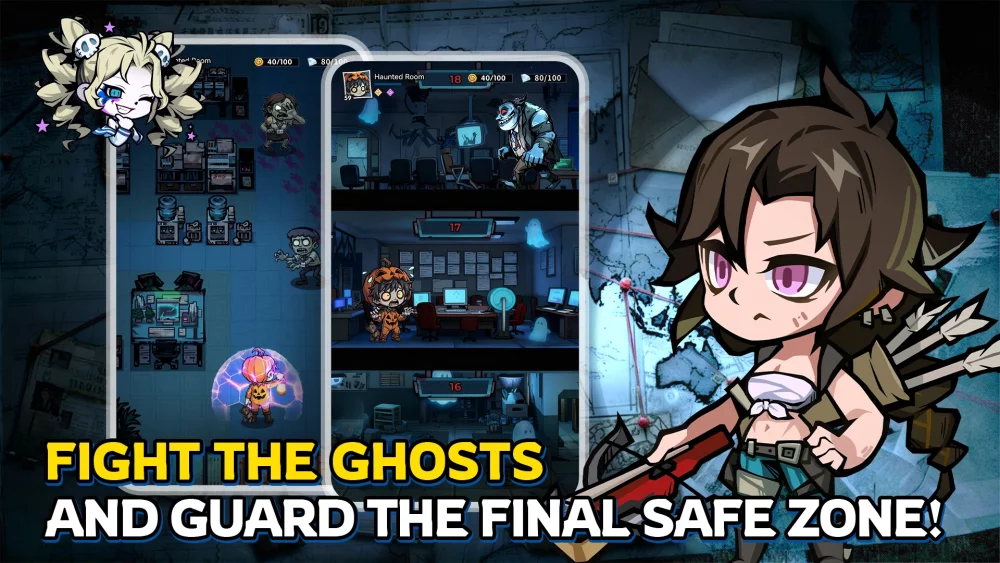
In the high-stakes environment of Knock Knock: Room Defense, understanding the spatial mechanics of your defensive layout is the difference between a successful hold and a total breach. Experienced players often look toward legacy map mechanics—the foundational geometry and collision rules inherited from earlier build versions—to optimize hero positioning. By auditing these boundaries, you can identify "dead zones" where enemy AI pathfinding fails, allowing you to create more efficient defensive chokepoints.
Understanding Room Geometry and Collision Mechanics
At its core, Knock Knock: Room Defense relies on a grid-based collision system. Every wall, door, and barricade in a room serves as a hard boundary for both your heroes and the encroaching enemy forces. Legacy mechanics refer to the original collision boxes programmed during the game’s initial development.
When you analyze these boundaries, you are essentially stress-testing the game’s "Room Integrity." If a hero is placed too close to a legacy boundary, they may experience "clipping," where their hitboxes overlap with environment geometry. This can lead to two outcomes:
- The Tactical Advantage: You discover a pixel-perfect placement that renders your hero immune to specific melee attacks because the enemy AI cannot pathfind to that exact coordinate.
- The Strategic Failure: Your hero becomes "stuck" in the geometry, preventing them from rotating to face new threats or retreating when a barricade falls.
The Role of Diagnostic Movement in Room Defense
While developers use movement-bypassing scripts to audit map integrity, players can perform "practical diagnostics" to achieve similar results. By observing how your heroes interact with corners and doorways, you can determine where the collision boxes are most stable.
To execute a diagnostic audit of your own defense:
- Identify High-Density Corners: Place your most durable hero in a corner where two walls meet. If the hero’s model shifts slightly upon placement, the collision box for that corner is likely misaligned with the visual asset.
- Pathfinding Stress Test: Send a unit to navigate a complex path around a barricade. If the unit takes a wide, inefficient turn, the room’s hidden "legacy pathing" is forcing them to respect a collision boundary that no longer exists visually.
- Trigger Verification: Ensure that your defensive triggers (such as traps or explosive barrels) are not placed on the seam of a floor tile. Legacy code often treats these seams as neutral zones where triggers fail to register enemy presence.
Risks of Pushing Boundary Limits
Attempting to exploit movement mechanics in Knock Knock: Room Defense carries significant risks to your progression. The game engine is highly sensitive to coordinate data. If a hero is forced into an "out-of-bounds" state—even partially—the game’s logic engine may struggle to process their defensive stats, leading to what is commonly called a "soft-lock."
Common risks include:
- Trigger Failure: Enemies may stop spawning entirely because the game believes you are still in a "loading" state.
- Save Data Corruption: If you save your game while a character is occupying an invalid coordinate, the game may refuse to load that save upon restart, forcing you to revert to an earlier backup.
- AI Desync: Enemies may freeze or move in erratic, non-defensive patterns, invalidating your tactical practice sessions.
Analyzing Legacy Map Flaws
Many stages in Knock Knock: Room Defense contain "ghost" assets—remnants of older versions that were never fully removed. While these are usually invisible to the player, they can still influence gameplay.
| Diagnostic Goal | Tactical Insight | Risk Level |
|---|---|---|
| Collision Auditing | Identify gaps in enemy pathing for choke points | Low |
| Boundary Stressing | Find stable zones for static, long-range heroes | Moderate |
| Trigger Mapping | Ensure all traps fire correctly in high-traffic areas | Low |
| Geometry Clipping | Avoid areas that cause hero movement bugs | High |
By identifying these "ghost" zones, you can build your defense around them. For example, if a legacy boundary causes enemies to bunch up in a specific, narrow corridor, you should prioritize high-AOE (Area of Effect) heroes in that lane to maximize damage output.
Best Practices for Save Integrity
Whenever you are experimenting with new hero lineups or testing room boundaries, the safety of your save file is paramount. Knock Knock: Room Defense performs frequent auto-saves, which can be detrimental if you are testing unstable positions.
- Use Dedicated Test Slots: Never perform "boundary testing" on your primary save file. Always utilize a secondary or guest slot to ensure your main progress remains untouched.
- Manual Backups: If you are on a platform that allows for local save management, copy your save file to a separate folder before engaging in intensive testing.
- The "Hard Reset" Protocol: If you notice your hero is clipping through a wall or the game is failing to trigger the next wave, do not attempt to finish the room. Exit to the main menu immediately. If the game is unresponsive, force-close the application to prevent the engine from writing the bad coordinate data to your save file.
- Avoid Mid-Wave Saving: Never save during the middle of a frantic breach. The game’s state is most volatile during combat, and saving while your units are moving through complex geometry is a common cause of save corruption.
Conclusion: Mastering the Room
Mastering Knock Knock: Room Defense requires more than just high-level heroes; it requires an intimate knowledge of the arena. By treating the game’s map boundaries as a tactical asset rather than a frustration, you can turn legacy mechanics to your advantage. Focus on identifying stable collision points, avoiding the traps of "out-of-bounds" movement, and always maintaining a clean save file to ensure your strategic insights are preserved. When you respect the limits of the game engine, you gain the control necessary to survive even the most intense room breaches.

Free Knock Knock: Room Defense Codes
Current active codes and how to redeem them.

Emily Johnson
Emily writes practical mobile strategy guides with a focus on resource planning, base progression, and the early decisions that shape a long-term account.
COMMUNITY
Player Comments
135 players commented on this guide.
Good guide for Knock Knock: Room Defense players. The heroes part was useful.
This guide answered the exact question I had.
This helped me understand heroes much better.
I tried this today and it worked better than my old setup.