
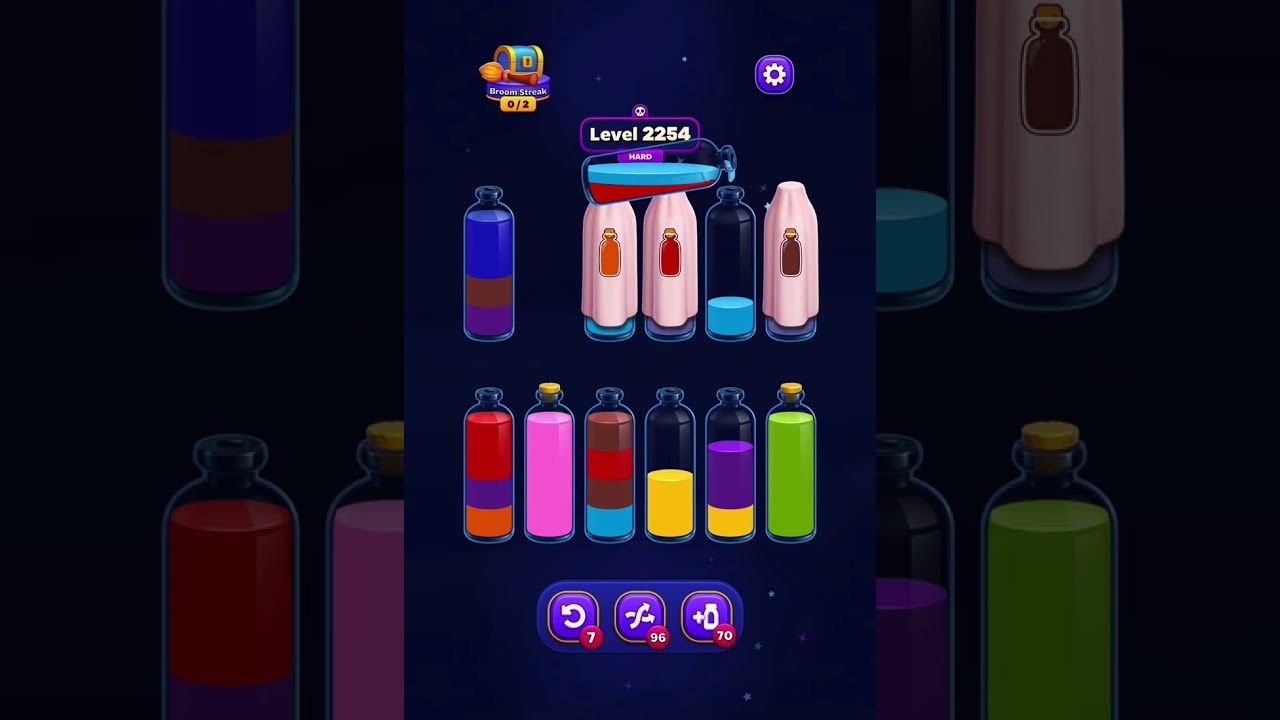
Reaching levels 2251–2260 in Magic Sort! marks a significant transition into the game’s "Expert" tier. At this stage, the complexity no longer comes from simple color matching, but from managing the limited vertical space of your bottles while navigating high-density color stacks. Players often find themselves in "soft-locked" states where every move leads to an invalid configuration. To conquer this range, you must shift your mindset from reactive sorting to proactive spatial management.
The Foundation: Why Empty Slots Are Your Primary Asset
In Magic Sort!, the board is a closed system. The most common cause of failure in levels 2251–2260 is the exhaustion of "workspace"—the empty capacity required to shuffle colors out of the way.
Think of your board as a puzzle where every move costs potential. If you fill all your bottles to partial capacity with mixed colors, you lose the ability to isolate individual colors.
- The Rule of One: Always strive to maintain at least one completely empty bottle. This acts as your "staging area."
- Buffer Management: When you don't have an empty bottle, you are forced to make moves that further mix colors, deepening the complexity. If you are stuck, identify which bottle has the least amount of "useless" liquid at the top and prioritize clearing that bottle entirely to create a new buffer.
Strategic Cleanup: Mastering Layer Density
As you advance through these ten levels, the game introduces more colors than there are available bottles to hold them in a finished state. This is intentional. The game forces you to consolidate colors systematically.
Identifying the Bottom-Layer Trap
In level 2255 and beyond, you will notice specific colors trapped at the very bottom of deep stacks. If you see a color you need for a target bottle buried under two or three other colors, do not attempt to move it immediately.
- Analyze the Column: Look at the column containing the buried color.
- Clear the Obstructors: Your goal is to move the top colors into temporary slots or other bottles that already contain that color.
- Execute the Release: Only once the path is clear should you move the target color.
Why Mixing is a Death Sentence
Many players attempt to move colors into partially filled bottles simply because there is "space." This is a trap. In the late 2000s levels, once you mix two colors, the number of moves required to undo that mistake often exceeds your available capacity. Always prioritize moving a color into a bottle that is either empty or already contains that same color.
Level-Specific Bottleneck Resolution
Levels 2258 and 2260 are notorious for "bottlenecking," where the game provides a layout that looks like it has many options, but actually has only one correct sequence of moves.
- The 2258 Bottleneck: This level forces a narrow path. You must identify the "anchor" color—the color that has the most volume on the screen. Clear the peripheral, smaller color stacks first. If you try to consolidate the anchor color too early, you will find that you have no room to move the smaller color segments.
- The 2260 Final Stretch: This is the most complex of the set. The final three bottles are usually the hardest to finish. Do not rush to fill them. Instead, verify that the color you are moving is the entirety of what is left for that bottle. If you fill a bottle and realize you left one layer of that color in a separate, inaccessible stack, you have effectively failed the level.
Pro-Tips for Advanced Players
To maintain high efficiency throughout your run from 2251 to 2260, apply these advanced heuristics to every puzzle:
1. The "Top-Down" Inspection
Before making your first move, look at the very top layer of every single bottle. Categorize them:
- High-Frequency Colors: These are the colors that appear in the most bottles. These are your priority for consolidation.
- Low-Frequency Colors: These are often the "keys" to unlocking a bottle. Use these to fill empty spaces or to clear a path for the high-frequency colors.
2. When to Use Magic Tools
Magic Sort! provides tools that can bypass difficult segments, but in levels 2251–2260, these should be saved for "dead-end" scenarios. If you reach a state where you have no legal moves left, use the "Undo" or "Add Bottle" tool. However, if you find yourself using these tools on every level, it is a sign that your strategy regarding empty slots needs to be tightened.
3. The Capacity Calculation
Before transferring a color, perform a quick visual check:
- Does the target bottle have enough empty "units" to hold the entire segment you are moving?
- If the answer is no, you are about to create a split-color situation that will require an extra move to fix later. Only move if you can clear the entire segment or if it completes the bottle.
Avoiding Common Pitfalls
Even experienced players hit walls in these levels due to three specific errors:
- The "Greedy" Move: Moving a color just because you can move it. Every move must serve a purpose: either to clear a bottle, unlock a buried color, or create a staging area.
- Ignoring the Bottoms: Always scan the bottom of each stack. If you don't know what is at the bottom of a stack, you are playing blind.
- Panic-Resetting: If you make a mistake, don't immediately hit the reset button. Look at the board to see if you can "shuffle" the error into a side bottle. Often, a board state that looks ruined can be salvaged by moving a single color to a neutral bottle.
By applying these principles—prioritizing empty slots, clearing top-layers systematically, and verifying capacity before every move—you will move through levels 2251–2260 with precision. Treat each bottle as a precious resource, and you will find that even the most complex Magic Sort! puzzles are solvable with patience and logic.

Free Magic Sort! Codes
Current active codes and how to redeem them.

Emily Johnson
Emily writes practical mobile strategy guides with a focus on resource planning, base progression, and the early decisions that shape a long-term account.
COMMUNITY
Player Comments
48 players commented on this guide.
The explanation is clear, especially for beginners.
I tried this today and it worked better than my old setup.
Can you add more details about early game in a future update?
This saved me time in the early game.