
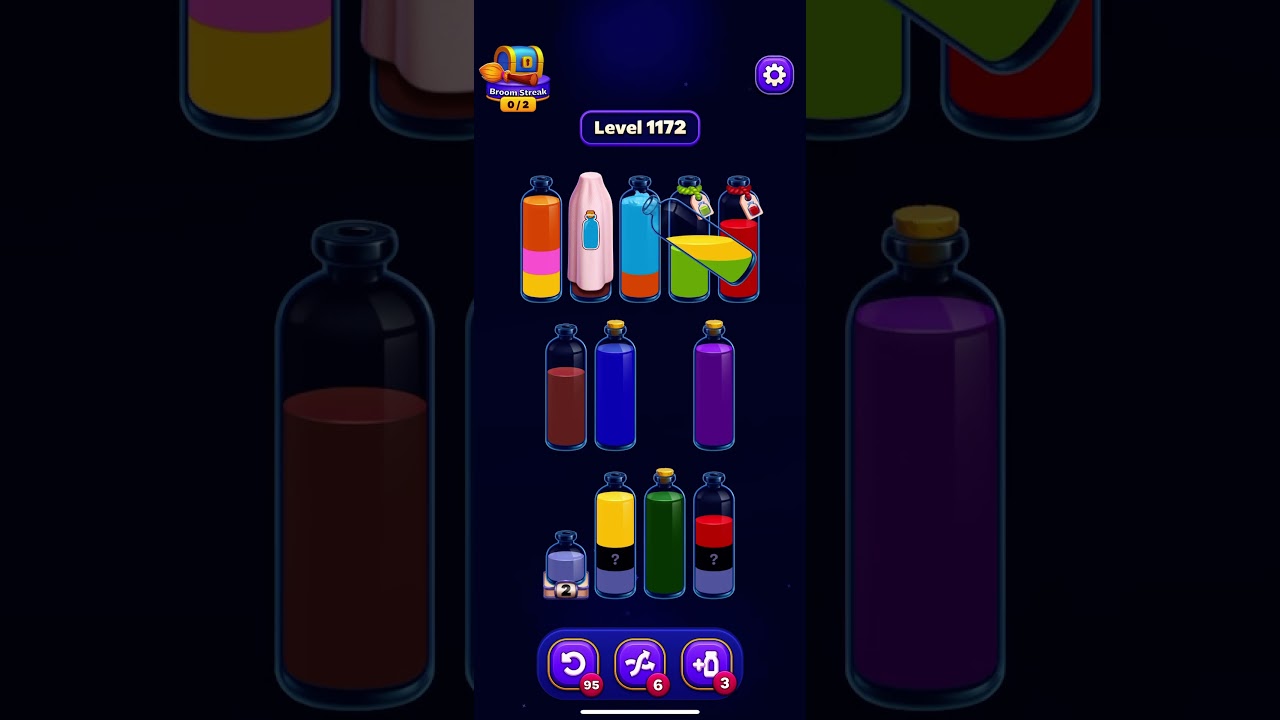
To clear Level 1172 in Magic Sort!, you must consolidate matching liquid segments into established tubes while keeping at least one of your two starting empty buffer tubes completely open. Success requires stripping away single-unit top layers only when an immediate destination exists for the liquid revealed underneath. By focusing on fully completing one four-unit color at a time rather than spreading partial stacks across the board, you prevent deadlocks and solve the puzzle without using undo steps or purchasing extra tubes.
Starting Layout and Key Bottlenecks
Level 1172 features a grid of four-unit liquid tubes alongside two empty buffer vials. The initial state scatters single units of contrasting colors—including blue, red, green, and yellow—across separate containers rather than grouping them into clean multi-unit blocks.
The primary obstacle in this stage is color dispersion:
- Buried Base Colors: High-priority matching segments sit trapped under single-unit caps of unrelated colors.
- Strict Matching Rules: Liquid can only be poured onto an identical color or into a completely empty tube, meaning mismatched surface layers entirely block access to the tubes below them.
- Buffer Congestion: Moving surface caps into both empty buffer vials without an immediate consolidation plan occupies both slots, leaving zero valid moves remaining.
Managing Your Two Buffer Tubes
Your two empty starting vials provide the operational room needed to untangle the board. Treat them with distinct tactical roles from your first move.
- Designate Buffer A for Active Transit: Use this tube strictly for temporary storage. Pour a single blocking top unit into Buffer A only when doing so immediately exposes a color that can be poured into another matching vial. Once the revealed segment is transferred, immediately clear Buffer A by routing its liquid to a matching destination.
- Reserve Buffer B as a Lockout Vessel: Keep the second empty tube untouched until you can commit a color that will quickly reach its full four-unit capacity. Pouring a dominant color into Buffer B permanently takes that color out of circulation and seals the vial, transforming a temporary buffer into a completed tube.
Move Priorities and Evaluation Criteria
Before transferring any liquid into an empty buffer tube, evaluate the board for direct surface combinations. Consolidating exposed matching units always takes precedence over digging into new vials.
| Move Category | Board Condition | Risk Level | Tactical Outcome |
|---|---|---|---|
| Direct Surface Match | Identical colors are exposed on top of two mixed vials | None | Consolidates liquid without occupying empty buffer space |
| Foundation Consolidation | Buried layer matches an exposed color in another tube | Low | Builds toward a 4/4 capacity vial and exposes deeper layers |
| Transit Peel | Single blocking layer covers an immediately usable match | Medium | Temporarily uses Buffer A to unlock an unblocked cascade |
| Premature Split | Pouring a color into a new tube when a matching stack exists | High | Fragments colors across three vials and risks an instant deadlock |
Whenever shifting a segment completely empties a mixed tube, take that move immediately. Creating a fresh empty vial restores your maneuvering room and gives you an extra transit slot for subsequent color peeling.
Deadlock Prevention: Avoid the Fragmentation Trap
The most common failure point in Level 1172 is the fragmentation trap. This occurs when identical color units are divided across three separate vials instead of pooled into one. Once multiple vials contain one or two units of the same shade, none of them can reach the four-unit maximum, effectively locking those containers out of active play.
To prevent and resolve deadlocks:
- Maintain a Single Target Tube: When multiple units of a color are accessible, route them directly into the established stack for that hue rather than starting a secondary column.
- Break Circular Dependencies: If Tube A requires Tube B, Tube B requires Tube C, and Tube C is blocked by Tube A, locate the vial holding the smallest blocking cap. Move that single segment into Buffer A, then immediately execute the three-step sequence to resolve all three tubes.
Endgame Execution
Once three tubes reach full four-unit completion, the remaining board state opens up significantly. Each completed vial removes a mixed container from the puzzle, typically leaving two or three open buffer slots.
To finish the stage, transfer your tallest remaining color stacks into the open tubes first. Sweep the remaining single-unit layers into their respective matching columns to seal each container. Once every vial holds a single, unified color, the level completes automatically.

Free Magic Sort! Codes
Current active codes and how to redeem them.

Sarah Williams
Sarah specializes in RPG and collection games, explaining team building, character growth, and beginner-friendly ways to avoid expensive early mistakes.
COMMUNITY
Player Comments
125 players commented on this guide.
This guide answered the exact question I had.
Nice guide. I am checking the other Magic Sort! articles next.
This saved me time in the early game.
I wish I had read this before upgrading the wrong thing.