
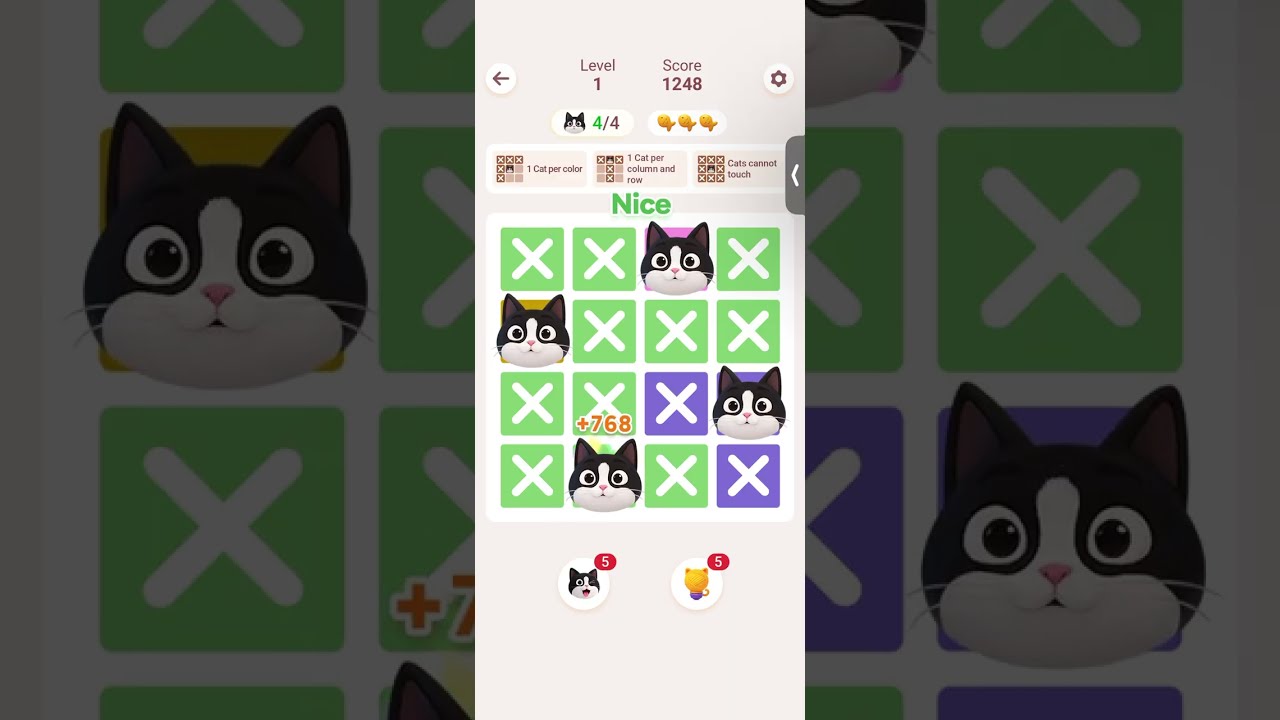
Meowdoku! is a sophisticated logic game that blends the structural grid discipline of Sudoku with the deductive, high-stakes thrill of Minesweeper. To solve levels 1 through 8, you must master the fundamental rule: every row, column, and 3x3 sub-grid must contain one instance of every unique cat icon without repetition.
While the early levels may seem straightforward, they are designed to build your "logic muscle." Success in these initial stages requires a disciplined approach to scanning, a firm grasp of elimination, and the avoidance of impulsive placements. This guide provides the expert strategies needed to clear these foundational levels with precision and speed.
Understanding the Core Mechanics of Meowdoku!
In Meowdoku!, your objective is to fill the grid by placing specific cat icons. Unlike traditional Sudoku, which relies on numbers 1–9, Meowdoku! uses distinct feline characters. The mechanics remain identical: if a cat appears in a row, it cannot appear again in that row. The same applies to columns and the designated 3x3 sub-grids.
Levels 1 through 8 function as your training grounds. During these levels, the grid is often partially populated with "anchor" icons. Your goal is not just to finish the level, but to learn to identify which cells are "forced"—meaning only one specific cat can legally occupy that space.
Mastering the 3x3 Grid Constraint
The 3x3 sub-grid is the most restrictive area of the board and should be your first point of analysis. When approaching a puzzle, scan each 3x3 square individually.
- Count the Icons: If a 3x3 square has six out of nine icons filled, you only need to identify the three missing cats.
- Intersection Analysis: Once you identify the missing icons, check the rows and columns passing through the empty cells. If one of the missing cats is already present in an intersecting row, that cat cannot be placed in the cell that shares that row.
- The "Hidden Single": If a 3x3 box has only one possible location for a specific cat icon, place it immediately. This creates a chain reaction, revealing information about the surrounding rows and columns.
Strategic Row and Column Elimination
Row and column elimination is the primary weapon in your arsenal. After you have assessed the 3x3 blocks, look at the rows and columns that are near completion.
- Prioritize Density: Always start with rows or columns that have the most pre-filled icons. A row with seven icons filled is significantly easier to solve than a row with only three.
- Cross-Referencing: When a row is missing two icons, check the columns for those two empty cells. If you determine that one column already contains one of the missing cats, you have effectively solved the cell by process of elimination.
- Visual Isolation: Most modern versions of Meowdoku! allow you to tap or highlight a row. Use this feature to isolate your vision, which prevents the "clutter effect" of seeing too many icons at once.
The Triple-Check Rule: Preventing Mistakes
One of the most common pitfalls in Meowdoku! is the "cascading error." Because the game relies on deductive logic, placing one cat in the wrong spot can make the entire puzzle unsolvable without you realizing it until the final steps.
Before committing a move, perform a Triple-Check:
- Check the Row: Does this cat already exist here?
- Check the Column: Does this cat already exist here?
- Check the 3x3 Square: Does this cat already exist in this sub-grid?
If you pass all three checks, your placement is correct. Developing this habit early is crucial, as levels 7 and 8 introduce more complex starting configurations that punish guesswork.
Developing Efficient Scanning Patterns
Speed in Meowdoku! comes from how you move your eyes across the board. Avoid staring at the center of the screen; instead, train your eyes to scan in a "Z" pattern.
- The Z-Scan: Start at the top-left 3x3 block and move your eyes horizontally across the first three rows, then drop down to the next set. This forces your brain to process the grid in chunks rather than as one overwhelming mess.
- Focus on the Missing: Instead of looking for what is there, look for what isn't. If a specific cat icon is missing from the entire board, find where it cannot go. By marking the "forbidden" cells, you will eventually be left with the only valid spot remaining.
Transitioning from Level 1 to Level 8
Levels 1 through 4 are designed for pattern recognition, focusing on simple placements. Levels 5 through 8 introduce "sparse grids," where there are fewer starting hints, requiring you to use more advanced deduction.
- Decision Making: If you reach a point where you cannot see a move, do not guess. Guessing is the fastest way to lose in Meowdoku!. Instead, step back and re-examine the 3x3 squares you might have missed.
- Patience is a Mechanic: The game is designed to reward patience. If you feel stuck, it is usually because you are overlooking one intersection point. Take five seconds to scan every empty cell in a single row; the solution is almost always hidden in the interaction between a row and a column.
Summary of Best Practices
To ensure you successfully clear the first eight levels, keep these expert tips in mind:
- Never Guess: Every move in Meowdoku! is logically provable. If you are guessing, you are missing a constraint.
- Clear the Easy Wins: Always fill in the "forced" cells (where only one option remains) before attempting to deduce more complex placements.
- Use the Interface: If the game provides highlighting or note-taking tools, use them to track potential candidates.
- Learn the Icons: Familiarize yourself with the specific cat shapes early on. Misidentifying a similar-looking cat is a common cause of invalid moves.
By following these strategies, you will establish the logical foundation necessary to move beyond level 8 and tackle the most difficult challenges in the game. Master these basics, and you will find that even the most complex, empty-looking grids eventually reveal their secrets.

Free Meowdoku! Codes
Current active codes and how to redeem them.

Sarah Williams
Sarah specializes in RPG and collection games, explaining team building, character growth, and beginner-friendly ways to avoid expensive early mistakes.
COMMUNITY
Player Comments
158 players commented on this guide.
I wish I had read this before upgrading the wrong thing.
The explanation is clear, especially for beginners.
I tried this today and it worked better than my old setup.
This saved me time in the early game.