
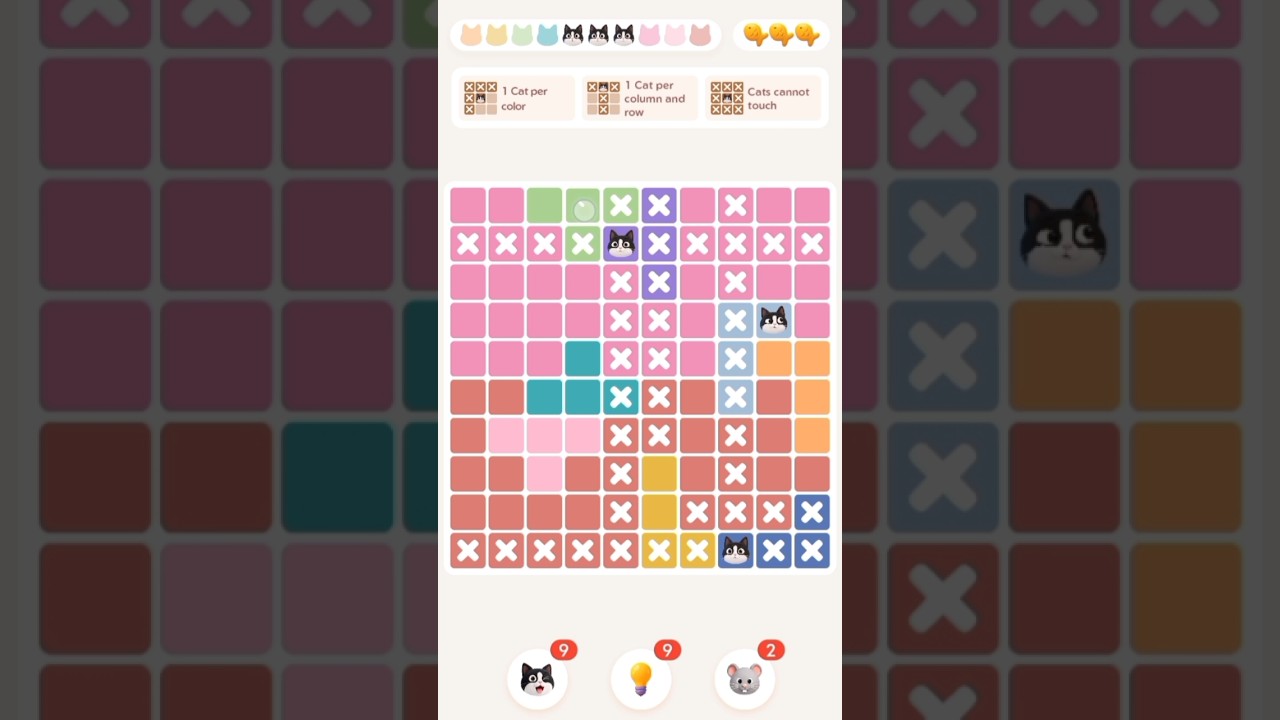
To solve Level 176 in Meowdoku!!, focus on eliminating impossible squares in the narrowest colored territories before attempting any cat placements in open areas. Level 176 features an asymmetric grid where irregularly shaped colored regions intersect rows and columns in tight bottlenecks. In Meowdoku!!, every row, column, and colored region must contain exactly one cat, and cats cannot touch horizontally, vertically, or diagonally. Marking X marks across restricted boundary tiles narrows your options and forces safe placements without risking mistake penalties.
Target Narrow Color Regions First
Begin by scanning for colored polyominoes that span only two or three cells across a single row or column. Broad regions offer too many open choices early on, whereas narrow shapes create immediate restrictions:
- When a colored territory is confined to a two-cell strip within a single row or column, any cat placed there eliminates that entire row or column for neighboring regions.
- If a cell inside a narrow territory shares borders with multiple adjacent color zones, evaluate whether placing a cat there leaves the neighboring zones with zero legal moves.
- Mark an X on any candidate square that would starve an adjoining region of its only remaining options.
Eliminating these invalid squares reduces visual clutter and reveals single-candidate cells that must contain a cat.
Eliminate Perimeter Corners and Edge Traps
Perimeter squares often appear safe because they border fewer tiles, but Level 176 places traps along the outer walls that choke off neighboring inner regions.
Before locking in outer cats, run these checks along the grid border:
- Check multi-region edge cells: If placing a cat on an outer border cell simultaneously contacts two separate colored territories, confirm that both territories retain at least one legal tile. If either is blocked, place an X on the border cell.
- Defend corner pockets: If a single-cell corner pocket eliminates all valid squares for an adjacent three-cell territory, mark that corner with an X immediately.
- Scan parallel outer strips: Where two parallel strips run along the outer wall, verify that placing a cat in one cell does not cause an unavoidable double-occupancy conflict in the parallel row.
- Preserve inner diagonal clearance: Check that an outer wall placement does not touch the only valid diagonal cell of an interior territory.
Use Diagonal Exclusion to Force Moves
Because a cat invalidates all eight surrounding squares (orthogonal and diagonal), diagonal intersections between two color zones provide the primary leverage for solving Level 176.
| Step | Action | Deduction Logic | Board Impact |
|---|---|---|---|
| 1 | Mark X on corner overhangs | Placing a cat there leaves an adjacent zone with zero valid tiles | Secures outer perimeter stability |
| 2 | Evaluate narrow 2-cell zones | Only one cell leaves the crossing row or column valid | Confirms first verified cat placement |
| 3 | Sweep surrounding 3x3 area | Cats cannot touch orthogonally or diagonally | Automatically marks up to 8 surrounding X's |
| 4 | Resolve single-candidate lines | Row and column completion rules | Unlocks remaining interior squares |
When two colored shapes meet at a corner, test the shared diagonal square. If placing a cat on that square eliminates every valid space in the neighboring zone, mark it with an X. Once that square is crossed out, the first zone is often reduced to a single remaining square, confirming your next cat.
Resolve the Center Cluster
The center of Level 176 contains the densest arrangement of overlapping shapes. Once the edges are pruned, check the central rows for locked pairs.
When an entire row's valid squares are reduced to just two spaces that both sit inside the same colored territory, you know the cat for that territory must occupy one of those two cells. You can safely place an X across every other cell in that colored territory outside of that row, even before knowing which of the two cells holds the cat. This row-region interaction eliminates candidate squares across the center, leaving single forced placements to finish the stage.
Free Meowdoku! Codes
Current active codes and how to redeem them.

Sarah Williams
Sarah specializes in RPG and collection games, explaining team building, character growth, and beginner-friendly ways to avoid expensive early mistakes.
COMMUNITY
Player Comments
143 players commented on this guide.
The tips are practical and easy to follow.
The explanation is clear, especially for beginners.
I tried this today and it worked better than my old setup.
Nice guide. I am checking the other Meowdoku! articles next.