
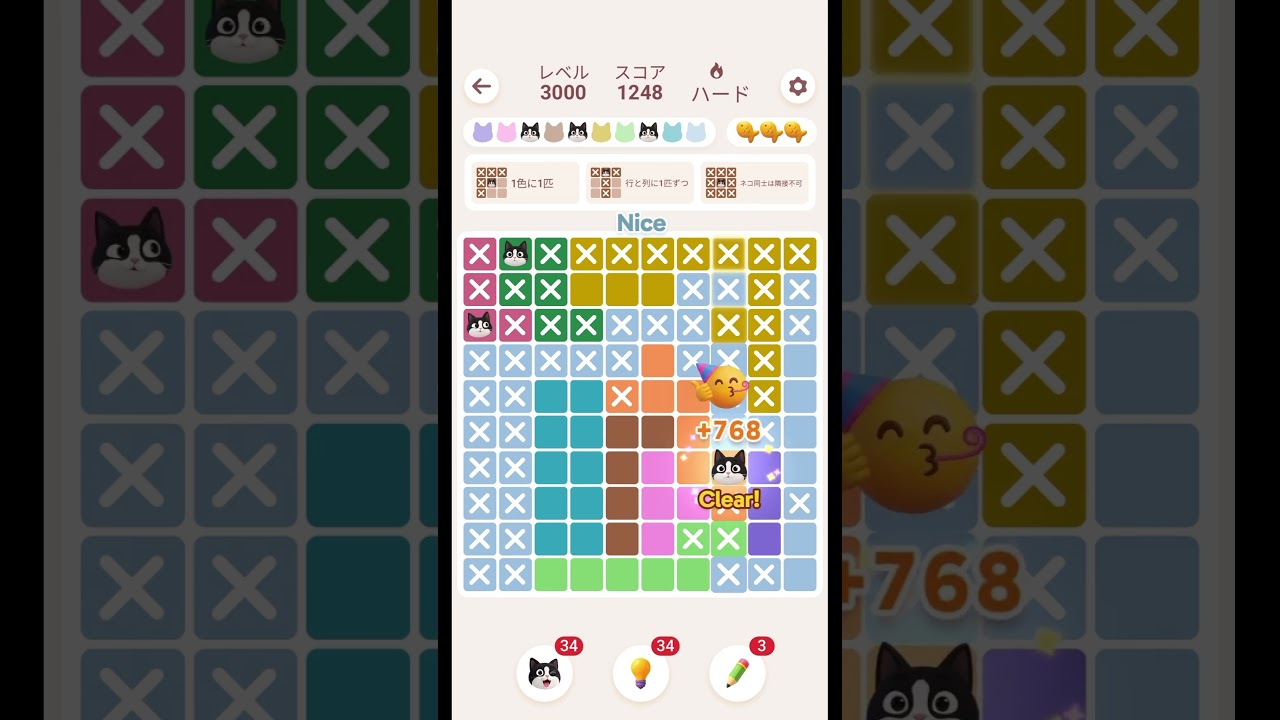
To clear Level 3000 on Hard Mode in Meowdoku!, bypass sparse areas and immediately target 3x3 blocks that contain six or more pre-filled numbers. Hard Mode boards at this stage withhold obvious starting singles, meaning early progress depends on mapping digits that appear four or more times across the board to isolate forced placements without triggering your limited mistake counter.
Setting Initial Solving Priorities
Before entering any values, scan the starting board and count the frequency of each digit from 1 through 9. Numbers that already appear four or more times provide the tightest geometric corridors across adjacent sectors. Tracing where these pre-filled digits project into neighboring zones reveals which empty cells are locked out.
Focus your attention on heavily constrained sectors while deferring wide-open sections of the grid:
| Focus Area | High-Priority Target | Low-Priority (Defer) |
|---|---|---|
| 3x3 Blocks | 6 or more pre-filled cells | 3 or fewer given cells |
| Rows & Columns | Missing only 2 or 3 digits | Missing 5 or more digits |
| Candidate Count | Cells restricted to 2 candidates | Cells with 4 or more possibilities |
Once you identify a block missing only two or three numbers, compare those missing digits against external intersecting lines. If a subgrid requires a 3, 7, and 8, and an intersecting column already contains a 3 and 7, the intersecting cell is forced to be an 8.
Applying Line and Sector Reductions
When simple block inspections stop yielding direct placements, use cross-axis line reductions to narrow candidates:
- Line Intersections: Check empty cells where a partially filled row and column cross. If the combined unique numbers along both intersecting lines leave only one legal digit, that cell is solved regardless of how open its local 3x3 box remains.
- Pointing Pairs: When a candidate digit within a 3x3 block can only fit into two cells along the same row or column, that digit is locked to that line. Eliminate that digit from all candidate lists in the rest of that row or column outside the subgrid.
- Box-Line Reduction: When an entire row or column restricts a specific digit to cells located inside a single 3x3 block, remove that digit as a candidate from all other empty cells within that block.
Breaking Deadlocks with Naked Pairs
Midway through Level 3000, you will encounter states where every open tile appears to hold multiple possibilities. Look for naked pairs to unlock these positions without guessing.
A naked pair occurs when two cells within the same row, column, or 3x3 box can only contain the exact same two digits (for example, 4 and 9). Because these two cells must claim those two values, no other cell in that shared unit can hold a 4 or a 9. Erase both digits from the candidate lists of all neighboring cells in that group. This elimination typically reveals a hidden single in an adjacent slot.
Pre-Placement Verification Sequence
Entering a wrong digit reduces your remaining mistake allowance and disrupts future deduction paths. Run this verification check before confirming any number on the board:
- Verify the Row: Scan the entire horizontal 9-cell row to confirm the digit is not duplicated.
- Verify the Column: Scan the entire vertical 9-cell column to ensure the line is clear.
- Verify the Subgrid: Check the 3x3 block perimeter to ensure the digit does not already exist within the box.
- Check Dependent Candidates: Confirm that placing the number does not leave an adjacent paired cell with zero valid options.
If a placement leaves any neighboring cell with no legal candidates, stop and recheck your line eliminations before locking in the move.

Free Meowdoku! Codes
Current active codes and how to redeem them.

James Brown
James focuses on Android gaming on PC, emulator setup, controls, performance tuning, and practical troubleshooting for longer play sessions.
COMMUNITY
Player Comments
85 players commented on this guide.
I tried this today and it worked better than my old setup.
I wish I had read this before upgrading the wrong thing.
Nice guide. I am checking the other Meowdoku! articles next.
This helped me understand strategy much better.