
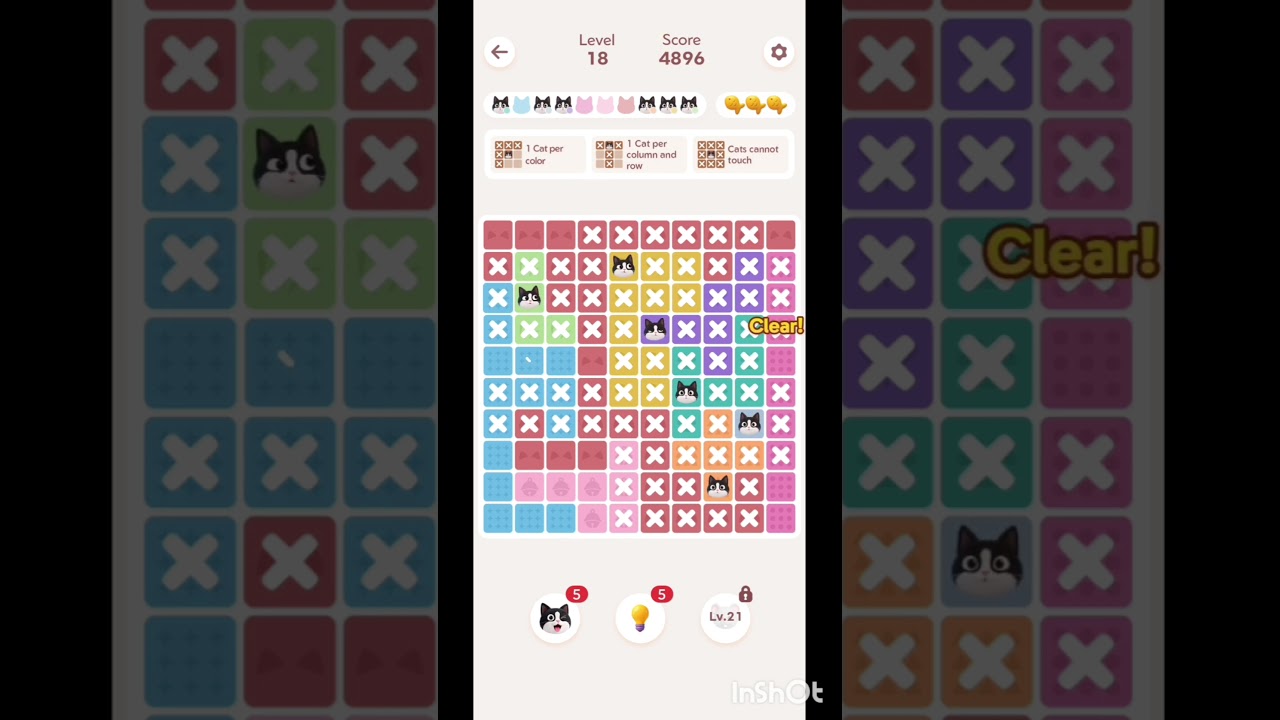
To solve Level 18 in Meowdoku!!, find the most restricted colored territory with the fewest open tiles and place an X on any square that would eliminate all legal options in an adjacent zone. Each placed cat claims its tile while automatically blocking its entire row, its entire column, and all eight surrounding squares. Prioritizing narrow regions and applying line-territory exclusions prevents costly mistakes and reveals forced cat placements without guesswork.
Core Rules and Exclusion Zones
Level 18 requires placing exactly one cat per row, column, and colored territory. Cats cannot touch horizontally, vertically, or diagonally. Because diagonal adjacency is forbidden, every confirmed cat eliminates surrounding spaces in addition to its entire row and column.
The physical position of a cat determines how many tiles it invalidates:
| Position Type | Adjacent Cells Eliminated | Diagonal Cells Eliminated | Total Line & Neighbor Impact |
|---|---|---|---|
| Corner Cell | 2 orthogonal + row/column line | 1 diagonal | Lowest collateral footprint |
| Edge Cell | 3 orthogonal + row/column line | 2 diagonals | Moderate collateral footprint |
| Interior Cell | 4 orthogonal + row/column line | 4 diagonals | Highest collateral footprint |
Because perimeter and corner tiles eliminate fewer adjacent cells than interior tiles, border deductions offer safer initial anchors for testing placements.
Target High-Constraint Territories First
Begin by scanning Level 18 for territories that span only two cells or are compressed against grid edges. Large regions with four or five cells contain too many variables for opening moves.
- Locate a territory with only two valid open squares.
- Check whether placing a cat on either square shares a row, column, or diagonal with another restricted zone.
- Test the ripple effect: if selecting a candidate square removes the last legal space in a neighboring territory, mark that candidate square with an X.
- Place a cat in the surviving square of the two-cell region.
- Immediately fill all eight adjacent squares and the matching row and column with X markers to unlock adjacent zones.
Apply Line-Territory Intersections
When all remaining valid cells of a colored territory fall inside a single row or column, that line cannot contain a cat anywhere else.
If Territory A's only available spaces sit in Row 3, Row 3's cat must belong to Territory A. You can safely mark every cell in Row 3 outside of Territory A with an X, even before determining which specific tile holds the cat. This technique removes false candidate tiles in intersecting territories, exposes hidden single-cell placements in crossing columns, and protects your mistake counter from blind guesses.
Navigate L-Shapes and Diagonal Traps
Irregular shapes, particularly three-cell bends and L-shaped territories, are the most frequent failure points in Level 18. Placing a cat on the inner vertex of an L-shape projects diagonal and orthogonal exclusion zones directly across both arms of the territory and into adjacent regions.
To resolve irregular polyomino shapes without guessing:
- Evaluate the outer endpoints of the shape before considering the inner corner bend.
- Check if placing a cat on the inner vertex eliminates all remaining options for an adjacent color group. If it does, mark the vertex with an X immediately.
- Verify that your selected tile leaves at least one open candidate in every crossing row and column.
Final Board Sweep
Before confirming your final cat placements, complete a quick audit across the entire grid:
- Row Check: Verify that every horizontal row contains exactly one cat.
- Column Check: Verify that every vertical column contains exactly one cat.
- Territory Check: Confirm that every distinct colored region has a placed cat.
- No-Touch Rule: Confirm that no two cats make contact orthogonally or diagonally at any corner.

Free Meowdoku! Codes
Current active codes and how to redeem them.

James Brown
James focuses on Android gaming on PC, emulator setup, controls, performance tuning, and practical troubleshooting for longer play sessions.
COMMUNITY
Player Comments
98 players commented on this guide.
Can you add more details about strategy in a future update?
This saved me time in the early game.
This helped me understand strategy much better.
I tried this today and it worked better than my old setup.