
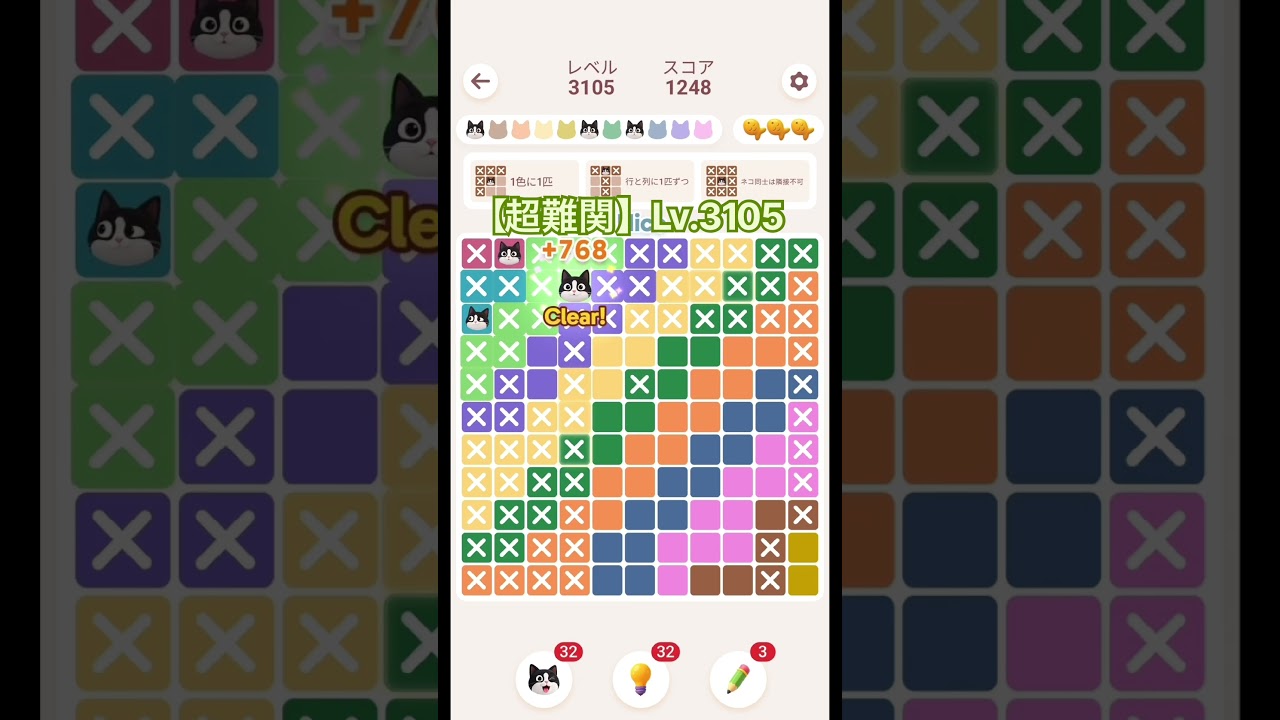
To solve Level 3105 in Meowdoku!!, eliminate impossible tiles using defensive X marks across restricted color zones before attempting to place any cats. Level 3105 is classified as an ultra-hard puzzle because its interlocking ribbons and nested shapes lack obvious starting tiles. Rushing to drop cats leads to invalid board states, so your opening action must always be identifying territories restricted to narrow row or column bands and marking their impossible neighbors.
Core Rules and Constraints for Level 3105
Every valid solution in Meowdoku!! adheres to three strict spatial limits:
- Row and Column Limits: Exactly one cat must appear in each row and each column.
- Color Territory Limits: Exactly one cat must appear in each distinct colored zone.
- Proximity Exclusion: Cats can never touch each other orthogonally or diagonally. Every placed cat completely blocks all eight surrounding adjacent squares.
Because an individual cat eliminates up to eight neighboring squares along with its entire row and column, a speculative placement can invalidate deductions on the opposite side of the grid. Every move on Level 3105 must be derived through direct elimination.
Step 1: Scan for Spatial Bottlenecks
Begin by locating color territories that span the smallest horizontal or vertical footprints. A territory compressed into only one or two rows severely restricts where cats can sit across those lines.
| Territory Feature | Board Behavior | Immediate Deduction |
|---|---|---|
| Single-Line Strip | Territory spans only one row or column | Mark X in all cells along that row/column outside the territory. |
| Two-Line Confinement | Territory is locked into two adjacent rows or columns | Mark safe perimeter X marks on tiles bordering both candidate cells. |
| Narrow Corner Pocket | Territory hugs grid corners or outer perimeters | Eliminate diagonal squares that touch multiple candidates across boundaries. |
| Complex Ribbon | Territory wraps around neighboring color zones | Mark cells that would mutually block all open tiles of an adjacent territory. |
Targeting these bottleneck shapes narrows down candidate cells to two or three options per zone, creating safe targets for defensive markings.
Step 2: Apply Defensive X Marks
Marking invalid squares with an X prevents accidental mistakes and reduces board clutter. When a territory is narrowed down to two candidate squares, look for tiles that are invalidated regardless of which candidate is chosen:
- Shared Diagonal Overlap: If a territory is reduced to two adjacent candidate cells, any external square touching both candidates diagonally must be an X. Whichever square holds the cat, that shared diagonal tile will be in its eight-square exclusion perimeter.
- Corner Hugging Exclusions: In L-shaped territories, candidate squares along the outer edges frequently share an inner crook. The interior cell touching both possible placements cannot hold a cat and should be marked with an X.
- Parallel Strip Pressure: When two candidate cells share a single row within their color zone, the squares directly above and below both candidates can often be eliminated through diagonal adjacency checks.
Step 3: Execute Forced Cat Placements
A forced move occurs when a row, column, or color territory is stripped of all candidates except one. Once a tile has no valid alternatives, execute this five-step sequence:
- Place the Cat: Lock the cat into the single remaining valid cell.
- Clear the Perimeter: Place X marks on all eight surrounding squares (horizontal, vertical, and diagonal).
- Wipe the Intersecting Lines: Trace the cat's entire row and column, placing X marks in all remaining empty squares along both axes.
- Re-evaluate Adjacent Zones: Check every colored territory that intersects the cleared row and column to see if any have dropped to a single open tile.
- Chain the Next Placement: Place the newly forced cat and repeat the routine to maintain momentum.
How to Break Late-Stage Deadlocks
If the board stalls and no single-candidate squares are visible, do not guess on 50/50 tiles. Instead, use these checks to uncover hidden line deductions:
- Perform a Line Census: Count open candidate tiles strictly by row and column, ignoring territory colors. A column often drops to one legal option while your attention is focused on color boundaries.
- Verify Territory Quotas: Check each color zone systematically. Clearing a row often quietly leaves an adjacent shape with only one remaining candidate.
- Identify Cross-Territory Pairs: If two separate territories each have their candidate tiles confined to the exact same two columns, those columns cannot hold cats in any other row. Mark Xs across all other cells in those two vertical lines.

Free Meowdoku! Codes
Current active codes and how to redeem them.

Michael Smith
Michael covers live-service games, events, reward systems, and efficient daily routines, turning frequent updates into clear actions for players.
COMMUNITY
Player Comments
50 players commented on this guide.
The tips are practical and easy to follow.
Nice guide. I am checking the other Meowdoku! articles next.
The explanation is clear, especially for beginners.
This helped me understand strategy much better.