
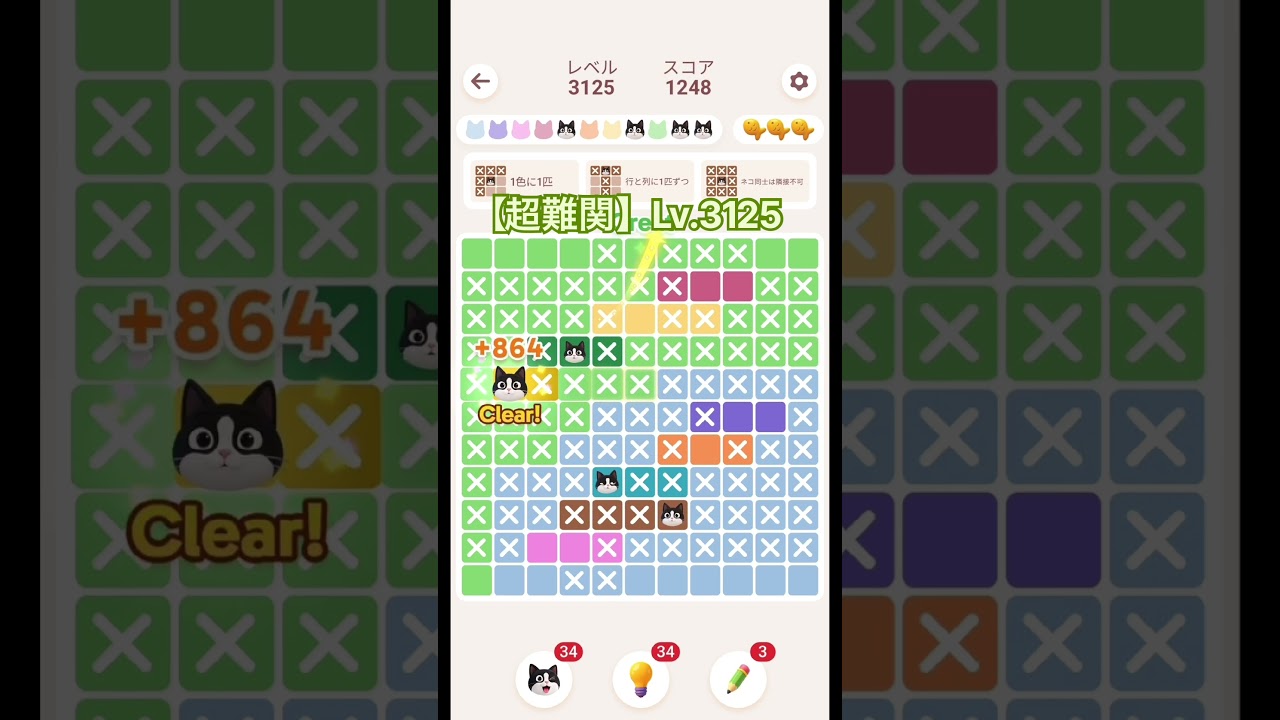
To clear Level 3125 in Meowdoku!!, prioritize marking safe X tiles across your most restricted color zones instead of guessing cat placements. Rushing to place cats on this ultra-hard board leads to broken line quotas and costly mistakes. By combining the fundamental no-touch rule with line-by-line deduction, you can systematically force every cat into its correct tile.
Core Rules and Constraints in Level 3125
Every valid tile in Level 3125 must satisfy three separate conditions at the same time:
- Territory Quotas: Each custom color-coded region must contain its exact assigned quota of cats (typically two on late-game stages).
- Line Quotas: Every horizontal row and vertical column must contain its designated cat count.
- The No-Touch Rule: No two cats may touch each other horizontally, vertically, or diagonally. Every placed cat immediately invalidates all eight surrounding squares.
Because incorrect placements trigger penalties and invalidate entire lines, your primary tool is the elimination marker (X). Each confirmed X reduces the open space in a row, column, and territory, eventually leaving cats with only one legal square.
Identifying Opening Moves in Constrained Territories
Begin by scanning the board for color territories with the fewest open tiles or the most irregular boundaries. Narrow shapes severely limit valid positions under the no-touch rule, allowing you to place safe X marks before committing any cats.
| Territory Profile | Grid Interaction | Immediate Action |
|---|---|---|
| Corner L-Clusters | Limits valid candidates to two adjacent border cells | Place an X on any cell touching both candidate squares |
| Narrow Corridors | Confines horizontal or vertical positioning to a two-cell pair | Cross out outer tiles along both flanks of the corridor |
| Fragmented Island Zones | Splits legal cells across separate pockets | Check if placing a cat in one pocket starves the remaining sections |
When a territory is reduced to two candidate squares, you do not need to know which square holds the cat to make progress. Any external tile that touches both candidates can never hold a cat and must be marked with an X immediately.
Applying the No-Touch Rule to Force Eliminations
The eight-direction no-touch rule creates wide dead zones around confirmed placements and candidate pairs. Using these zones to clear adjacent regions is your most effective method for unlocking crowded sections of the board.
- Map Candidate Perimeters: When two candidate tiles sit next to each other within a region, mark an X on every neighbor that shares contact with both squares.
- Neutralize Border Pairs: If a candidate pair runs along a grid edge, cross out the adjacent tiles in the rows or columns directly parallel to it.
- Shrink Neighboring Colors: Check how those new X marks impact adjacent color territories. Reducing an adjacent territory's available space often forces its cats into direct, obvious positions.
Managing Row and Column Quotas
Once initial territory deductions slow down, shift your attention to full grid lines. Balancing row and column quotas prevents you from overfilling or starving neighboring sections.
- Quota Saturation: As soon as a row or column reaches its required cat count, place an X in every remaining empty cell in that line. Unmarked empty cells create visual clutter and cause calculation errors later.
- Forced Inclusion: If a line requires two cats and contains only two uncrossed squares, both squares must contain cats. Place the cats immediately, then mark an X across all eight surrounding cells to update intersecting lines and territories.
Alternating between line checks and territory checks forms a steady solving loop: completing a column creates new X marks, which often reduces an intersecting row to a forced placement.
Resolving Late-Stage Stalemates Without Guessing
If you encounter an apparent 50/50 split near the end of Level 3125, do not guess. A single misplaced cat can cause a contradiction several turns later that forces a full puzzle reset.
To break the standoff, trace the dependencies of one candidate tile:
- Temporarily test placing a cat on Candidate A.
- Check if Candidate A deprives an intersecting row or territory of its mandatory quota.
- If selecting Candidate A leaves another line with fewer open cells than its required cat count, Candidate A is mathematically invalid.
- Mark Candidate A with an X, confirm Candidate B, and let the remaining forced moves resolve the puzzle.

Free Meowdoku! Codes
Current active codes and how to redeem them.

James Brown
James focuses on Android gaming on PC, emulator setup, controls, performance tuning, and practical troubleshooting for longer play sessions.
COMMUNITY
Player Comments
29 players commented on this guide.
I tried this today and it worked better than my old setup.
This saved me time in the early game.
This helped me understand strategy much better.
Nice guide. I am checking the other Meowdoku! articles next.