
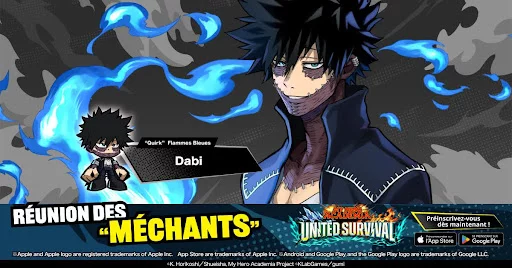
In MHA: UNITED SURVIVAL, victory is rarely achieved through the strength of a single character alone. Because the game utilizes a fast-paced, rogue-lite combat structure, your success depends on how effectively your three-character squad functions as a cohesive unit. Whether you are tackling challenging combat encounters or grinding through randomized procedural stages, understanding how to pair characters—regardless of their canonical hero or villain alignment—is the most critical skill for any player.
Understanding the Three-Character Team Structure
Every mission in MHA: UNITED SURVIVAL mandates a three-character squad. This team acts as your primary tactical tool, requiring you to balance durability, crowd control, and raw damage output. While you directly control one active character at a time, the other two members of your squad are not mere spectators.
The game’s design emphasizes a "tag-team" flow. When you swap characters or trigger support abilities, the inactive members contribute to the combat flow through passive perks and triggered skills. To build an elite team, you must move beyond personal favorites and analyze how each character’s kit fills the gaps in your roster:
- The Anchor: A durable character capable of holding the frontline and absorbing damage.
- The DPS/Striker: Your primary source of burst damage for clearing bosses.
- The Utility/Support: A character that provides crowd control, debuffs, or area-of-effect (AoE) clearing power.
Leveraging Auto-Combat for Strategic Efficiency
MHA: UNITED SURVIVAL includes an integrated auto-combat toggle, a feature that significantly alters how you manage high-intensity stages. When enabled, the AI takes control of basic attack rotations and skill execution, which is invaluable for farming or clearing lower-level waves.
However, the key to mastering the game is knowing when to toggle auto-combat off. The AI excels at sustain but often fails to prioritize high-value targets or execute frame-perfect dodges against boss telegraphs.
- When to Auto: Use auto-combat during mob-heavy sections where efficiency and constant pressure are needed.
- When to Manual: Disable auto-combat during boss encounters. Manual control allows you to position your character to avoid environmental hazards and focus your strongest abilities on the boss’s weak points rather than wasting them on minor enemies.
Balancing Hero and Villain Faction Synergy
One of the most liberating aspects of MHA: UNITED SURVIVAL is that you are not restricted by lore. You can freely mix heroes and villains to create the most mechanically sound team possible. The best teams often ignore faction lines in favor of "Quirk Synergy."
When examining your roster, look for characters whose quirks complement one another. For example, if you have a character with a "Knockback" or "Launch" ability, pairing them with a character who possesses an "Airborne Finisher" creates a massive damage multiplier. Because rogue-lite runs provide random buffs at the end of every wave, aim for a team that is "mechanically versatile." A team that is too specialized—such as one consisting only of short-range melee fighters—will likely struggle against ranged bosses or swarms that require constant movement.
Managing Team Progression and Resource Allocation
Many players fall into the trap of over-investing in their "main" hero while leaving their support units under-leveled. In MHA: UNITED SURVIVAL, this is a critical mistake. If your secondary characters have low stats, they will provide negligible passive support and will be the first to fall if you are forced to swap to them under pressure.
To maintain a competitive edge:
- Uniform Leveling: Attempt to keep your entire squad within 5–10 levels of each other.
- Stat Prioritization: Allocate gear and upgrade materials to your primary damage dealer first, but ensure your support units have enough defensive stats to survive incoming chip damage.
- Early Commitment: Because high-level upgrades are expensive, identify your core trio early. Avoid spreading your resources across five or six characters, as this will result in a mediocre team that cannot clear high-difficulty rogue-lite thresholds.
Best Practices for Rogue-Lite Combat Pacing
The rogue-lite nature of the game means that no two runs are identical. You will encounter randomized enemy configurations, environmental hazards, and ability buffs. Your squad must be built as a "generalist" force to handle these unpredictable variables.
To survive the late-game stages, ensure your squad has at least one high-output AoE character. If your team cannot clear screens of minor enemies, you will find yourself overwhelmed before the boss even appears. Conversely, if your team lacks single-target burst, you will run out of time or health while trying to chip away at a boss’s massive health bar.
Quick Checklist for Squad Viability:
- Does your team have at least one character with AoE skills? (Required for swarm control)
- Do you have a way to displace or stun enemies? (Required for interrupt mechanics)
- Are your passive abilities active? (Check the character screen for "Team Buffs" that trigger automatically)
Strategic Decision-Making: The "Tag-In" Meta
The "Tag-In" mechanic is not just for swapping damaged characters; it is a strategic maneuver. In MHA: UNITED SURVIVAL, swapping characters often triggers a short window of invulnerability or a specific synergy effect. If you are cornered, use the swap mechanic to reposition your squad and reposition your active character to a safer location.
As you become more comfortable with the pacing, experiment with "Combo Swapping." Start an ability with character A, swap to character B to apply a debuff, and then swap to character C to finish with a high-damage ultimate. Mastering this rhythm will significantly decrease your run times and increase your survivability in the toughest combat encounters. By focusing on these core pillars—squad balance, resource management, and reactive manual play—you will quickly rise through the ranks of MHA: UNITED SURVIVAL.

Free MHA: UNITED SURVIVAL Codes
Current active codes and how to redeem them.

Emily Johnson
Emily writes practical mobile strategy guides with a focus on resource planning, base progression, and the early decisions that shape a long-term account.
COMMUNITY
Player Comments
91 players commented on this guide.
Nice guide. I am checking the other MHA: UNITED SURVIVAL articles next.
This saved me time in the early game.
The explanation is clear, especially for beginners.
I tried this today and it worked better than my old setup.