
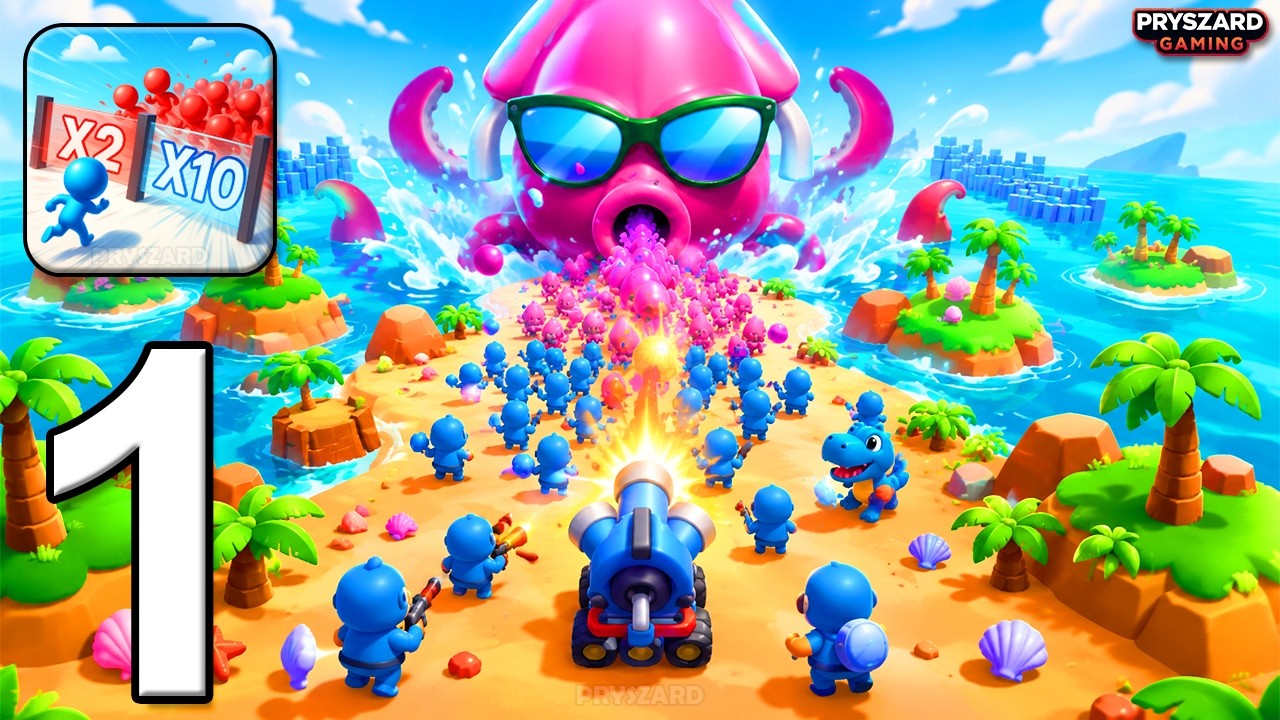
Success in Mob Control is determined by your ability to manage a mathematical scaling game in real-time. The core mechanic relies on your cannon’s firing angle and your ability to navigate unit streams through beneficial multipliers while avoiding detrimental divisors. Whether you are a newcomer or looking to refine your strategy for the Champions League, understanding the physics of your mob stream is the first step toward consistent victory.
The Foundation: Mastering Cannon Aim and Positioning
In Mob Control, your cannon is not a static turret; it is a dynamic tool that requires constant manual adjustment. Because your units fire in a forward-facing arc, your swipe speed and positioning dictate the trajectory of every mob deployed.
- Avoid the "Center Trap": Beginners often fire directly down the center of the lane. However, the most effective multipliers rarely remain static in the middle. Constantly scan the playfield and adjust your aim to track the movement of blue gates.
- Preventing Clustering: If you keep your cannon in one position, your units will form a narrow, easily targetable line. By continuously sweeping your cannon left and right, you create a wider spread of units, making it harder for enemy defenses to eliminate your entire force with a single area-of-effect attack.
- Anticipatory Aiming: Don't aim where the gate is; aim where the gate will be by the time your mob stream travels across the screen. This requires learning the travel speed of your specific unit type.
Strategic Selection of Multipliers
Multipliers are the primary engines of growth in Mob Control. Without passing through blue gates, your mob count will remain stagnant, leading to inevitable defeat against base defenses.
Blue vs. Red Gates
- Blue Gates (Multipliers): These are your priority. Always target the highest value (e.g., x3, x5). Even if a smaller x2 gate is closer, the long-term benefit of hitting a high-value multiplier outweighs the short-term convenience of a quick tap.
- Red Gates (Divisors): These are the primary threat to your momentum. If a red gate is positioned in front of a blue gate, you must decide whether to pass through the red gate to hit the blue one or avoid both. If the red gate is a high-value divisor (e.g., /5), it is almost always better to maneuver around it entirely.
- Gate Movement Patterns: Gates move in predictable, looping patterns. Observe these patterns for a few seconds before committing to a heavy firing strategy.
Managing Unit Flow and Density
Winning in Mob Control is a game of attrition. You do not necessarily need the strongest individual units; you need the highest volume of units to push against the enemy’s defensive line.
The Stacking Strategy
If you find yourself losing ground, stop trying to hit every gate. Instead, focus on "stacking." By firing continuously into a single high-value multiplier, you can create a massive cluster of units. This cluster acts as a physical barrier. A dense, high-count mob wave can absorb defensive fire from enemy turrets while still having enough units left over to penetrate the base and deal damage.
Maintaining Momentum
Never stop firing. Even when your mob wave reaches the enemy base, your cannon should continue to output units. This creates a "reinforcement train" that prevents the enemy base from regenerating or pushing back. If you stop firing, the enemy will gain the initiative, and your previous progress will be wiped out within seconds.
Advanced Tactics: Base Siege and Final Pushes
Once you have successfully pushed your wave to the enemy base, your role shifts from scaling to support. At this stage, the base will deploy its own defensive mechanisms, such as turrets or spawning enemy waves.
- Spread Firing: If the enemy base has multiple defensive turrets, avoid firing in a straight line. Spread your fire across the face of the base to ensure your units hit multiple targets simultaneously, preventing any single turret from focusing down your entire wave.
- Champion Deployment: If you have unlocked champions, use them as the "tip of the spear." Deploy your champion just before your main mob wave hits the base to tank incoming damage, allowing your smaller mobs to pass through unharmed and deal consistent damage to the base health.
Common Mistakes and How to Avoid Them
Even experienced players fall into traps that stall their progress. Here are the most common pitfalls:
- Chasing Risky Gates: Never risk losing 70% of your current army just to hit a x10 gate. If the path to a high-value gate puts your units directly in the path of enemy fire, ignore the gate and preserve your current count.
- Neglecting Cannon Upgrades: Early in your progression, ensure you are spending your earned currency on cannon fire rate and mob health. A faster firing rate is significantly more valuable than base damage in the early levels, as it allows you to recover faster from losses.
- Ignoring Lane Hazards: Some levels feature obstacles that can deflect your units. Always account for these, as hitting an obstacle will scatter your mobs and render them ineffective against incoming enemy forces.
Strategic Decision-Making Summary
To climb the ranks in Mob Control, you must be able to switch between two distinct mindsets:
- The Scaling Phase: During the start of the level, your focus is 100% on efficiency. Hit the blue gates, avoid the red, and maximize your total count.
- The Siege Phase: Once you reach the enemy gate, your focus shifts to persistence. Keep the stream flowing, use your champion to distract defenses, and ensure your unit density remains high enough to overwhelm the base's health bar.
By consistently applying these principles, you will find that even the most difficult levels become manageable. Remember: in Mob Control, numbers are your greatest weapon. Protect your count at all costs, prioritize the multiplier gates, and never let your cannon go silent.

Free Mob Control Codes
Current active codes and how to redeem them.

Sarah Williams
Sarah specializes in RPG and collection games, explaining team building, character growth, and beginner-friendly ways to avoid expensive early mistakes.
COMMUNITY
Player Comments
61 players commented on this guide.
This saved me time in the early game.
I wish I had read this before upgrading the wrong thing.
I tried this today and it worked better than my old setup.
Can you add more details about early game in a future update?