
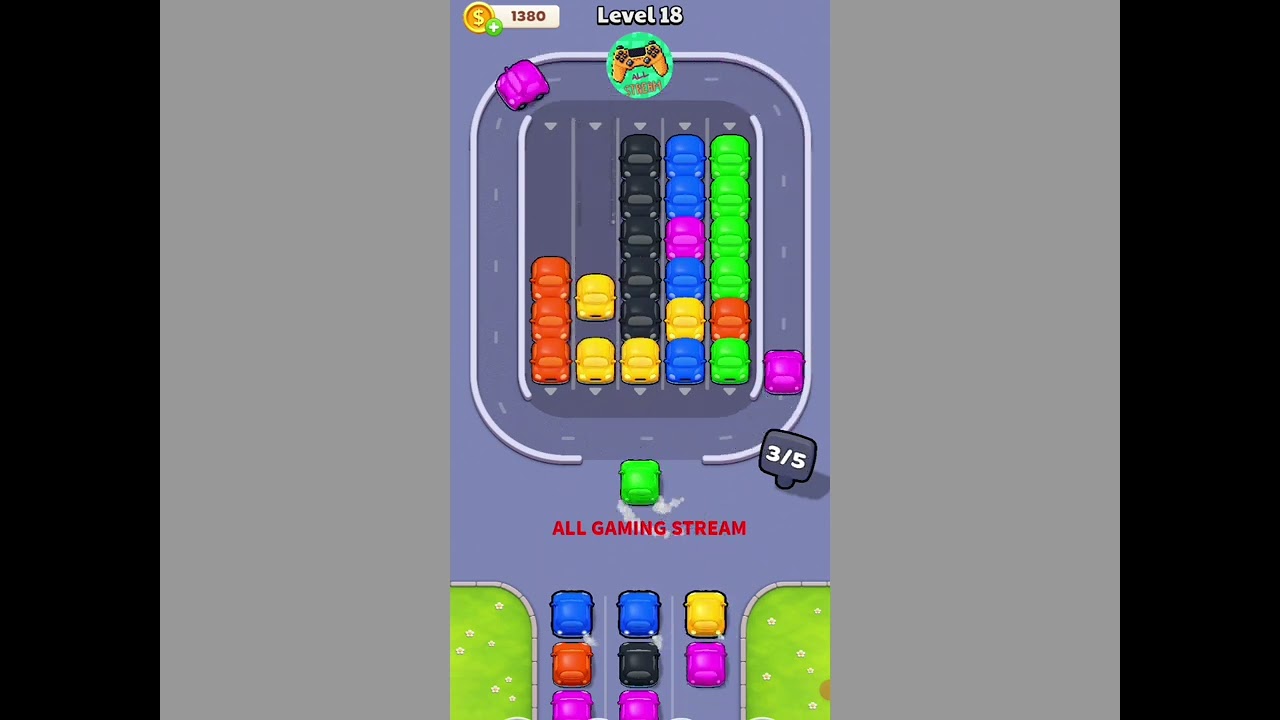
To beat Level 18 in Parking Loop, clear the unobstructed vehicles along the outer edges of the lot first, then time each car's merge into the driving loop so it does not collide with moving traffic. Only after perimeter stalls are vacant should you work inward to untangle the central gridlock.
Level 18 Board Layout and Merge Hazards
Level 18 wraps an active driving loop around a compact parking grid. Cars parked in the interior face outward, but their exit paths are blocked by the bumpers or sides of outer vehicles.
Vehicles that leave their bays enter this outer loop track and travel along the perimeter toward the off-screen exit gate. If you launch a car while another vehicle is passing its junction, they will collide instantly and fail the stage. Success depends on both finding open paths and timing your releases to match the rhythm of loop traffic.
Step-by-Step Car Release Order
Follow this sequence to dismantle the grid without triggering collisions:
- Clear free perimeter vehicles: Scan the upper and lateral edges for cars with a straight, unblocked path into the driving loop. Tap each open car one at a time, allowing it to complete its turn into the circuit before releasing another.
- Open the first interior exit corridors: As outer cars leave, their empty stalls create open exit lanes for the second row of vehicles.
- Dispatch the central key vehicle: Locate the single vehicle in the central cluster whose exit line is now clear thanks to the vacated perimeter spaces. Release it into an open gap in the perimeter traffic.
- Work inward across perpendicular stalls: Each vacated stall unlocks an adjacent car parked perpendicular to it. Work systematically across these newly cleared cross-lanes rather than tapping cars on opposite sides of the board.
- Space out the final departures: When three or four cars remain, they often share a single exit lane to reach the outer loop. Launch the first car, wait for it to rotate fully into the perimeter circuit, and then launch the next one to avoid rear-end collisions.
Merge Timing Rules
Use these dispatch rules to evaluate when a car can safely leave its stall:
| Vehicle State | Action Required | Collision Risk |
|---|---|---|
| Fully Blocked | Leave untouched until the blocking vehicle exits | High (guaranteed stall collision) |
| Clear Lane, Busy Loop | Wait until the moving car passes the junction | High (merge-point t-bone or rear-end) |
| Clear Lane, Empty Loop | Tap immediately to dispatch | None (safe merge into circuit) |
| Shared Exit Lane | Pause between taps until the lead car finishes its turn | High (trailing bumper collision) |
The safest launch window occurs just as the rear bumper of a moving car clears the front of your waiting vehicle. Tapping at that moment slots the new vehicle safely behind passing traffic.
Common Failure Points to Avoid
If you fail Level 18, check your timing and input discipline against these common errors:
- Rapid tapping: Dispatching several cars in quick succession bunches them up at merge junctions, causing immediate pileups.
- Corner clipping: Adjacent stalls share tight boundaries. Never launch a car if its front end must swing through the corner of a neighboring parked vehicle.
- Ignoring vehicle lengths: Longer vehicles take more time to clear their parking stalls, leaving their rear bumpers exposed to cross-traffic for a longer window.
- Losing track of loop direction: Note whether perimeter traffic flows clockwise or counterclockwise so you know which side incoming cars will approach from before you tap.
Free Parking Loop Codes
Current active codes and how to redeem them.

Emily Johnson
Emily writes practical mobile strategy guides with a focus on resource planning, base progression, and the early decisions that shape a long-term account.
COMMUNITY
Player Comments
46 players commented on this guide.
This helped me understand strategy much better.
The explanation is clear, especially for beginners.
This saved me time in the early game.
I tried this today and it worked better than my old setup.