
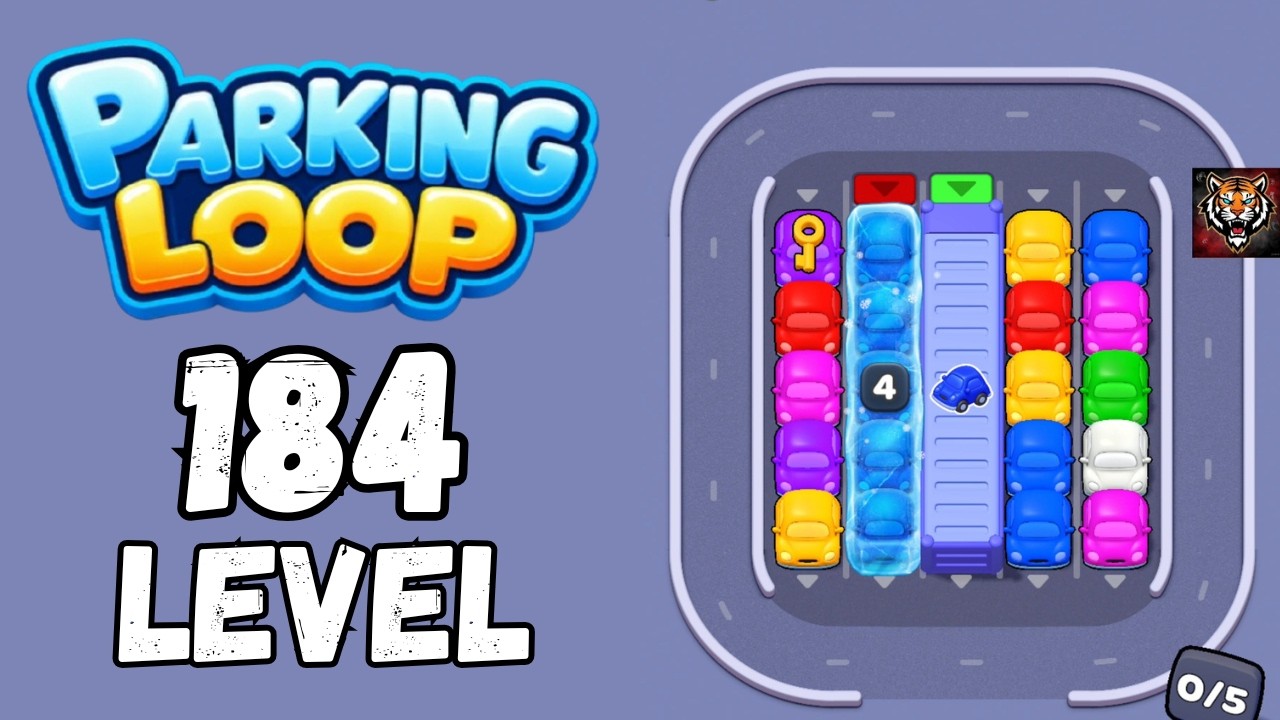
To beat Parking Loop Level 184, release the unobstructed perimeter cars first, empty the front blockers from tandem stalls into open traffic gaps, and dispatch the inner core vehicles once the circular track clears. Moving cars from the outside inward prevents interior vehicles from turning into gridlock and keeps the single-lane loop moving steadily toward the exit gate.
Step-by-Step Vehicle Release Order
Level 184 pairs outer stalls that feed directly into the loop with deep tandem stalls and tight inner parking bays. Following a four-phase sequence prevents stalls from cutting off circulating traffic.
| Phase | Target Vehicles | Primary Action | Purpose |
|---|---|---|---|
| Phase 1 | Outer free bays | Launch sequentially into the empty loop | Clear perimeter stalls and establish base traffic flow |
| Phase 2 | Tandem front blockers | Merge into open gaps behind passing cars | Expose trapped rear vehicles and open stall lanes |
| Phase 3 | Freed rear tandem cars | Wait for a clear gap, then release | Empty tandem bays without clipping circulating cars |
| Phase 4 | Inner core stalls | Merge into remaining loop intervals | Clear tight central stalls to complete the level |
Begin by tapping the outer perimeter vehicles that have a direct, unobstructed path to the main circuit. Clearing these bays creates open space across the lot, making it easier to track intervals between moving cars. Do not touch trapped rear tandem vehicles or central bays during this initial phase.
Merge Timing and Collision Avoidance
Vehicles accelerate instantly from their stalls into the roadway, making merge timing the primary failure point. Tapping a parked car when an active vehicle is directly alongside its stall entrance causes an immediate broadside crash.
- The Midpoint Visual Cue: Tap a staged car the exact moment the rear bumper of a passing vehicle crosses the midpoint of your stall's exit line. This slots your vehicle safely behind the lead car while preserving a safe cushion ahead of trailing traffic.
- Double-Tap Opportunities: If two adjacent perimeter stalls are unobstructed and oncoming loop traffic is clear, double-tap both vehicles in rapid succession to merge them as a tight convoy.
- Vehicle Length Differences: Account for vehicle sizes when judging gaps. Longer sedans occupy more track space and require wider gaps than compact hatchbacks.
Managing Tandem Rows and Inner Stalls
Tandem bays require two separate merge cycles. The rear vehicle cannot move until the forward blocker has fully crossed the stall threshold. Tapping a rear car while the front car is still clearing the stall wastes an input and risks mistiming the subsequent merge. Once the front car merges into the loop, hold the rear car in place until another suitable gap approaches.
Central inner bays present the sharpest turning radius into the loop. Because these vehicles require slightly more time to align with the circular flow, launching them into tight traffic often results in clipping the rear quarter-panel of circulating cars. Hold all inner-core vehicles stationary until earlier loop traffic has exited the course.
Preventing and Clearing Loop Saturation
Launching too many vehicles into the loop at once causes loop saturation. When the single circuit lane fills up, the distance between circulating vehicles drops to near zero, eliminating the merge windows required to empty the remaining stalls.
Parking Loop imposes no time limit. If the main circuit becomes congested, stop tapping and wait. Allow circulating cars to clear through the exit gate on their own. Once the roadway is empty, resume releasing your remaining staged vehicles one by one to finish the stage.
Free Parking Loop Codes
Current active codes and how to redeem them.

Michael Smith
Michael covers live-service games, events, reward systems, and efficient daily routines, turning frequent updates into clear actions for players.
COMMUNITY
Player Comments
132 players commented on this guide.
This guide answered the exact question I had.
Nice guide. I am checking the other Parking Loop articles next.
I tried this today and it worked better than my old setup.
Can you add more details about strategy in a future update?